

Somewhere in your late 30s or early 40s, your body starts sending you odd little memos. Digestion that used to be predictable isn't. Energy dips earlier in the day. Your skin, cycle and mood all seem to be negotiating new terms without consulting you first.
This is perimenopause — the hormonal transition that can last anywhere from two to ten years before menopause itself. And your gut microbiome is right in the middle of it, influencing how your body processes oestrogen, manages stress hormones and keeps inflammation in check.
If you're standing in a pharmacy aisle (or scrolling a website at midnight) trying to work out the best probiotic for women over 40, this guide walks you through exactly what matters — and what's just clever packaging.
"The transition to menopause is a natural biological process, not a disease, but the hormonal shifts involved can affect multiple body systems simultaneously." — Mayo Clinic, Perimenopause
Why Your Gut Changes Gears After 40
Oestrogen and gut bacteria have a two-way relationship. A specific community of gut microbes, sometimes called the estrobolome, helps metabolise and recirculate oestrogen through the body. As oestrogen naturally fluctuates and declines during perimenopause, this bacterial community shifts too — and the shift can go both ways.
Research on the gut-hormone relationship is still evolving, but several patterns show up consistently in women over 40:
- Reduced microbial diversity, which is associated with less resilient digestion
- Slower gut motility, contributing to the bloating many women notice after 40
- Changes in gut lining integrity, which may influence how the immune system responds to everyday stressors
- Altered short-chain fatty acid production, important for mood and metabolic regulation
If any of this sounds familiar, you're not imagining it. We've covered the deeper mechanics of this in How Gut Bacteria Affect Oestrogen in Women: Meet Your Estrobolome and Gut and Hormones Connection in Women Explained. This article is about what to actually do about it when you're shopping for support.
What "Best" Actually Means: The Non-Negotiables
Not every probiotic is built for this life stage. A supplement designed for general wellness in your twenties isn't necessarily doing anything useful for a 44-year-old managing hormonal bloating, fatigue and mood swings. Here's what separates a genuinely useful formula from a shelf-filler.
Strain Diversity and Specificity
Look for named strains, not vague "probiotic blend" labelling. Strains studied in relation to women's hormonal health, digestion and mood include Lactobacillus rhamnosus, Lactobacillus plantarum, Bifidobacterium lactis and Bifidobacterium longum. Each does a slightly different job — some support regularity, others are more associated with mood and stress resilience.
We break down exactly which strains matter and why in Best Probiotic Strains for Women: A Science-Backed Guide and Her-Biotics Ingredients Strains: What's Really Inside.
Delivery Technology (Survival to the Gut)
This is the part most women never think to ask about — and it's arguably the most important.
Stomach acid is brutal. Studies estimate that a large proportion of probiotic bacteria in standard capsules never survive the trip through the stomach to reach the gut where they're needed. If the delivery system can't protect the bacteria, the CFU count on the label is close to meaningless.
"Encapsulation technologies that protect probiotic viability through gastric transit are critical to ensuring that live cultures reach the intestine in sufficient numbers to exert a biological effect." — Journal of Functional Foods, review on probiotic delivery systems
This is why microencapsulation matters so much. We go deep on the science in SCO2 Microencapsulation: Why Most Probiotics Never Reach Your Gut — but the short version is: a probiotic is only as good as its ability to survive the journey.
CFU Count vs Potency
Higher CFU (colony-forming units) isn't automatically better. A well-protected 10 billion CFU formula can outperform a poorly protected 50 billion CFU one. When comparing products, ask:
- Is the CFU count measured at manufacture or at expiry?
- Is there any mention of acid resistance or delayed-release technology?
- Are strains backed by human studies, not just lab (in vitro) data?
Red Flags to Avoid When Shopping
The supplement aisle is crowded with products chasing the "women's probiotic" trend without the substance to back it up. Watch out for these warning signs:
- Proprietary blends with no strain names — you can't research what you can't see
- No mention of delivery or survivability — a sign the formula may not survive stomach acid
- Vague, sweeping claims that a single pill will fix hormones, weight and mood overnight
- No third-party testing or manufacturing transparency
- Marketing-heavy, science-light reviews — always worth cross-checking real feedback against the research, which is exactly what we unpack in Probiotics for Bloating Women Reviews: How to Tell Real Results From Marketing Hype
If you want a side-by-side breakdown specific to bloating-focused formulas, The Best Probiotic for Women With Bloating in South Africa: A No-Nonsense Buying Guide covers that ground thoroughly.
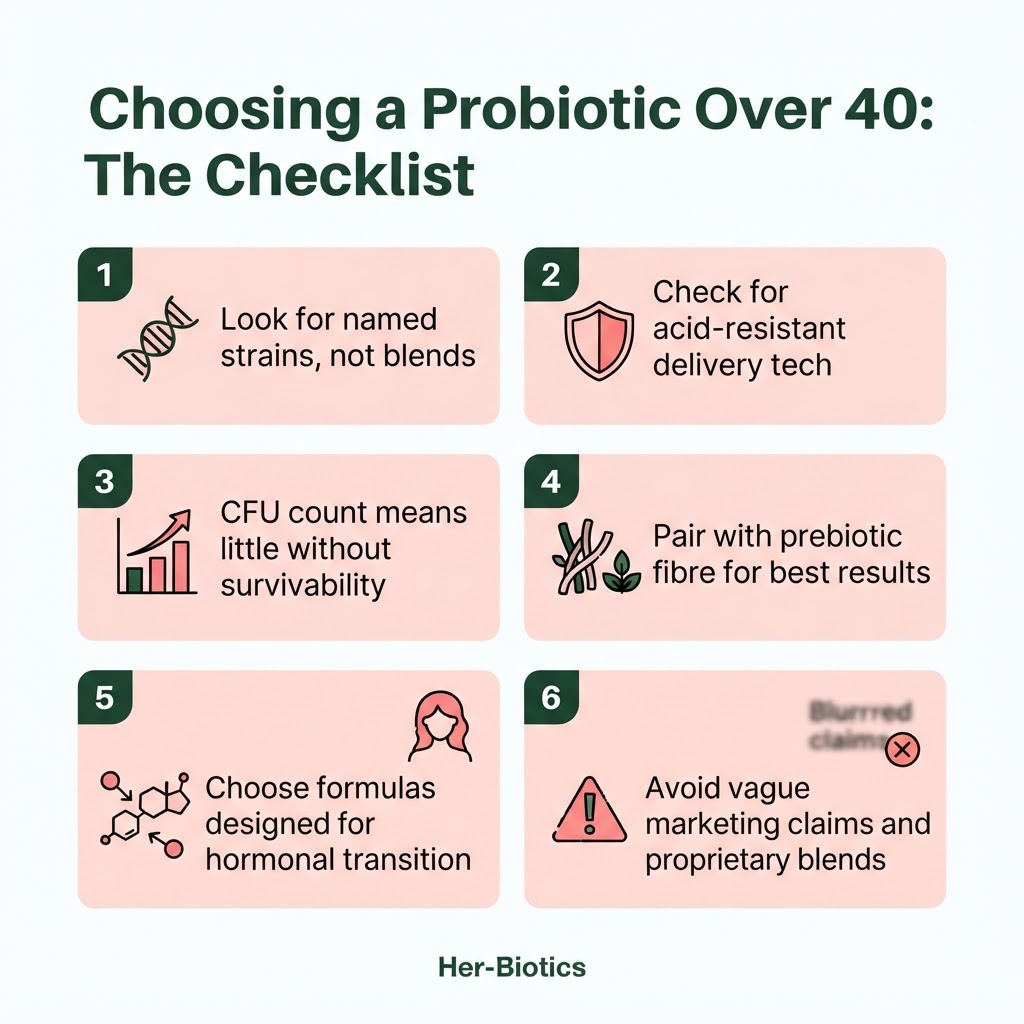
How to Read a Label Like a Pro
Next time you're comparing products, run through this quick checklist:
- Named strains with CFU counts per strain, not just a total
- Delivery system explained — acid-resistant capsule, microencapsulation, or delayed-release
- Expiry-dated potency, not just "at time of manufacture"
- Added prebiotic fibre, which feeds the bacteria you're introducing (more on that pairing in Prebiotic Foods That Supercharge Your Probiotic Supplement)
- Life-stage relevance — formulas designed with hormonal transitions in mind, rather than a generic one-size-fits-all blend
- Transparent sourcing and manufacturing standards
Real customer experiences matter too. If you want an honest look at what actual women report — alongside the clinical reasoning behind it — see Her-Biotics Probiotic Reviews: What Real Women Say.
Supporting Your Probiotic: Lifestyle Multipliers
A good probiotic works harder when it isn't fighting an uphill battle. A few habits make a measurable difference during perimenopause:
- Fibre-rich meals to feed beneficial bacteria (fermented foods, vegetables, legumes)
- Consistent sleep, since gut and sleep health influence each other in both directions — covered in Sleep and Gut Health: The Bidirectional Relationship Every Woman Needs to Understand
- Stress management, as cortisol has a direct line to gut function — see Stress, Cortisol and the Gut: How Anxiety Is Silently Destroying Your Microbiome
- Movement, which supports gut motility and reduces the sluggishness many women notice after 40
- Addressing fatigue directly if it's persistent — our causes checklist is a useful starting point
If you're also noticing stubborn midsection changes alongside digestive shifts, Cortisol Belly Women and Why Do I Bloat Every Afternoon as a Woman? dig into the daily patterns behind it.
"Across populations, menopause transition is associated with changes in metabolic risk factors, underscoring the value of lifestyle and nutritional strategies during this period." — World Health Organization, Menopause fact sheet
And if you're already taking a multivitamin or considering adding one, it's worth checking Starting a Multivitamin After 50? Questions to Ask Before You Add One so your supplements work together rather than overlap unnecessarily.
The Bottom Line Before You Buy
The best probiotic for women over 40 isn't the one with the biggest number on the front of the bottle. It's the one with:
- Named, researched strains relevant to hormonal and digestive health
- A delivery system proven to survive stomach acid
- Transparent manufacturing and realistic claims
- A formula designed with this specific life stage in mind, not repurposed from a generic probiotic line
For a deeper look at the beauty and longevity side of this transition — skin, radiance and long-term ageing — Ageless Beauty After 50: How Your Gut Microbiome Holds the Secret to Longevity and Radiance and Optimizing Menopause: Beyond Symptoms to Inner Radiance are both worth your time.
This article is for general information and does not replace individualised medical advice. If you have persistent digestive symptoms, significant hormonal changes, or are considering a new supplement, please consult your doctor or a registered healthcare provider. For general reading on this life stage, the Mayo Clinic's overview of perimenopause, the WHO menopause fact sheet, and current PubMed research on probiotics and perimenopause are all solid starting points.
Your Simplest Next Step
You don't need to overhaul your entire routine overnight. The simplest first step is choosing one formula built specifically for this stage of life — with named strains, a delivery system that actually works, and ingredients chosen for hormonal transition rather than generic "gut health."
Her-Biotics Menopause Support was formulated with exactly this in mind: targeted strains, our SCO2 microencapsulation technology for improved gut delivery, and ingredients that support digestion, mood balance and bone health through perimenopause and beyond.
👉 Explore Her-Biotics Menopause Support or browse the full Her-Biotics range to find the formula that matches where you are right now.
And if you'd like practical, science-backed guidance on gut health, hormones and ageing well delivered straight to your inbox, subscribe to the Her-Biotics newsletter below — no spam, just the research that actually matters to you.
Enjoyed this? Get the next one first.
Science made simple, delivered to your inbox. No spam, unsubscribe anytime.