
By Dr. Chomba Chuma, MD & Founder of Her-Biotics | September 4, 2026
Let me ask you something: have you ever had a gut feeling before an important meeting, felt your stomach drop during a difficult conversation, or noticed that your digestion goes completely haywire during stressful periods? That's not a coincidence. That's your gut-brain axis speaking — and if chronic stress has become a fixture of your life, that communication network is almost certainly under siege.
As a physician and the founder of Her-Biotics, I've spent years studying the intricate relationship between stress, hormones, and the gut microbiome. What I've found — and what a growing body of research confirms — is deeply sobering: chronic anxiety and elevated cortisol are among the most destructive forces your gut bacteria will ever face. The good news is that once you understand the mechanism, you have genuine power to intervene.
This article is for every woman who has ever wondered why she feels bloated during a stressful week, why her mood crashes after a difficult month, or why her gut never quite feels right despite eating well. You deserve a clear, science-backed answer.
The Gut-Brain Axis: Your Body's Most Underrated Communication Highway
Your gut and your brain are in constant, bidirectional conversation. This communication network — the gut-brain axis — operates through three primary channels:
- The vagus nerve — a sprawling neural highway that carries signals in both directions between your gut and your brainstem
- The enteric nervous system (ENS) — sometimes called the "second brain," a complex network of over 500 million neurons lining your gastrointestinal tract
- The hypothalamic-pituitary-adrenal (HPA) axis — your central stress-response system, responsible for releasing cortisol and other stress hormones
When everything is functioning well, this system is elegant. Your gut microbiome produces neurotransmitters, your brain regulates gut motility, and your immune system stays calibrated. But introduce chronic stress into the equation, and this exquisite system starts to break down in ways that ripple through every aspect of your health.
"The gut microbiome and the central nervous system are so deeply interconnected that researchers now consider gut dysbiosis a contributing factor in anxiety, depression, and cognitive dysfunction." — Carabotti et al., Annals of Gastroenterology, 2015
For women, this connection is particularly significant. Fluctuating oestrogen and progesterone levels — across the menstrual cycle, pregnancy, and perimenopause — directly modulate both the HPA axis and the gut microbiome, meaning that women are uniquely vulnerable to stress-driven gut disruption at multiple life stages.
Cortisol: Your Body's Alarm System Gone Wrong
Cortisol is not your enemy. In short bursts, it is a life-saving hormone — sharpening your focus, mobilising energy, and priming your immune system in the face of genuine threat. The problem is that the human stress-response system evolved for acute, physical dangers, not the relentless, low-grade psychological stressors of modern life: financial pressure, relationship conflict, doomscrolling, work deadlines, caring responsibilities.
When cortisol remains chronically elevated, the consequences for your gut are severe and multi-layered:
1. Cortisol Increases Intestinal Permeability ("Leaky Gut")
The lining of your gut is just one cell thick in places, protected by a carefully regulated barrier of tight junction proteins. Chronic cortisol exposure degrades these tight junctions, allowing bacterial endotoxins, partially digested food particles, and inflammatory molecules to pass into the bloodstream — a phenomenon widely known as intestinal hyperpermeability or "leaky gut."
Once these substances breach the gut barrier, the immune system mounts a systemic inflammatory response. This inflammation feeds back to the brain, where it has been strongly linked to symptoms of anxiety and depression.
2. Cortisol Reduces Secretory IgA
Secretory IgA (SIgA) is your gut's primary immunological defence — a class of antibody that coats the gut mucosa and neutralises pathogens before they can colonise. Research consistently shows that chronic psychological stress suppresses SIgA production, leaving your microbiome dramatically more vulnerable to opportunistic bacteria and pathogens.
3. Cortisol Alters Gut Motility
Elevated cortisol directly affects the speed at which food moves through your digestive tract. This can manifest as diarrhoea during acute stress (the gut accelerates) or constipation during chronic stress (motility dysregulation). Either scenario disrupts the environment in which your gut bacteria live, creating conditions that favour inflammatory species over beneficial ones.
4. Cortisol Suppresses the Immune Response in the Gut
Approximately 70–80% of your immune system resides in your gut. Chronic cortisol elevation impairs the mucosal immune response, reducing your body's ability to discriminate between friend and foe in the microbial world — and making dysbiosis far more likely.
Dysbiosis: When Your Microbiome Turns Against You
Dysbiosis refers to a state of microbial imbalance — a reduction in microbial diversity, a decline in beneficial species such as Lactobacillus and Bifidobacterium, and an overgrowth of potentially harmful bacteria. It is, in essence, the gut equivalent of a ransacked ecosystem.
The stress-gut connection becomes most damaging at this stage. Here is what dysbiosis actually looks like at the cellular and systemic level:
- Reduced GABA production: Beneficial gut bacteria — particularly certain Lactobacillus strains — are primary producers of GABA (gamma-aminobutyric acid), your brain's principal inhibitory neurotransmitter. GABA is what keeps anxiety in check, promotes calm, and supports restorative sleep. When dysbiosis depletes these strains, GABA production falls — and anxiety worsens. A landmark 2019 study published in Nature Microbiology identified gut bacteria as a key source of GABA in the human gut, with significant implications for mood regulation.
- Reduced serotonin synthesis: An estimated 90–95% of your body's serotonin is produced in the gut, largely regulated by the microbiome. Dysbiosis disrupts this production, contributing to the low mood and emotional dysregulation that so often accompanies chronic stress.
- Elevated LPS (lipopolysaccharide): Gram-negative bacteria that thrive during dysbiosis release LPS, a potent inflammatory endotoxin. Elevated LPS has been directly associated with depression, anxiety, cognitive impairment, and metabolic dysfunction.
- Impaired short-chain fatty acid (SCFA) production: Beneficial bacteria ferment dietary fibre to produce SCFAs such as butyrate, which feed the gut lining, reduce inflammation, and regulate immune function. Dysbiosis dramatically reduces SCFA output.
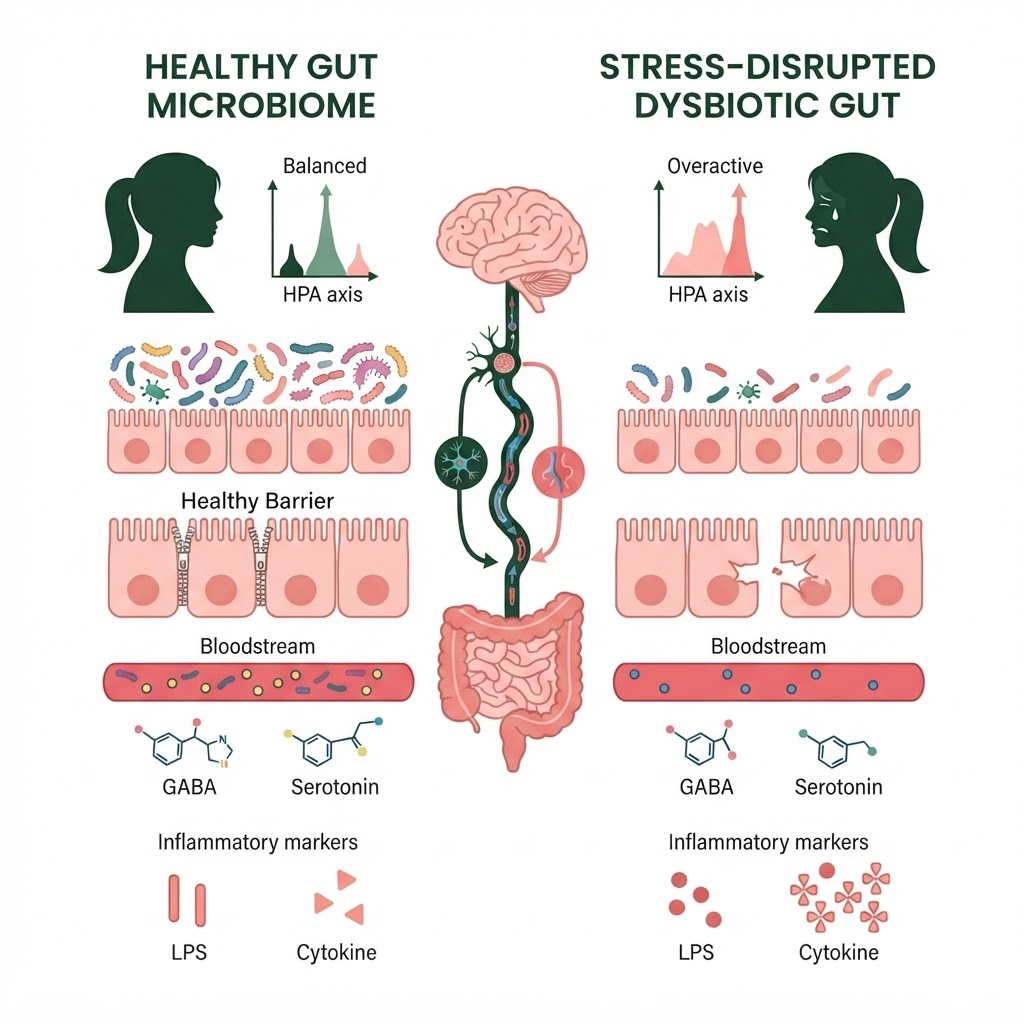
What makes this so insidious is the vicious cycle it creates. Stress causes dysbiosis. Dysbiosis reduces GABA and serotonin. Low GABA and serotonin increase anxiety. Anxiety elevates cortisol. Elevated cortisol worsens dysbiosis. Around and around it goes — until something interrupts the loop.
The Gender Gap: Why Women Are Hit Harder
The science is clear: women experience stress-related gut disruption more acutely and more frequently than men. This is not a matter of emotional sensitivity — it is biology.
Several factors drive this disparity:
Oestrogen and the microbiome Oestrogen directly modulates gut microbiome composition. The "estrobolome" — the collection of gut microbes that metabolise oestrogen — plays a crucial role in circulating oestrogen levels. When dysbiosis occurs, oestrogen metabolism is impaired, which in turn amplifies HPA axis reactivity and stress sensitivity. This creates a hormonal feedback loop that is distinctly female.
Progesterone and gut motility Progesterone slows gut transit time. In the luteal phase of the menstrual cycle, when progesterone peaks, many women experience bloating, constipation, and increased intestinal permeability — all of which prime the gut for stress-driven damage.
Greater HPA axis reactivity Multiple studies have documented that women show stronger cortisol responses to psychosocial stressors than men, and that these responses are modulated by ovarian hormones. This means that hormonal fluctuations — during PMS, perimenopause, or postpartum recovery — significantly amplify the gut-damaging effects of everyday stress.
"Women with high perceived stress scores show significantly greater reductions in gut microbial diversity compared to men under equivalent stress loads, suggesting sex-specific vulnerabilities in the stress-microbiome relationship." — Gur et al., Brain, Behavior, and Immunity, 2020
If you're in your 30s, 40s, or approaching perimenopause and feel like stress hits you differently in your gut than it used to, your biology is not wrong — it's responding to a real and measurable shift. Explore more on this topic in our Radiance Hub.
The GABA Connection: Why Your Gut Bacteria Hold the Key to Calm
Of all the mechanisms through which the microbiome influences anxiety, the GABA connection is perhaps the most profound — and the most underappreciated in mainstream medicine.
GABA is your brain's primary brake pedal. When GABA signalling is insufficient, the nervous system remains in a state of hyperexcitability — you feel on edge, overstimulated, unable to wind down, prone to intrusive thoughts. Many pharmaceutical anxiolytics, including benzodiazepines, work precisely by enhancing GABA activity in the brain. But what few people realise is that the gut is a major site of GABA production and that specific probiotic strains have demonstrated the ability to meaningfully increase GABA levels.
In particular, research has focused on Lactobacillus rhamnosus and Lactobacillus brevis, both of which have demonstrated the capacity to produce GABA in the gut environment. A pivotal study from the University of Cork showed that L. rhamnosus supplementation altered GABA receptor expression in the brains of mice, reducing anxious behaviour and lowering corticosterone (the mouse equivalent of cortisol). Critically, when the vagus nerve was severed, these effects disappeared — confirming that the gut-brain axis was the mechanism of action.
This is not speculative neuroscience. This is a mechanistic pathway with growing clinical evidence behind it — and it points directly to targeted probiotic supplementation as a meaningful, evidence-based intervention for anxiety-driven gut disruption.
Practical Strategies to Break the Stress-Dysbiosis Cycle
Understanding the mechanism is empowering precisely because it illuminates the intervention points. Here is what the evidence supports:
Dietary Strategies
- Increase prebiotic fibre: Foods like chicory root, garlic, leeks, asparagus, and green bananas feed beneficial bacteria and support SCFA production. Aim for 25–35g of fibre daily.
- Prioritise polyphenol-rich foods: Berries, dark chocolate (70%+), olive oil, and green tea contain polyphenols that selectively nourish beneficial bacterial strains and reduce gut inflammation.
- Reduce ultra-processed foods and refined sugars: These preferentially feed pro-inflammatory bacterial species and accelerate dysbiosis.
- Increase fermented foods: Kefir, live yoghurt, kimchi, sauerkraut, and miso provide a direct influx of beneficial bacteria to the gut environment.
Lifestyle Interventions
- Vagal nerve activation practices: Slow diaphragmatic breathing (4-7-8 technique), cold water immersion, humming, and singing all activate the vagus nerve and directly downregulate the HPA axis — reducing cortisol and improving gut motility simultaneously.
- Consistent sleep: Sleep deprivation is among the most potent drivers of cortisol dysregulation. Prioritising 7–9 hours of quality sleep is not a luxury — it is gut medicine.
- Moderate exercise: Regular aerobic exercise at moderate intensity has been shown to increase microbial diversity and reduce gut permeability. Overtraining, however, has the opposite effect — another reason why rest and recovery matter.
- Mind-body practices: Mindfulness-based stress reduction (MBSR) has demonstrated statistically significant improvements in gut microbiome diversity in clinical trials, mediated through HPA axis downregulation.
Targeted Supplementation
This is where precision matters. Not all probiotics are equal, and the delivery problem is real: most standard probiotic capsules lose 90–99% of their viable bacteria before they even reach the colon, destroyed by stomach acid, bile salts, and temperature fluctuations.
This is precisely why we developed our patented SCO2 microencapsulation technology at Her-Biotics — using supercritical carbon dioxide to create a protective matrix around each probiotic strain that is impervious to stomach acid and bile, delivering 1000× more viable bacteria to the gut compared to standard supplements. You can read more about the technology on our Science Page.
For women navigating stress and anxiety-driven gut disruption, our Her-Biotics Original provides a comprehensive 16-strain probiotic foundation — including Lactobacillus rhamnosus, L. brevis, Bifidobacterium longum, and B. breve — alongside B-vitamins, Vitamin C, E, and Zinc to support the immune and nervous system simultaneously. For women whose stress is closely tied to hormonal fluctuations and PMS, our Her-Biotics PMS Support adds Chasteberry, Evening Primrose Oil, Magnesium Glycinate, and Vitamin B6 — addressing the hormonal amplifiers that make stress-driven dysbiosis so much worse in the second half of the menstrual cycle.
Browse our complete range at Shop All Formulas to find the formula that best matches where you are right now.
What Recovery Actually Looks Like
I want to be honest with you about timeframes, because I believe women deserve straight answers rather than marketing promises.
Microbiome restoration is not an overnight process. Research suggests that meaningful shifts in bacterial composition can begin within 2–4 weeks of consistent probiotic supplementation combined with dietary changes. However, full microbiome recovery from chronic stress-induced dysbiosis typically takes 3–6 months — and it requires sustained effort across multiple domains: sleep, diet, stress management, and supplementation working together.
What you may notice first — often within the first 2–3 weeks — are improvements in digestive symptoms: reduced bloating, more regular bowel movements, less post-meal discomfort. Mood stabilisation and anxiety reduction typically follow as GABA and serotonin synthesis gradually normalises. By the 8–12 week mark, many women report significant improvements in energy, skin clarity, sleep quality, and emotional resilience.
The gut is remarkably plastic. It wants to heal. It simply needs the right conditions and the right microbial reinforcements to do so.
Final Thoughts: Your Gut Is Not a Casualty of Stress — It's a Gateway to Resilience
Chronic stress is a modern epidemic, and its effects on the gut microbiome are among its most underappreciated consequences. The stress-gut connection is not abstract — it is a concrete, measurable biological pathway through which anxiety rewires your microbial ecosystem, depletes your GABA, inflames your gut lining, and feeds the very anxiety it was born from.
But understanding this loop is not a reason for despair. It is, in fact, a reason for genuine optimism. Because every single intervention point in this cycle — from the foods you eat, to the breathing practices you adopt, to the precision probiotics you take — is within your reach.
Your microbiome is not a passive bystander in your mental health journey. It is an active, responsive, modifiable system that is listening to every signal you send it. When you support it with intention, it responds with profound generosity — better mood, better immunity, better resilience, better gut health.
Ready to start rebuilding your gut from the inside out? If stress, anxiety, or hormonal disruption have taken a toll on your digestive health, Her-Biotics Original was formulated specifically for this — 16 clinically researched strains, delivered alive and intact to your gut via our patented SCO2 technology, alongside the vitamins and minerals your nervous system needs to recalibrate. Take the first step toward a calmer gut, a calmer mind, and the resilient, energised version of yourself you deserve. Explore Her-Biotics Original →
Dr. Chomba Chuma is a medical doctor and founder of Her-Biotics. The information in this article is intended for educational purposes and does not constitute medical advice. Always consult a qualified healthcare professional before beginning any new supplement regimen.
Enjoyed this? Get the next one first.
Science made simple, delivered to your inbox. No spam, unsubscribe anytime.