

If you've typed "always tired as a woman causes checklist" into a search bar at 11pm, you're not imagining it and you're not lazy. Persistent fatigue in women is common, under-investigated, and almost always multifactorial — meaning it rarely has one single cause.
This article walks through the most evidence-backed reasons women feel perpetually drained, organised as a practical checklist you can run through yourself before your next doctor's visit. We'll also look at the gut's often-overlooked role in energy production, because for many women, that's the missing piece.
Why "I'm Just Tired" Deserves a Second Look
Fatigue is a symptom, not a diagnosis. It can stem from sleep, hormones, nutrient status, thyroid function, mental load, or your gut microbiome — often several at once.
The problem is that "tired" gets normalised for women in a way it doesn't for other health complaints. Many go years without anyone asking the deeper questions.
"Fatigue is one of the most common reasons for medical consultations, yet it is frequently under-recognised and under-treated, particularly in women." — Mayo Clinic, Fatigue: Causes
Before reaching for another coffee or supplement at random, it helps to work through a structured checklist. That's what we'll do next.
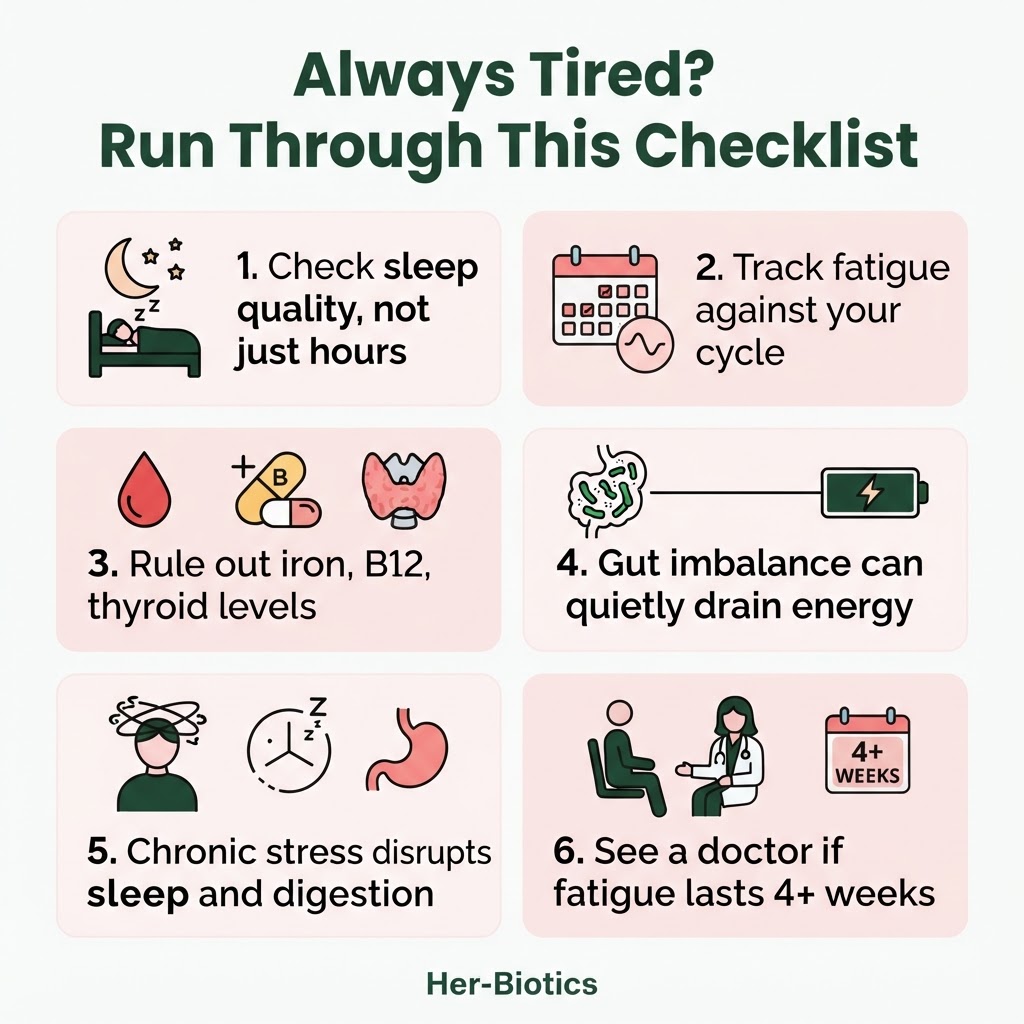
The Always-Tired-As-A-Woman Causes Checklist
Sleep Debt and Circadian Disruption
This sounds obvious, but sleep quality matters as much as sleep quantity. Fragmented, light, or poorly timed sleep can leave you feeling exhausted even after eight hours in bed.
- Waking at the same time every night (often 2–4am)
- Feeling groggy despite a "full" night's sleep
- Relying on screens right before bed
- Irregular bedtimes across the week
Your gut and sleep systems are more connected than most people realise — the same microbial signals that affect digestion also influence melatonin and sleep architecture. We cover this in detail in Sleep and Gut Health: The Bidirectional Relationship Every Woman Needs to Understand.
Hormonal Shifts Across Your Cycle
Energy naturally dips and rises with your menstrual cycle, largely driven by shifts in oestrogen and progesterone. Many women feel noticeably more tired in the luteal phase (the week or two before a period).
- Fatigue that follows a monthly pattern
- Heavier or longer periods than usual
- Low energy alongside mood changes or bloating
- Symptoms that ease once your period starts
If this sounds familiar, cycle-aware eating can genuinely help. See Cycle Syncing Nutrition: How to Eat for Your Hormonal Phases and Transform Your Health and PMS and the Microbiome: How Gut Health Governs Your Cycle.
Iron, B12 and Nutrient Gaps
Iron-deficiency fatigue is extremely common in women of reproductive age, largely because of monthly blood loss. Vitamin B12, folate, and vitamin D deficiencies can produce near-identical tiredness.
- Pale skin, brittle nails, or hair thinning
- Breathlessness on mild exertion
- Restless legs at night
- Heavy periods or low dietary iron intake
According to the World Health Organization, iron-deficiency anaemia disproportionately affects women and girls globally, and is a leading contributor to fatigue-related complaints (who.int, Anaemia fact sheet). A simple blood test can rule this in or out — don't guess.
Thyroid and Metabolic Function
The thyroid gland regulates metabolism, and an underactive thyroid (hypothyroidism) is a classic, frequently missed cause of relentless tiredness in women.
- Feeling cold more often than others
- Unexplained weight changes
- Dry skin, thinning hair, or brittle nails
- Low mood alongside sluggishness
Thyroid issues are diagnosed with a simple blood test — worth asking your doctor about if fatigue has lasted more than a few weeks without explanation.
Gut Health and the Microbiome
Your gut microbiome helps manufacture B vitamins, regulate inflammation, and communicate with your brain via the gut-brain axis. An imbalanced gut can quietly drain energy even when every other test comes back "normal."
- Fatigue alongside bloating or irregular digestion
- Energy crashes after meals
- Brain fog that lifts and returns unpredictably
- Skin flare-ups paired with tiredness
This connection runs deeper than most people expect — see Gut and Hormones Connection in Women Explained: The Hidden Communication System Running Your Body for the full picture.
Mental Load, Stress and Cortisol
Chronic stress keeps cortisol elevated, which disrupts sleep, digestion, and blood sugar — a trio that fuels fatigue. Many women carry an invisible "mental load" of planning and managing that never properly switches off.
- Waking up tired even after sleep
- Tension headaches or jaw clenching
- Difficulty relaxing even when free time appears
- Fatigue that worsens during high-stress weeks
The stress-gut link is well documented. For more, read Stress, Cortisol and the Gut: How Anxiety Is Destroying Your Microbiome (And What to Do About It) and Cortisol Belly Women: What to Do When Stress Hormones Reshape Your Middle.
Hidden Lifestyle Habits
Small daily habits add up more than people expect.
- Skipping breakfast or under-eating protein
- Excess caffeine masking true energy levels
- Dehydration (often mistaken for hunger or tiredness)
- Sedentary days with little movement
- Alcohol close to bedtime
None of these alone "causes" chronic fatigue, but stacked together, they can tip you from mildly tired to constantly exhausted.
When Fatigue Is a Gut Problem Wearing a Disguise
Here's something many women don't realise: your gut produces or helps regulate a surprising share of the compounds your body uses for energy and mood — including precursors to serotonin and several B vitamins.
When gut bacteria are out of balance (a state researchers call dysbiosis), nutrient absorption can suffer even on a good diet. That means you could be eating well and still feel flat, foggy, and low on fuel.
"Emerging research increasingly implicates the gut microbiome in host energy metabolism and fatigue-related symptoms, independent of classic markers like iron or thyroid status." — Frontiers in Microbiology, gut-microbiome-fatigue research (2021)
This is part of why probiotic viability matters — a strain that dies before reaching your colon can't do much for you. Her-Biotics uses SCO2 microencapsulation specifically to help more live cultures survive stomach acid and reach the gut intact. You can read the mechanism in detail in SCO2 Microencapsulation: The Science Behind 1000× More Probiotics and Her-Biotics Ingredients Strains: What's Really Inside Your Daily Probiotic (And Why It Matters).
If bloating and digestive discomfort are part of your fatigue picture, it's worth reading Why Do I Bloat Every Afternoon as a Woman? The Hidden Daily Rhythm Behind It and Bloating, IBS and Leaky Gut: How to Finally Solve Your Digestive Issues with Probiotics.
Red Flags: When Tiredness Needs a Doctor, Not Just a Checklist
Some patterns deserve prompt medical attention rather than self-management. Please consult a healthcare provider if you experience:
- Fatigue lasting more than four to six weeks with no clear cause
- Unexplained weight loss or gain
- Shortness of breath, chest pain, or heart palpitations
- Very heavy or irregular periods
- Fatigue paired with fever, night sweats, or swollen glands
- Thoughts of self-harm or persistent low mood
This article is educational and does not replace individual medical advice. A doctor can run blood work for iron, B12, vitamin D, and thyroid function to rule out underlying conditions.
Building Your Personal Energy-Repair Plan
Once medical causes have been checked, most women benefit from addressing several checklist items at once rather than chasing one "magic fix."
A simple starting framework:
- Protect sleep timing — consistent bed and wake times, even on weekends.
- Anchor meals with protein and fibre to steady blood sugar and reduce energy crashes.
- Support your gut daily with a quality probiotic and prebiotic-rich foods — see Prebiotic Foods That Supercharge Your Probiotic Supplement (Science-Backed Guide).
- Track your cycle alongside your energy to spot hormonal patterns.
- Build in micro-recovery — five minutes of breathing or a short walk between demanding tasks.
- Ask for the right blood tests if fatigue persists beyond a few weeks.
Active women juggling training alongside daily life may find additional value in Female Athlete Gut Health: How the Microbiome Drives Sports Performance, Recovery, and Iron Absorption, and women over 50 navigating energy changes may want to explore Ageless Beauty After 50: How Your Gut Microbiome Holds the Secret to Longevity and Radiance.
For further reading from reputable medical sources, the NIH offers a helpful overview of iron deficiency in women (ncbi.nlm.nih.gov, PMC article on iron deficiency and women's health), and Mayo Clinic maintains a thorough breakdown of general fatigue causes (mayoclinic.org, Fatigue: Causes).
Your Simplest First Step
You don't need to overhaul everything today. A good place to start is supporting the system that quietly influences sleep, mood, nutrient absorption, and digestion all at once — your gut.
Her-Biotics Original was designed for exactly this: daily gut support formulated with SCO2 microencapsulation so more live cultures actually reach your gut, where they may help support digestion, immunity, and everyday energy from the inside out.
👉 Explore Her-Biotics Original or browse the full range at the Her-Biotics store.
And if you'd like practical, science-backed guidance like this delivered straight to your inbox, subscribe to the Her-Biotics newsletter below — no spam, just useful information for feeling more like yourself again.
This article is for general educational purposes and is not a substitute for professional medical advice. Please consult a healthcare provider about persistent or severe fatigue.
Enjoyed this? Get the next one first.
Science made simple, delivered to your inbox. No spam, unsubscribe anytime.