

By Dr. Chomba Chuma, MD & Founder, Her-Biotics | August 31, 2026
When we talk about optimising performance as a female athlete, the conversation usually centres on training loads, macronutrient ratios, sleep quality, and periodisation. Rarely does anyone point to what's happening in your gut — and yet, the 38 trillion microorganisms living in your gastrointestinal tract may be doing more for your splits, your strength, and your recovery than any pre-workout formula on the market.
I became fascinated by the intersection of the gut microbiome and athletic performance during my clinical training, when I noticed that many of my most committed female patients — triathletes, CrossFitters, recreational runners — were chronically fatigued, iron-depleted, and struggling with gastrointestinal symptoms that no one had adequately explained. The more I looked, the more clearly I could see: their gut health was at the centre of everything.
This article is for every woman who trains hard and wants her biology working with her, not against her. Whether you're a competitive athlete or a committed gym-goer, understanding your microbiome could be the missing link between where you are and where you want to be.
1. The Athlete's Gut: Why Female Biology Changes Everything
First, let's acknowledge something the sports science world has been painfully slow to accept: female physiology is not simply a scaled-down version of male physiology. Women experience cyclical hormonal shifts, different body composition patterns, a distinct iron metabolism, and a unique gut microbiome profile — all of which interact with training in ways that demand a specifically female lens.
Research published in the journal Cell Host & Microbe has confirmed that sex hormones directly influence gut microbiome composition. Oestrogen and progesterone modulate the diversity and abundance of key bacterial species, which means your microbiome is not static — it shifts across your menstrual cycle, during perimenopause, and throughout your athletic career.
The Female Athlete Microbiome: What We Know
Studies comparing elite female athletes to sedentary controls have consistently demonstrated that regular endurance exercise increases gut microbial diversity — a marker strongly associated with overall health, immune resilience, and metabolic efficiency. Athletes tend to show higher populations of Akkermansia muciniphila, Faecalibacterium prausnitzii, and Bifidobacterium species — all associated with reduced systemic inflammation and improved gut barrier integrity.
However — and this is critical — high training volumes can simultaneously damage the very gut lining you're trying to protect. This paradox sits at the heart of gut health challenges for female athletes.
"Exercise-induced gastrointestinal syndrome is a clinically significant condition affecting up to 70% of endurance athletes, characterised by increased intestinal permeability, altered motility, and microbiome dysbiosis." — Adapted from Pyne et al., Applied Physiology, Nutrition, and Metabolism, 2015 (source)
2. Intestinal Permeability, Inflammation, and the Performance Penalty
During intense or prolonged exercise, blood is redirected away from the gastrointestinal tract to the working muscles. This splanchnic hypoperfusion — reduced blood flow to the gut — causes oxidative stress and inflammation in the intestinal lining. The result is a phenomenon known colloquially as "leaky gut" or, more precisely, increased intestinal permeability.
When the tight junctions between intestinal epithelial cells break down, bacterial endotoxins (particularly lipopolysaccharides, or LPS) can pass into the bloodstream. This triggers a systemic inflammatory response that:
- Elevates pro-inflammatory cytokines (TNF-α, IL-6, IL-1β)
- Increases perceived exertion and muscle soreness
- Impairs glucose metabolism and glycogen synthesis
- Disrupts sleep quality — which is when recovery actually happens
- Suppresses immune function, increasing susceptibility to upper respiratory infections
For the female athlete, this inflammatory cascade hits particularly hard. Women already experience a baseline inflammatory shift during the luteal phase of the menstrual cycle (the two weeks before menstruation), meaning that training heavy during this window with a compromised gut can compound inflammation to a level that genuinely impairs adaptation.
The Role of Short-Chain Fatty Acids (SCFAs)
One of the most important ways the microbiome protects the gut lining is through the production of short-chain fatty acids (SCFAs), particularly butyrate, acetate, and propionate. These metabolites are produced when beneficial bacteria ferment dietary fibre, and they:
- Fuel colonocytes (the cells lining your colon), maintaining barrier integrity
- Modulate immune responses, reducing inappropriate inflammation
- Influence energy metabolism, improving insulin sensitivity
- Regulate appetite and satiety hormones, including GLP-1 and PYY
When your microbiome is depleted — through antibiotic use, chronic stress, low-fibre eating, or overtraining — SCFA production drops, your gut lining weakens, and the cycle of inflammation and poor recovery begins.
3. Iron Absorption: The Female Athlete's Most Critical Gut-Microbiome Connection
If there is one nutrient that brings the gut-performance connection into sharp focus for women, it is iron.
Iron deficiency is the most common nutritional deficiency worldwide, and female athletes are disproportionately affected — due to menstrual losses, the destruction of red blood cells through foot-strike haemolysis (particularly in runners), sweat losses, and frequently inadequate dietary intake in athletes pursuing leanness.
The consequences are severe: reduced haemoglobin, impaired oxygen delivery to muscles, decreased VO₂ max, early onset of fatigue, poor concentration, and slowed recovery.
But here's what most practitioners miss: iron absorption is fundamentally a gut event, and the microbiome is a central player.
How the Microbiome Regulates Iron
Non-haem iron (from plant sources) must be converted from ferric (Fe³⁺) to ferrous (Fe²⁺) form before it can be absorbed in the duodenum. This process depends on:
- Adequate stomach acid — which is reduced by stress, dysbiosis, and chronic NSAID use (common in athletes managing pain)
- Vitamin C — an electron donor that facilitates the Fe³⁺ → Fe²⁺ conversion
- A healthy mucosal surface — compromised by intestinal permeability
- The microbiome itself — certain bacterial species compete with the host for iron, while others enhance its bioavailability
Research from the NIH National Institute of Environmental Health Sciences has demonstrated that gut dysbiosis is associated with both iron deficiency and iron overload in the gut lumen, since pathogenic bacteria thrive on free iron, displacing beneficial species and creating a vicious cycle (source).
Lactobacillus and Bifidobacterium species — the backbone of a well-formulated probiotic — have been shown to reduce intestinal pH, enhance ferric reductase activity, and produce SCFAs that improve the absorptive capacity of the intestinal epithelium, collectively improving iron bioavailability.
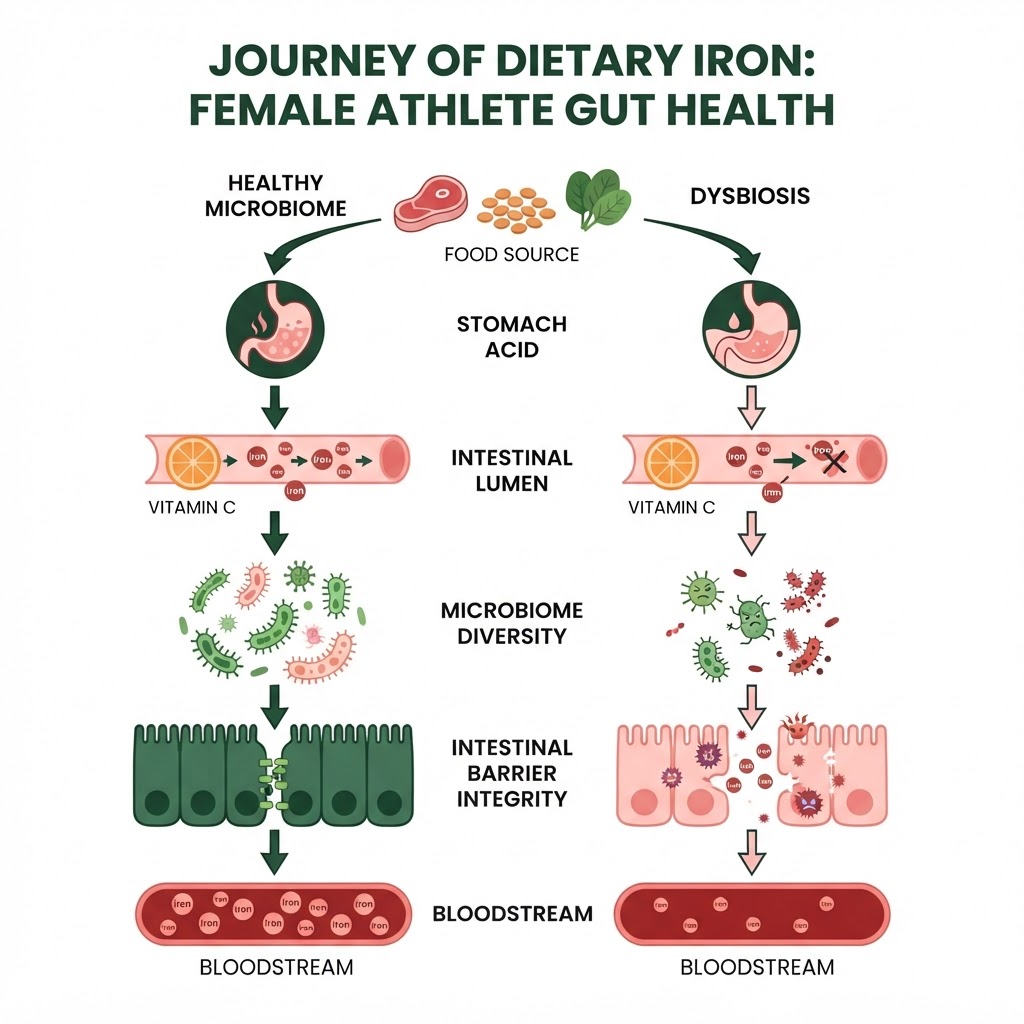
This is precisely why Her-Biotics Sport was formulated with a 16-strain probiotic base plus bioavailable Iron — because optimising iron status in female athletes requires addressing the gut environment first, not just throwing more iron at the problem.
4. Probiotics, Recovery, and Exercise Adaptation
Recovery is not simply the absence of training. It is an active biological process involving tissue repair, glycogen resynthesis, immune regulation, and hormonal recalibration. The gut microbiome participates in every one of these processes.
Reducing Exercise-Induced Muscle Damage
A landmark randomised controlled trial published in the Journal of the International Society of Sports Nutrition found that athletes supplementing with multi-strain probiotics experienced significantly lower markers of exercise-induced muscle damage — including creatine kinase (CK) and lactate dehydrogenase (LDH) — following downhill running compared to placebo. The proposed mechanism? Reduced gut permeability, lower circulating LPS, and consequently, attenuated systemic inflammation.
For female athletes, this matters enormously. Faster resolution of muscle damage means shorter recovery windows, the ability to train harder more frequently, and compounded adaptation over time.
Protein Synthesis and Amino Acid Metabolism
The microbiome doesn't just passively sit alongside your protein intake — it actively participates in amino acid metabolism. Gut bacteria produce and modify amino acids, synthesise neurotransmitter precursors, and influence how effectively dietary protein is broken down and absorbed.
Certain probiotic strains, particularly Lactobacillus helveticus and Bifidobacterium longum, have been shown to enhance protein digestibility and increase the bioavailability of branched-chain amino acids (BCAAs) — the primary substrates for muscle protein synthesis. When your microbiome is thriving, you extract more functional nutrition from every meal you eat.
Sleep, the Gut-Brain Axis, and Recovery Quality
Recovery happens during sleep — and the gut-brain axis directly regulates sleep quality. Approximately 95% of the body's serotonin is produced in the gut, and serotonin is the precursor to melatonin. A dysbiotic gut disrupts this serotonin-melatonin pathway, impairing sleep onset, reducing deep sleep duration, and elevating cortisol — a recovery nemesis.
Athletes with healthy, diverse microbiomes consistently report better sleep quality scores, and emerging data supports the idea that targeted probiotic supplementation can meaningfully improve sleep architecture through the gut-brain axis.
5. Common Gut Challenges Facing Female Athletes — and How to Address Them
Understanding the science is only useful if it translates into action. Here are the most common gut health challenges I see in female athletes, along with evidence-based strategies.
Challenge 1: Exercise-Induced GI Distress
Up to 70% of endurance athletes experience nausea, cramping, diarrhoea, or bloating during training and competition. Triggers include:
- High-intensity effort redirecting blood away from the gut
- High-fibre, high-fat, or high-fructose intake close to exercise
- Dehydration impairing gut motility
- Stress hormones (cortisol, adrenaline) disrupting the gut-brain axis
Strategy: Time fibre and fat intake away from training windows. Prioritise hydration. Supplement with multi-strain probiotics 4–8 weeks before key events to build mucosal resilience.
Challenge 2: Relative Energy Deficiency in Sport (RED-S)
Formerly known as the female athlete triad, RED-S occurs when energy availability is insufficient to support both training demands and physiological function. The gut is among the first systems to suffer — reduced food intake means reduced substrate for beneficial bacteria, leading to dysbiosis, impaired nutrient absorption, and a worsening energy deficit.
Strategy: Work with a sports dietitian to establish adequate energy availability. Prioritise prebiotic-rich foods (chicory root, garlic, oats, green banana) to feed beneficial bacteria even during periods of dietary restriction.
Challenge 3: Antibiotic-Induced Dysbiosis
Athletes are not immune to infection, and antibiotic courses — however necessary — cause significant collateral damage to the microbiome that can persist for six months or longer without active restoration.
Strategy: Begin a high-potency, multi-strain probiotic during and immediately after any antibiotic course. Look for strains with specific evidence for antibiotic-associated dysbiosis recovery, including Saccharomyces boulardii, Lactobacillus rhamnosus GG, and Bifidobacterium lactis.
Challenge 4: Hormonal Fluctuations and Gut Motility
Progesterone — which peaks in the luteal phase — slows gut motility, contributing to bloating, constipation, and altered absorption kinetics. This is not in your imagination; it is a well-documented physiological reality that affects performance and recovery during the second half of your cycle.
Strategy: Increase fluid and soluble fibre intake during the luteal phase. Consider targeted probiotic support to modulate oestrogen metabolism via the estrobolome — the collection of gut bacteria responsible for metabolising and recirculating oestrogens. For broader hormonal support, explore Her-Biotics PMS Support, which pairs our SCO2-microencapsulated probiotic base with Chasteberry and Magnesium Glycinate.
6. Building Your Gut Health Performance Stack: Practical Protocols
Science is only as good as its application. Here is a framework I recommend to the female athletes I work with:
Daily Non-Negotiables
- 30+ different plant foods per week — diversity of fibre = diversity of bacteria
- Fermented foods daily — plain kefir, natural yoghurt, kimchi, sauerkraut, miso
- Adequate hydration — 35ml per kg of body weight, more on training days
- Minimise emulsifiers and artificial sweeteners — research increasingly implicates these in gut barrier disruption
- Consistent sleep schedule — circadian rhythm disruption alters microbiome composition within 48 hours
Probiotic Supplementation: What to Look For
Not all probiotics are equal — in fact, most are woefully inadequate by the time they reach your gut. Standard probiotic capsules are exposed to stomach acid, bile salts, and enzymatic degradation, with studies estimating that fewer than 10% of live cultures in standard formulas survive to reach the colon.
This is the problem that our patented SCO2 (supercritical carbon dioxide) microencapsulation technology was developed to solve. By encapsulating each bacterial strain in a protective lipid matrix using CO₂ at supercritical pressure, we achieve 1000× greater viability at the site of action compared to standard unencapsulated probiotics. The bacteria arrive alive — which is, rather obviously, the only way they can do their job.
For the full science behind our delivery technology, visit our Science Page.
Training Phase Considerations
| Training Phase | Gut Priority | Key Strategy | |---|---|---| | Base/Off-Season | Build diversity | High dietary variety, consistent probiotic | | Pre-Competition | Reduce GI risk | Test supplement protocol, low-residue pre-race | | Competition Day | Maintain function | Familiar foods, stay hydrated, avoid novel fibres | | Recovery Week | Restore barrier | Anti-inflammatory foods, probiotics, adequate sleep |
For a deeper dive into women's health and performance nutrition, explore our Radiance Hub — a growing library of evidence-based resources written for and about women.
7. Why Her-Biotics Sport Was Built for the Female Athlete
When I developed Her-Biotics Sport, I was guided by one central question: what does a female athlete's body actually need from a probiotic?
The answer, based on the clinical evidence, was a formula that goes beyond basic digestion support to address the specific physiological demands of training: gut barrier integrity, iron bioavailability, sustained energy, and accelerated recovery.
Her-Biotics Sport contains:
- 16-strain SCO2-microencapsulated probiotic blend — for gut barrier support, SCFA production, and immune regulation
- L-Glutamine — the primary fuel for enterocytes; clinically shown to reduce exercise-induced intestinal permeability
- L-Carnitine — facilitates fatty acid transport into mitochondria, enhancing fat oxidation and sparing glycogen
- CoQ10 — a critical electron carrier in the mitochondrial respiratory chain, supporting ATP production and reducing oxidative stress
- Ashwagandha (KSM-66®) — adaptogenic support for cortisol regulation and recovery; shown in multiple RCTs to improve VO₂ max and muscular endurance
- Bioavailable Iron — paired with the probiotic base to optimise gut-mediated absorption
Every ingredient is chosen because female athletes have specific needs that generic sports nutrition consistently fails to address. You can compare all our formulas on the Shop All Formulas page.
The Bottom Line
Your microbiome is not a passive bystander in your athletic journey. It is an active participant — modulating inflammation, driving recovery, protecting your gut lining under the mechanical and metabolic stress of training, and governing how well your body absorbs the nutrients your performance depends on. For female athletes, the gut-performance connection is amplified by hormonal biology, iron physiology, and the unique demands of training across the menstrual cycle.
Investing in your gut health is not a wellness trend. It is a performance strategy backed by a rapidly expanding body of rigorous science.
Ready to Make Your Gut Your Greatest Performance Asset?
If you train hard, recover harder, and want a supplement that understands the complexity of the female athletic body, Her-Biotics Sport was made for you. With our clinically validated SCO2 microencapsulation technology delivering 1000× more viable probiotics to your gut, combined with L-Glutamine, Ashwagandha, CoQ10, L-Carnitine, and bioavailable Iron, this is the most comprehensive gut-performance formula designed specifically for women who refuse to leave anything on the table. Start your 90-day protocol today and feel the difference that a genuinely healthy gut makes to your training, your recovery, and your life.
Dr. Chomba Chuma, MD, is the founder of Her-Biotics and a practising physician specialising in women's health and nutritional medicine. All content is intended for informational purposes and does not constitute individual medical advice. Please consult your healthcare provider before beginning any new supplement regimen.
Enjoyed this? Get the next one first.
Science made simple, delivered to your inbox. No spam, unsubscribe anytime.