

If you've noticed weight settling around your middle even though your habits haven't changed much, you're not imagining it. Many women search "cortisol belly women what to do" because something feels different — tighter waistbands, more bloating, and a stubbornness that diet and exercise alone don't seem to touch.
This article breaks down what's actually happening, why your midsection can become a stress storage site, and what you can realistically do about it — without extreme diets or fear-based advice.
What Is "Cortisol Belly" and Is It Actually a Thing?
"Cortisol belly" isn't an official medical diagnosis. It's a popular way of describing a pattern researchers have observed for decades: chronic stress is associated with fat storage around the abdomen, particularly visceral fat that sits around your organs.
Cortisol is your body's primary stress hormone. In short bursts, it's incredibly useful — it mobilises energy, sharpens focus, and helps you respond to a real threat. The problem starts when cortisol stays elevated for weeks or months because stress never fully switches off.
"Stress-induced cortisol secretion is consistently greater among women with central fat distribution compared to those with peripheral fat distribution." — Epel et al., Psychosomatic Medicine (2000)
That early study was one of the first to connect psychological stress, cortisol reactivity, and abdominal fat specifically in women — and the pattern has been replicated in later research.
Why Your Midsection Becomes a Stress Storage Site
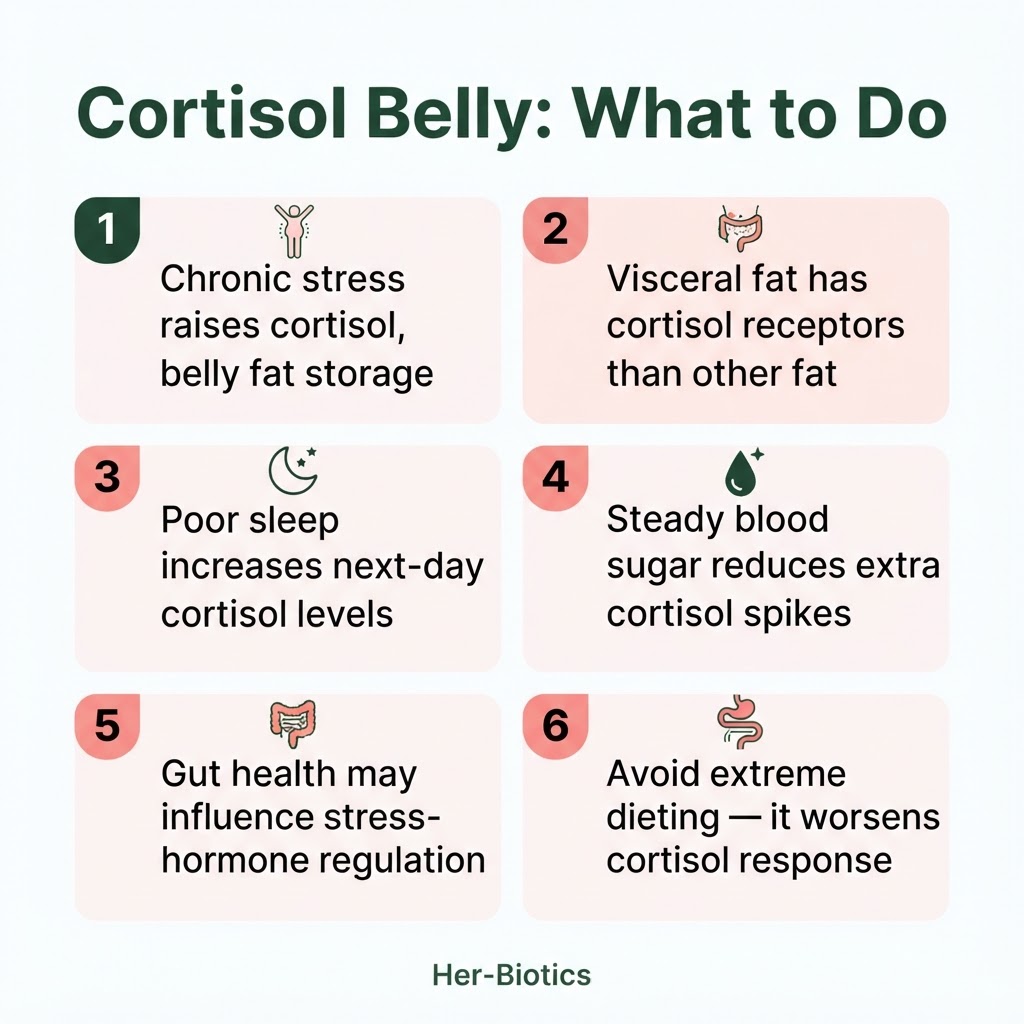
Not all fat tissue is equal. Visceral fat — the kind stored deeper in the abdomen — has a particularly high number of cortisol receptors compared to fat stored on the hips or thighs.
This means that when cortisol is chronically elevated, your body may preferentially direct energy storage toward this area. It's not about willpower; it's biology responding to a signal that says "stay alert, store fuel."
A few other factors tend to compound this:
- Disrupted sleep raises cortisol the next day, creating a feedback loop
- Blood sugar swings from skipped meals or high-sugar snacking add extra stress to the system
- Poor recovery from constant low-grade stress (work, caregiving, financial pressure) keeps cortisol from resetting
- Reduced movement due to fatigue, which lowers the natural stress-buffering effect of exercise
If this pattern sounds familiar, you may also notice bloating that gets worse later in the day — a rhythm we've explored in more depth in Why Do I Bloat Every Afternoon as a Woman? The Hidden Daily Rhythm Behind It.
Signs This Might Be You
Cortisol-related midsection changes often show up alongside other stress symptoms, not in isolation. Common signs include:
- Weight gain concentrated around the waist rather than hips or thighs
- Fatigue that doesn't improve with sleep
- Sugar or carb cravings, especially in the afternoon or evening
- Trouble falling or staying asleep
- A sense of being "wired but tired"
- Digestive changes like bloating or irregularity
None of these on their own confirm cortisol is the cause — but together, they paint a picture worth paying attention to.
The Gut-Cortisol Loop You Can't Ignore
Your gut and your stress response are in constant two-way communication through what's known as the gut-brain axis. Chronic stress can alter gut bacteria diversity, and in turn, an imbalanced microbiome may influence how your body manages inflammation and stress hormones.
We've covered this bidirectional relationship in detail in Stress, Cortisol and the Gut: How Anxiety Is Destroying Your Microbiome (And What to Do About It), so we won't repeat it here. What matters for this article is simple: supporting your gut is one lever you can pull alongside stress management, not instead of it.
"Chronic stress is linked to changes in gut microbial composition, which may in turn influence the body's stress-response systems." — National Institutes of Health, PMC research summary
Cortisol Belly: What to Do, Starting Today
There's no single fix, but there are several small, evidence-informed adjustments that tend to help most women. Start with one or two — not all five at once.
Prioritise Sleep Like a Non-Negotiable
Poor sleep raises next-day cortisol and increases cravings for high-sugar, high-fat foods. Even modest improvements matter.
- Aim for a consistent wake time, even on weekends
- Dim screens an hour before bed
- Keep your room cool and dark
For a deeper look at why this matters so much for women specifically, see Sleep and Gut Health: The Bidirectional Relationship Every Woman Needs to Understand.
Move in Ways That Calm, Not Spike, Cortisol
Intense exercise is valuable, but when you're already under chronic stress, very high-intensity training can sometimes add to the cortisol load rather than relieve it.
- Balance harder sessions with walking, yoga, or swimming
- Aim for consistency over intensity
- The World Health Organization recommends at least 150 minutes of moderate activity weekly for general health — a useful, achievable benchmark
Eat to Steady Your Blood Sugar
Blood sugar crashes are a stressor in themselves, prompting another cortisol release.
- Include protein and fibre at each meal
- Avoid long gaps without eating
- Limit ultra-processed snacks that spike and crash blood sugar quickly
If you're also navigating cycle-related cravings, Cycle Syncing Nutrition: How to Eat for Your Hormonal Phases and Transform Your Health offers a practical framework.
Support Your Gut Microbiome
A diverse, well-supported gut microbiome may help the body manage inflammation and stress signalling more efficiently.
- Add fermented foods or a quality probiotic
- Include prebiotic fibres that feed beneficial bacteria — see Prebiotic Foods That Supercharge Your Probiotic Supplement (Science-Backed Guide)
- Stay consistent; microbiome shifts take weeks, not days
This is where Her-Biotics Original can play a supporting role — its SCO2 microencapsulation technology is designed to help more live probiotic cultures survive the journey to your gut, supporting daily digestive balance, energy, and skin clarity as part of a broader stress-management routine.
Build in Real Recovery
Recovery isn't optional — it's part of the biological process that allows cortisol to come back down.
- Schedule short, non-negotiable breaks during the day
- Practise slow breathing or brief mindfulness pauses
- Protect at least one screen-free wind-down ritual each evening
"Chronic stress that goes unmanaged can lead to a variety of health problems, including anxiety, depression, digestive problems, and weight gain." — Mayo Clinic, Stress Management
What Not to Do (Common Mistakes That Backfire)
It's tempting to respond to "cortisol belly" with extreme measures. Most of these make things worse.
- Severe calorie restriction — this can raise cortisol further and increase fatigue
- Skipping meals to "save calories" — destabilises blood sugar and intensifies cravings
- Over-exercising — especially high-intensity training without adequate recovery
- Relying on stimulants (excess caffeine) to push through fatigue — this layers more stress onto an already taxed system
- Chasing quick fixes — supplements or detoxes promising rapid results rarely address the underlying stress load
If bloating is part of your picture too, it's worth ruling out simple digestive causes before assuming it's all cortisol-driven. How to Debloat Fast Naturally: 9 Science-Backed Ways to Feel Lighter Today is a good starting point.
When to Talk to a Healthcare Provider
Most midsection weight changes linked to stress are manageable with lifestyle adjustments. However, you should speak with a healthcare provider if you notice:
- Rapid, unexplained weight gain
- Severe fatigue that doesn't improve with rest
- Signs of hormonal imbalance such as irregular cycles
- Persistent high blood pressure or blood sugar concerns
Conditions like PCOS or thyroid dysfunction can also influence midsection weight and should be properly assessed. If PCOS is a concern for you, PCOS and the Microbiome: A Root-Cause Approach to Hormonal Balance explores this further.
This article is for general information and does not replace personalised medical advice — always consult a qualified healthcare provider about your specific symptoms and history.
Your Next Step: Start Small, Start Today
You don't need to overhaul your entire life this week. Pick one lever — sleep, movement, nutrition, or gut support — and give it two to three consistent weeks before adding another.
If gut support is the piece you've been missing, Her-Biotics Original is formulated to support daily digestive balance, energy, and skin clarity — a steady foundation while you work on the bigger stress picture. For the full range, browse the Her-Biotics collection.
Want more practical, no-nonsense guidance like this delivered straight to your inbox? Subscribe to the Her-Biotics newsletter below and get the next article before it's published.
Enjoyed this? Get the next one first.
Science made simple, delivered to your inbox. No spam, unsubscribe anytime.