

If you could set a clock by your own stomach, it would probably ring sometime between 1pm and 4pm. Your jeans feel tighter, your stomach pushes against your waistband, and you start wondering what you ate at lunch. For many women, this isn't a one-off — it's a near-daily pattern.
The good news? Afternoon bloating usually isn't a mystery illness. It's the predictable result of how your gut, hormones, and daily rhythms interact. Once you understand the pattern, you can work with your body instead of fighting it every afternoon.
Your Gut Has Its Own Body Clock
Most people know about the circadian rhythm that governs sleep. Fewer know your digestive system runs on a similar internal clock.
Research on gut microbiota shows that bacterial populations and activity actually shift in a rhythmic, time-of-day pattern — not randomly throughout the day.
"Microbiota and their function undergo diurnal oscillations that influence intestinal physiology and contribute to metabolic homeostasis." — Thaiss et al., Cell (2014)
This means your gut may be more efficient at certain times and slower at others. For many women, the early-to-mid afternoon lines up with a natural dip in digestive efficiency — exactly when gas, fluid shifts, and slower motility can combine to make bloating more noticeable.
Why This Matters for You
It's not that something is "wrong" with your digestion specifically in the afternoon. It's that your gut's natural rhythm, combined with a full day's worth of food, drink, and movement (or lack of it), tends to peak in visible bloat by mid-afternoon.
If you've ever wondered whether your gut bacteria are working against you, our guide on how gut bacteria affect oestrogen in women goes deeper into how your microbiome influences far more than digestion.
The Cumulative Effect: Breakfast, Lunch, and Everything In Between
Bloating is rarely caused by a single meal. It's often the accumulation of the day so far.
By 2pm, your gut has usually processed:
- Breakfast (often eaten quickly, sometimes with air-swallowing)
- A mid-morning coffee or two (which can speed up colon activity)
- Lunch, often eaten at a desk, fast, and under stress
- Snacks nibbled between meetings or tasks
Each of these adds gas, fluid, and partially digested material to a gut that's trying to keep up. By early afternoon, this cumulative load is at its peak — and so is the visible bloat.
"Bloating is commonly caused by excess gas production, impaired gas transit, or increased sensitivity to normal amounts of gas in the gut." — Mayo Clinic, Causes of Bloating
If lunch itself tends to be the trigger, our guide on how to debloat fast naturally offers same-day strategies worth keeping on hand.
Cortisol's Afternoon Dip and Your Gut
Cortisol, your main stress hormone, doesn't stay flat all day. It peaks in the morning and gradually declines — with many women noticing a noticeable dip in the early-to-mid afternoon.
This matters for digestion because cortisol influences gut motility, blood flow to the digestive tract, and even the tightness of the gut lining.
How This Can Translate to Bloat
- Lower cortisol can slow gut transit temporarily
- Slower transit means gas has more time to build up
- Stress-related dips can also affect the gut-brain signalling that controls comfortable digestion
This is one reason the "3pm slump" so often comes bundled with a bloated stomach, not just low energy. If this stress-gut link resonates, our deep dive on stress, cortisol and the gut explains the biology in more detail.
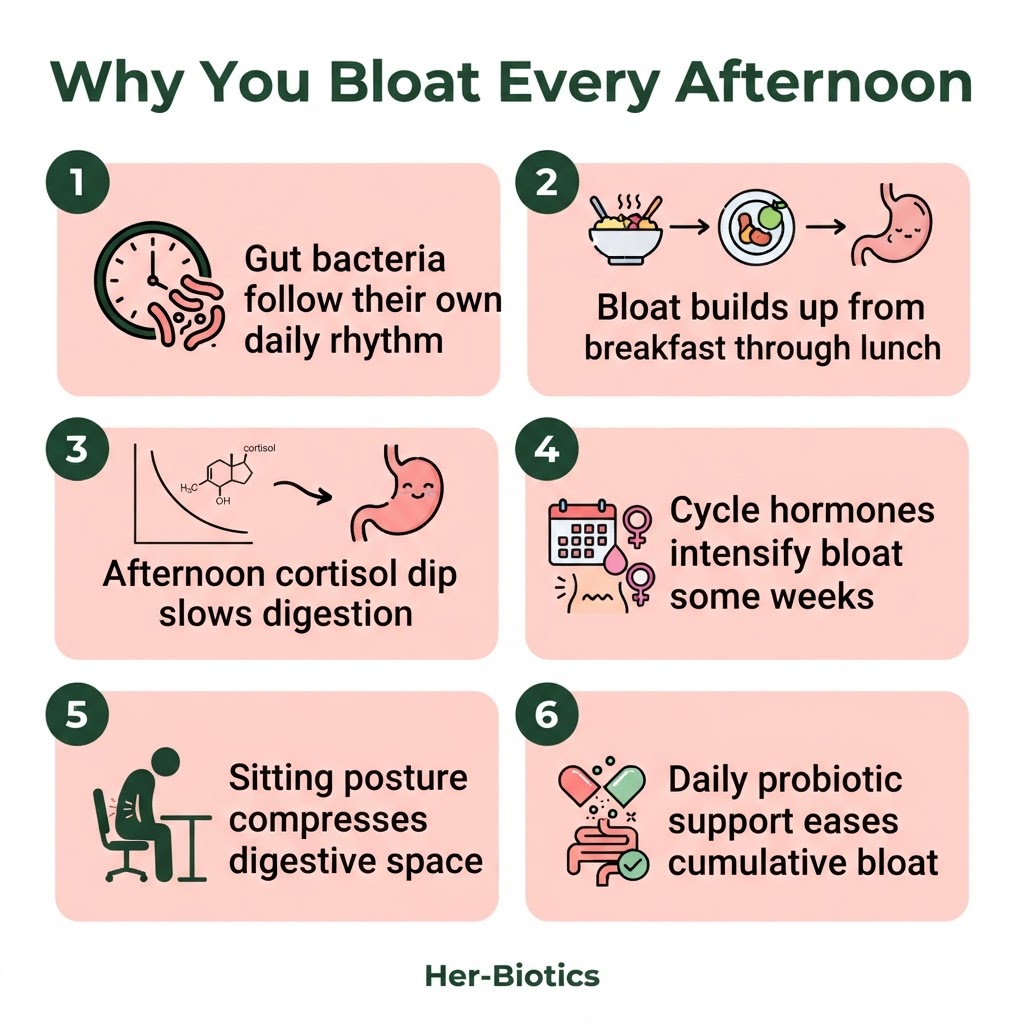
Hormones and Your Cycle: Why Some Days Are Worse
If your afternoon bloat feels dramatically worse in the days before your period, you're not imagining it. Oestrogen and progesterone both influence fluid retention and gut motility across your cycle.
- Rising progesterone (luteal phase) can relax gut muscles, slowing things down
- Shifting oestrogen affects how much fluid your body holds onto
- Both can make an already-predictable afternoon bloat feel more intense in the second half of your cycle
"Gastrointestinal symptoms, including bloating, fluctuate significantly across the menstrual cycle in a majority of women surveyed." — Journal of Women's Health cycle-symptom studies
This is why some women notice their afternoon bloat is mild most of the month, then noticeably worse for about a week. If this sounds familiar, the gut and hormones connection article explains why your gut and cycle are so tightly linked.
Posture, Sitting, and the 2pm Slouch
By early afternoon, many women have been sitting — at a desk, in a car, in meetings — for hours. Posture plays a bigger role in bloating than most people realise.
Sitting for long periods can:
- Compress the abdomen, reducing space for normal gut movement
- Slow circulation to the digestive tract
- Encourage shallow breathing, which reduces the natural "massage" effect deep breathing has on the gut
A short walk, a few minutes of standing, or simply sitting up straighter can sometimes ease afternoon tightness within minutes — not because the bloat disappears, but because there's more physical room for gas and fluid to move through.
What Actually Helps: Small, Realistic Shifts
You don't need to overhaul your entire day to see a difference. Most women find relief from a few consistent, small changes rather than one dramatic fix.
Rethink Your Lunch Pace
- Eating lunch in under 10 minutes increases air-swallowing and makes gas more likely
- Slower eating, with a few extra chews per bite, can meaningfully reduce gas buildup
Move for Two Minutes Every Hour
- Standing, stretching, or a short walk after lunch supports gut motility
- Movement doesn't need to be intense — gentle and consistent is what matters
Support Your Gut Bacteria Daily
A resilient, diverse microbiome is better equipped to handle the normal gas and fermentation that comes with digestion. This is where a well-chosen probiotic can make a meaningful difference over time — not as a single-dose fix, but as part of a daily foundation.
Many probiotic capsules, however, don't survive stomach acid long enough to reach the gut in meaningful numbers. This is why delivery technology matters as much as the strain itself — something we explain in detail in SCO2 Microencapsulation: Why Most Probiotics Never Reach Your Gut.
Watch Your Afternoon Drinks
- Carbonated drinks add gas directly
- Sipping water steadily (rather than large amounts at once) supports smoother digestion
Choose Gas-Friendly Snacks
If mid-afternoon snacking is part of your routine, lighter options — fruit, a small handful of nuts, plain yoghurt — tend to be gentler than heavily processed or very high-fibre snacks eaten quickly.
For a broader toolkit, how to debloat fast naturally outlines nine specific, same-day approaches worth testing to see what works for your body.
Building a Daily Rhythm That Works With Your Gut
Because afternoon bloating is largely rhythmic and cumulative, consistency tends to matter more than any single "fix." A gut that's supported daily — through food choices, movement, and a quality probiotic — is generally better equipped to handle the normal gas and fermentation load that builds by early afternoon.
This is also where daily probiotic strains matter. Not all strains behave the same way in the gut, and some are better studied for gas and comfort than others. Our guide to best probiotic strains for women breaks down which strains are worth looking for on a label.
If you're also navigating PMS-related bloat on top of your daily pattern, it may be worth reading how probiotics may help reduce PMS symptoms, since cycle-driven and daily-rhythm bloating often overlap.
"Consistency of intervention, rather than dose intensity alone, is associated with improved gastrointestinal symptom outcomes in women with functional bloating." — NIH-supported gastrointestinal symptom research
A Quick Note on When to Check In With a Professional
Occasional afternoon bloating that eases by evening is common and usually not a cause for concern. However, it's worth speaking to a healthcare provider if bloating is severe, persistent, accompanied by pain, unexplained weight changes, or doesn't improve with lifestyle adjustments. This article is educational and isn't a substitute for personalised medical advice.
Start Supporting Your Gut's Daily Rhythm Today
Afternoon bloating isn't something you simply have to accept as "normal for you." It's a pattern — and patterns respond to consistent, gentle support.
The simplest first step is giving your gut bacteria daily reinforcement with a probiotic designed to actually survive the journey to your gut. Her-Biotics Original, formulated with our patented SCO2 microencapsulation technology, is built to support daily gut balance, energy, and comfort — exactly the kind of steady foundation that helps take the edge off that predictable 2pm tightness.
Explore Her-Biotics Original →
Or browse the full range at the Her-Biotics store to find the formula that best matches your stage of life.
Want more practical, science-backed guidance like this delivered straight to your inbox? Subscribe to the Her-Biotics newsletter below and get our next gut-health deep dive before anyone else.
Enjoyed this? Get the next one first.
Science made simple, delivered to your inbox. No spam, unsubscribe anytime.