

By Dr. Chomba Chuma, MD & Founder, Her-Biotics | September 16, 2026
If you've ever felt your stomach clench before a big presentation, lost your appetite during a difficult period in your life, or found yourself running to the bathroom when nerves hit — you already know, on a visceral level, that your gut and your brain are in constant conversation. But what most women don't realise is that this conversation isn't just a fleeting physiological reflex. When stress becomes chronic, it triggers a cascade of hormonal and microbial changes that can fundamentally alter the health of your gut — with consequences that ripple outward into your immunity, your mood, your metabolism, and your hormonal balance.
I see this pattern repeatedly in clinical practice: women in their 30s, 40s, and 50s who are managing enormous loads — careers, families, caregiving responsibilities, financial pressures — who begin to experience bloating, irregular digestion, recurring infections, brain fog, and low mood. They've often been told these are separate problems. They aren't. They are frequently the interconnected symptoms of a microbiome under siege from chronic stress.
This article is my attempt to give you the full picture: the real science behind the stress-gut connection, what cortisol actually does inside your intestines, how dysbiosis develops and why it matters, and the evidence-based steps you can take to restore balance.
1. The Gut-Brain Axis: Your Body's Most Underestimated Communication Network
The gut-brain axis is a bidirectional superhighway linking your central nervous system (CNS) to your enteric nervous system (ENS) — the intricate web of over 500 million neurons embedded in your gastrointestinal tract. This network communicates via the vagus nerve, immune signalling molecules, hormones, and the metabolic byproducts of your gut bacteria themselves.
Your gut is sometimes called the "second brain," and for good reason:
- 90% of the body's serotonin is produced in the gut, not the brain
- Your gut microbiome produces or regulates over 30 neurotransmitters, including GABA, dopamine precursors, and short-chain fatty acids that influence neural function
- The vagus nerve carries signals upward from gut to brain far more than it carries signals downward — meaning your gut is actively informing your emotional state, not just responding to it
"The microbiota-gut-brain axis represents a paradigm shift in how we understand mental and physical health. Disruption of this axis is now implicated in anxiety disorders, depression, IBS, and metabolic disease." — Cryan et al., Nature Reviews Neuroscience, 2019
This is not fringe science. The NIH's Human Microbiome Project has invested hundreds of millions of dollars into understanding exactly how this ecosystem shapes human health. What's emerged is a picture of extraordinary interdependence — one where stress is among the most potent disruptors.
2. What Cortisol Actually Does to Your Gut
When your brain perceives a threat — whether it's a predator on the savannah or an inbox with 200 unread emails — it activates the hypothalamic-pituitary-adrenal (HPA) axis, triggering the release of cortisol from your adrenal glands. Cortisol is your primary stress hormone, and in short bursts, it is genuinely life-saving: it sharpens focus, mobilises energy, and temporarily suppresses non-essential functions.
The problem is what happens when it never turns off.
Cortisol and Gut Permeability
One of cortisol's most damaging effects on the gut is its ability to increase intestinal permeability — what's commonly called "leaky gut." The epithelial lining of your intestine is just one cell layer thick, held together by tight junction proteins. Cortisol disrupts these tight junctions, allowing bacterial fragments, undigested food particles, and toxins to pass into the bloodstream.
This triggers a systemic low-grade inflammatory response that has been linked to:
- Autoimmune conditions
- Metabolic dysfunction and weight gain
- Skin conditions including eczema and acne
- Mood disorders including anxiety and depression
- Hormonal dysregulation
Cortisol and Gut Motility
Cortisol also directly affects how quickly food moves through your digestive tract. Depending on the individual and the nature of the stress, this can manifest as either constipation (slowed motility) or diarrhoea (accelerated motility). Both disrupt the stable environment your beneficial bacteria need to thrive.
Cortisol and Stomach Acid
Chronic stress alters gastric acid production — sometimes increasing it (contributing to reflux and ulcers) and sometimes impairing it (reducing the gut's first line of defence against pathogens). Either way, the balance of your gut ecosystem is compromised.
A landmark study published in Gut demonstrated measurable changes in microbiome composition in participants following just two weeks of induced psychological stress — changes that persisted even after the stressor was removed.
3. Dysbiosis: When Your Microbiome Loses Its Balance
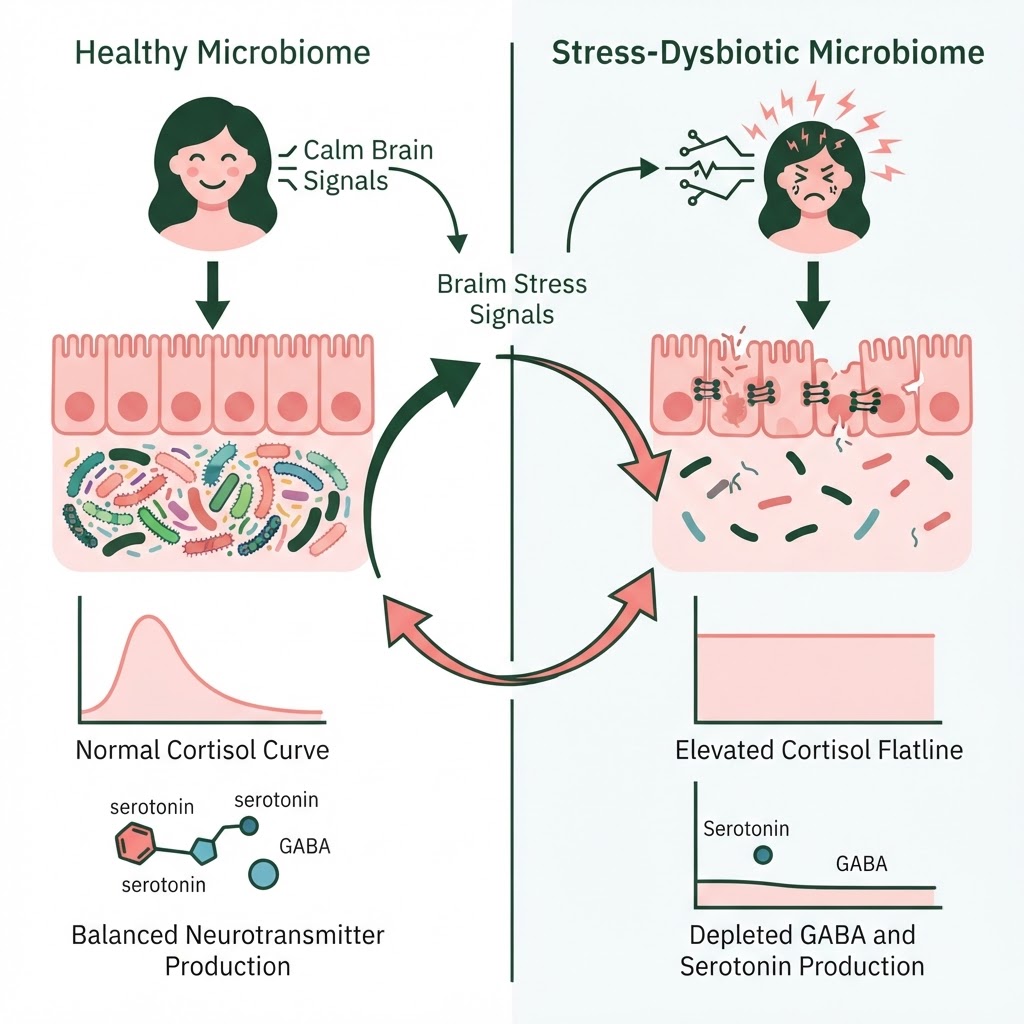
Dysbiosis refers to a state of microbial imbalance in the gut — too many harmful bacteria, not enough beneficial ones, or a loss of the diversity that makes a healthy microbiome resilient. Chronic stress is one of the most reliable drivers of dysbiosis, operating through the cortisol mechanisms described above as well as through behavioural changes (disrupted sleep, poor dietary choices, increased alcohol consumption) that commonly accompany prolonged anxiety.
What Dysbiosis Looks Like in Practice
Women with dysbiosis often report a constellation of symptoms that can be bewildering because they seem unrelated:
- Digestive symptoms: bloating, gas, alternating constipation and diarrhoea, abdominal discomfort
- Immune dysregulation: frequent colds, UTIs, thrush, or slow recovery from illness
- Mental health: persistent low mood, heightened anxiety, difficulty concentrating
- Hormonal issues: worsening PMS, irregular cycles, oestrogen dominance symptoms
- Metabolic signs: unexplained weight gain, sugar cravings, fatigue after meals
- Skin: breakouts, rosacea flares, dullness
What's particularly insidious is that dysbiosis itself elevates cortisol and inflammatory signalling — creating a self-reinforcing loop. Stress causes dysbiosis; dysbiosis amplifies the stress response. Breaking this cycle requires intervention at multiple points.
The Oestrobolome Connection
For women specifically, there is an additional layer of complexity. A subset of gut bacteria called the oestrobolome is responsible for metabolising and recycling oestrogen. When dysbiosis reduces or disrupts these bacteria, oestrogen metabolism becomes erratic — contributing to hormonal imbalances that affect everything from menstrual health to menopausal symptom severity. This is a uniquely female dimension of the stress-gut-microbiome story that is only now receiving the research attention it deserves.
4. GABA, Anxiety and the Microbial Missing Link
One of the most fascinating — and clinically important — findings in gut-brain research over the past decade concerns GABA (gamma-aminobutyric acid), the brain's primary inhibitory neurotransmitter. GABA is the neurochemical that tells your nervous system to calm down. Low GABA activity is directly associated with anxiety, panic disorders, insomnia, and an overactive stress response.
What researchers have discovered is that certain gut bacteria — particularly Lactobacillus and Bifidobacterium species — are capable of producing GABA directly within the gut. These bacteria synthesise GABA from glutamate, and via the gut-brain axis (primarily through vagal afferent signalling), this production influences brain GABA levels and activity.
"Lactobacillus rhamnosus (JB-1) was shown to alter GABA receptor expression in the brain and reduce anxiety-like behaviour in mice — an effect that was abolished when the vagus nerve was severed, confirming the gut-brain pathway." — Bravo et al., PNAS, 2011
Subsequent human research has reinforced this connection. A 2019 systematic review in Frontiers in Psychiatry found that probiotic supplementation with Lactobacillus and Bifidobacterium strains produced significant reductions in anxiety scores across multiple randomised controlled trials.
The implication is profound: when chronic stress depletes your populations of Lactobacillus and Bifidobacterium through dysbiosis, you are also potentially depleting your gut's capacity to support healthy GABA production — making you more anxious, which drives more cortisol, which causes more dysbiosis. Again: a vicious cycle.
This is precisely why the probiotic strain selection in Her-Biotics Original prioritises clinically studied Lactobacillus and Bifidobacterium strains alongside the nutrients that support their activity — because recovering your gut bacteria is inseparable from recovering your stress resilience.
5. Why Standard Probiotics Often Fail Stressed Women (And What's Different About SCO2 Technology)
If you've tried a probiotic before and felt it made little difference, you are not alone — and you are not imagining it. The majority of probiotic supplements on the market face a fundamental delivery problem: the bacteria they contain must survive the highly acidic environment of the stomach (pH 1.5–3.5) before they can reach the large intestine where they're needed. Standard probiotic capsules typically deliver only 0.1–1% of their labelled bacteria to the target site. The rest are destroyed by stomach acid.
This is the problem that our patented SCO2 (supercritical carbon dioxide) microencapsulation technology was developed to solve. By encapsulating each bacterial strain in a precision lipid matrix using supercritical CO2 — a process that operates at low temperatures to preserve bacterial viability — we achieve 1000× greater survival through the gastric environment compared to standard formulations.
In a stressed gut, where gastric conditions may be even more hostile and transit time unpredictable, this delivery advantage is not merely marginal — it's the difference between a supplement that works and one that doesn't.
You can read the full mechanism and the supporting research on our Science Page.
6. A Practical Framework for Breaking the Stress-Dysbiosis Cycle
Understanding the science is empowering, but what you actually need is a plan. Here is the evidence-informed framework I recommend to women navigating chronic stress and its gut consequences.
Step 1: Address the Nervous System First (Even Partially)
You don't need to eliminate stress from your life — that's neither realistic nor always desirable. But you do need to activate your parasympathetic nervous system regularly. The research-backed approaches include:
- Diaphragmatic breathing: Even 5 minutes of slow, deep breathing activates vagal tone and lowers cortisol measurably
- Cold water face immersion: Triggers the dive reflex, rapidly shifting the nervous system toward parasympathetic dominance
- Gentle movement: Yoga, walking in nature, and swimming have demonstrated cortisol-lowering effects in multiple RCTs
- Sleep prioritisation: Cortisol rhythm is governed by circadian biology — consistently poor sleep dysregulates the entire HPA axis
Step 2: Feed Your Bacteria Strategically
Your gut bacteria eat before you do — they ferment the fibre you can't digest, producing the short-chain fatty acids (SCFAs) that repair your gut lining, reduce inflammation, and modulate the immune system. A dysbiotic gut starved of fibre cannot recover, regardless of how many probiotics you take.
- Aim for 30 different plant foods per week (including herbs, spices, legumes, wholegrains, nuts, seeds, and vegetables) — this target is associated with significantly greater microbiome diversity in the American Gut Project data
- Prioritise fermented foods: kefir, yoghurt with live cultures, kimchi, sauerkraut, and kombucha introduce beneficial bacteria and their metabolites
- Reduce ultra-processed foods, refined sugar, and alcohol — all three are independently associated with dysbiosis and increased intestinal permeability
Step 3: Supplement Intelligently and Consistently
This is where targeted probiotic supplementation becomes genuinely valuable — not as a replacement for the steps above, but as a precision tool that accelerates microbiome recovery and maintains it under ongoing stress.
- If your primary concern is general gut health, immunity, and the stress-dysbiosis cycle, Her-Biotics Original provides the foundational 16-strain protocol with B-vitamins and antioxidant support
- If stress is manifesting as cyclical hormonal symptoms and PMS, Her-Biotics PMS Support adds Chasteberry, Magnesium Glycinate, and Vitamin B6 — nutrients with robust evidence for stress-related hormonal dysregulation
- If you're in perimenopause or menopause and finding that stress is amplifying symptoms, explore the full Shop All Formulas range for options tailored to your stage
Step 4: Monitor and Adjust
Microbiome recovery is not linear and is not the same for every woman. I recommend keeping a simple symptom journal for the first 8–12 weeks of any gut restoration protocol: noting energy, digestion, mood, skin, and sleep quality. Patterns that emerge will tell you far more than any single metric.
7. A Note on Anxiety as Both Cause and Consequence
I want to close the loop on something important, because I think it's easy to read an article like this and feel an additional layer of anxiety about your anxiety — a kind of health-worry spiral that is itself counterproductive.
The relationship between anxiety and gut dysbiosis is bidirectional, as we've established. But that bidirectionality is also good news: it means that intervening at the gut level can meaningfully improve anxiety symptoms, even when you haven't resolved the external stressors causing them. You have more leverage than you think.
Women who restore their microbiome frequently report — often before they expect it — improvements in mood, resilience, and a sense of calm that they hadn't associated with their gut health at all. This is the GABA connection made real. It is the gut-brain axis working for you instead of against you.
For more evidence-based content on women's gut health, hormones, and wellbeing, visit our Radiance Hub where I publish regularly.
Take the Next Step with Her-Biotics
If this article has resonated with you — if you recognise the pattern of chronic stress, digestive disruption, hormonal imbalance, and persistent low mood in your own experience — I want you to know that this is not simply your baseline. It is a state that can be changed, with the right support.
Her-Biotics Original was formulated specifically for women navigating the demands of modern life. With 16 clinically selected probiotic strains delivered via our patented SCO2 microencapsulation technology — ensuring 1000× greater viability than standard supplements — alongside B-vitamins, Vitamin C, E, and Zinc, it provides the comprehensive foundation your gut needs to begin recovering from chronic stress. Whether you're starting your gut health journey or rebuilding after a particularly difficult season, Her-Biotics Original is where I recommend beginning. Your microbiome is not a passive bystander in your health — it is an active participant. Give it the tools it needs to work for you.
Dr. Chomba Chuma is a medical doctor and the founder of Her-Biotics. All content is for informational purposes only and does not constitute individual medical advice. Please consult your healthcare provider before beginning any new supplement protocol.
Enjoyed this? Get the next one first.
Science made simple, delivered to your inbox. No spam, unsubscribe anytime.