

If you've ever wondered why a stressful week wrecks your digestion, or why your skin flares up right before your period, you've already met the gut-hormone axis. It's the constant, two-way conversation between the trillions of microbes living in your intestines and the hormones that regulate your mood, cycle, skin, sleep and energy.
This isn't a fringe idea — it's an active area of medical research. But it's rarely explained simply. So let's break down, in plain language, how your gut and your hormones are actually connected, and what that means for how you feel every single day.
"The gut microbiome is now recognized as an active endocrine organ, capable of producing, activating and regulating hormones throughout the body." — Journal of the National Cancer Institute (2016)
What Is the Gut-Hormone Axis, Really?
Think of your gut microbiome as a bustling internal chemistry lab. It doesn't just digest food — it manufactures compounds, breaks down hormones, and sends signals to your brain, ovaries, adrenal glands and thyroid.
This network is often called the gut-hormone axis, and it works in both directions:
- Your hormones shape your gut bacteria — estrogen and cortisol levels can change which microbial species thrive.
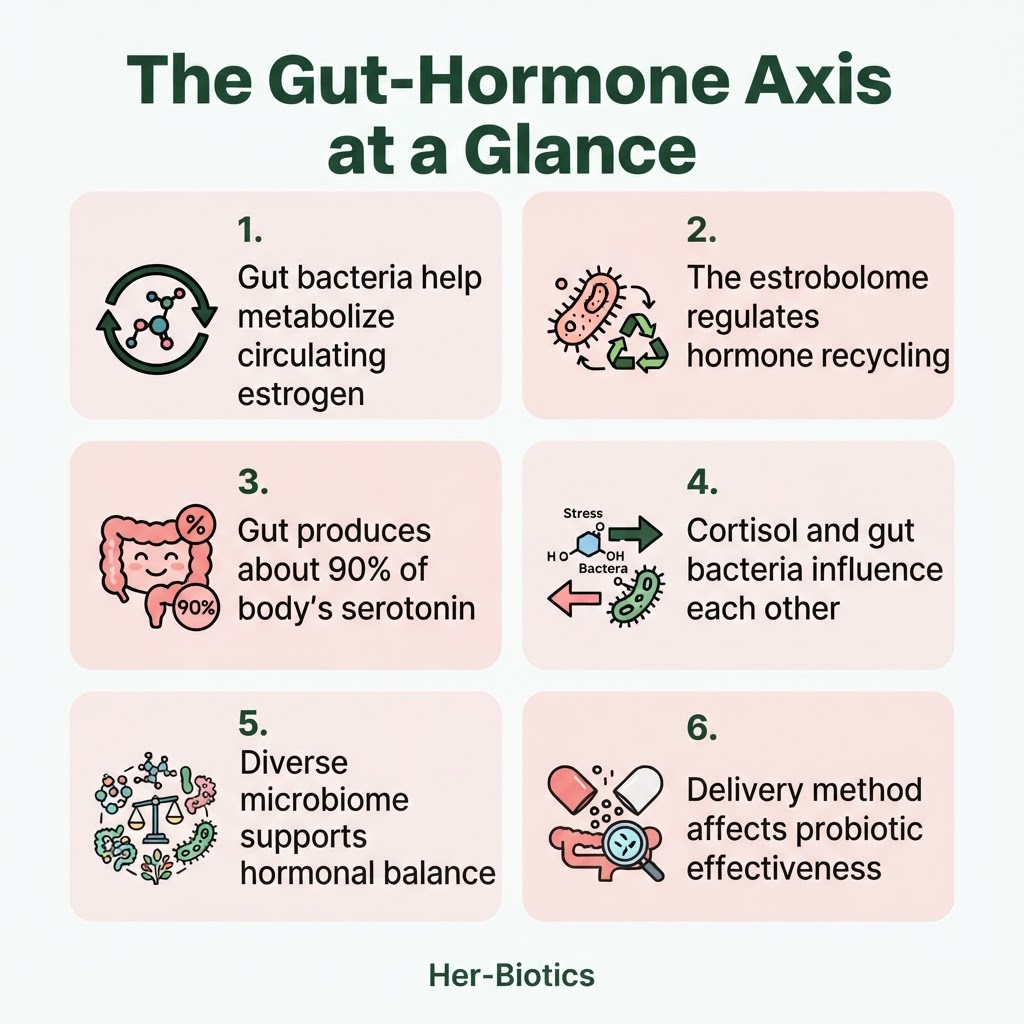
- Your gut bacteria shape your hormones — they help metabolize, recycle and even help regulate circulating hormone levels.
When this loop is balanced, you tend to feel steady: predictable cycles, stable moods, clear skin, decent sleep. When it's disrupted, the effects can show up almost anywhere in the body.
We've covered specific pieces of this puzzle before — how probiotics may help ease PMS symptoms and mood swings, and how gut bacteria relate to PCOS. This article is the bigger-picture map that ties those threads together.
Meet the Estrobolome: Your Gut's Estrogen Control Center
One of the most fascinating discoveries in women's health research is the estrobolome — a collection of gut bacteria genes specifically involved in metabolizing estrogen.
How it works
Here's the simplified version:
- Your liver processes used estrogen and sends it to the gut for elimination.
- Certain gut bacteria produce an enzyme called beta-glucuronidase.
- This enzyme can "reactivate" some of that estrogen, allowing it to recirculate back into the bloodstream instead of leaving the body.
When your microbiome is diverse and balanced, this process tends to stay in a healthy range. When bacterial diversity is low, this recycling can shift — potentially contributing to estrogen levels running higher or lower than what feels balanced for you.
"An altered gut microbiome may influence circulating estrogen levels, with implications for hormone-related health across a woman's lifespan." — Journal of the National Cancer Institute (2016), PubMed
This is one reason the topics of gut health and hormonal balance keep showing up together — in PMS, in PCOS, and in menopause.
For a deeper dive specifically into the estrobolome and your cycle, see PMS and the Microbiome: How Gut Health Governs Your Cycle.
The Gut-Brain-Hormone Loop: Cortisol, Serotonin and Mood
Your gut isn't just an estrogen processing plant — it's also deeply wired into your nervous system through what's known as the gut-brain axis.
Here's what makes this so relevant to women's health specifically:
- About 90% of the body's serotonin (a key mood-regulating neurotransmitter) is produced in the gut, not the brain.
- The gut and brain communicate constantly via the vagus nerve, a direct physical connection.
- Gut bacteria can influence the production of short-chain fatty acids, which appear to affect inflammation and brain signaling.
At the same time, your stress hormone cortisol has a direct effect on gut bacteria diversity. Chronic stress tends to reduce the variety of beneficial bacteria, which may in turn affect serotonin production — creating a loop where stress affects your gut, and your gut affects your stress resilience.
"Bidirectional gut-brain signaling plays a role in stress reactivity, mood regulation and behavior." — NIH-supported research summarized by Mayo Clinic
We've explored this cycle in detail in Stress, Cortisol and the Gut: How Anxiety Is Destroying Your Microbiome (And What to Do About It). It's worth reading if you notice your digestion and your mood seem to rise and fall together.
How This Plays Out Across Your Life: Cycle, Skin, Sleep and Midlife
The gut-hormone axis doesn't just operate in the background — it shows up in visible, tangible ways throughout a woman's life stages.
During your menstrual cycle
Estrogen and progesterone naturally rise and fall each month, and your gut bacteria composition may shift right along with them. This is part of why bloating, cravings and mood can change so predictably. Eating in sync with these phases is something we cover in Cycle Syncing Nutrition: How to Eat for Your Hormonal Phases and Transform Your Health.
In your skin
Hormonal fluctuations and gut inflammation both appear to influence skin clarity, which is why breakouts often cluster around certain points in the cycle. We break this down further in The Gut-Skin Connection: How to Clear Acne and Eczema from the Inside Out.
At night
Gut bacteria help regulate the production of melatonin precursors, and poor sleep can, in turn, reduce microbial diversity — another two-way loop, explored in Sleep and Gut Health: The Bidirectional Relationship Every Woman Needs to Understand.
Through perimenopause and beyond
As estrogen production naturally declines, the estrobolome's role in managing what estrogen remains becomes even more relevant. This is discussed in Menopause and the Microbiome: How to Reduce Hot Flashes Naturally.
Signs Your Gut-Hormone Axis May Be Out of Sync
There's no single test that says "your gut-hormone axis is off," but certain patterns tend to cluster together. You might notice:
- Digestive symptoms (bloating, irregularity) that seem to track with your cycle
- Mood swings that feel disproportionate to what's actually happening in your life
- Skin changes that flare around specific hormonal phases
- Low energy or poor sleep that doesn't match your workload or stress level
- Sugar or carb cravings that intensify at predictable times
None of these are diagnostic on their own, and they can have many causes. If symptoms are persistent or severe, it's always worth speaking with a healthcare provider, since gut and hormone symptoms can overlap with conditions that deserve individual attention.
"Emerging evidence suggests the gut microbiome may be a meaningful, modifiable factor in women's hormonal and metabolic health." — Mayo Clinic, Expert Answers
Supporting the Gut-Hormone Connection Naturally
The encouraging part of this science is that the gut microbiome is one of the more responsive systems in the body — it shifts with diet, sleep, stress management and, for many women, targeted probiotic support.
A few evidence-informed habits that may help support this axis:
- Prioritize fiber diversity. A wide variety of plant fibers feeds a wider variety of beneficial bacteria. See Prebiotic Foods That Supercharge Your Probiotic Supplement for specifics.
- Manage stress intentionally. Since cortisol and gut bacteria influence each other, even small daily stress-reduction habits may support balance.
- Protect your sleep window. Consistent sleep timing appears to support both microbial rhythm and hormone regulation.
- Consider a targeted probiotic. Certain strains have been studied for their potential role in supporting estrogen metabolism and gut-brain signaling.
- Move your body regularly. Physical activity is associated with greater microbial diversity in several studies.
Of course, supplements are only as useful as their ability to actually survive digestion and reach the gut alive. That's the exact problem we set out to solve — you can read the full story in SCO2 Microencapsulation: Why Most Probiotics Never Reach Your Gut (And What We Did About It).
Why delivery matters as much as the strain
Most standard probiotic capsules lose the vast majority of their live cultures to stomach acid before they ever reach the intestines where they're needed. Our SCO2 microencapsulation process was specifically designed to protect probiotic strains through digestion, so more of them arrive where they can actually interact with your gut-hormone axis.
Your Simplest First Step
You don't need to overhaul your entire lifestyle overnight to start supporting your gut-hormone connection. The simplest first step is consistency: feeding your gut well, protecting your sleep, and giving your microbiome the daily support it needs to stay diverse and resilient.
Her-Biotics Original was formulated for exactly this — daily gut health support designed for energy, skin clarity and everyday hormonal balance, built on our SCO2 microencapsulation technology so the probiotics inside actually make it to your gut.
👉 Explore Her-Biotics Original or browse the full Her-Biotics collection to find the formula that matches where you are right now — whether that's cycle support, menopause, or active training.
And if you'd like ongoing, practical guidance on the gut-hormone connection delivered straight to your inbox, subscribe to the Her-Biotics newsletter below.
This article is for educational purposes and is not a substitute for personalized medical advice. Please consult a qualified healthcare provider about your individual symptoms or health history.
Sources:
- Kwa M, et al. "The Intestinal Microbiome and Estrogen Receptor-Positive Female Breast Cancer." Journal of the National Cancer Institute (2016). https://pubmed.ncbi.nlm.nih.gov/27509858/
- Mayo Clinic. "Gut bacteria: Do they affect body weight and health?" Expert Answers. https://www.mayoclinic.org/healthy-lifestyle/consumer-health/expert-answers/gut-bacteria/faq-20058230
- World Health Organization. "Menopause" Fact Sheet. https://www.who.int/news-room/fact-sheets/detail/menopause
Enjoyed this? Get the next one first.
Science made simple, delivered to your inbox. No spam, unsubscribe anytime.