
By Dr. Chomba Chuma, MD & Founder, Her-Biotics | September 11, 2026
If you've ever been jolted awake at 2 a.m. drenched in sweat, or felt a wave of heat crawl up your chest and flush your face in the middle of a meeting, you already know that hot flashes are one of the most disruptive symptoms of menopause. What you may not know is that the trillions of microorganisms living in your gut — your gut microbiome — are intimately involved in how severe those hot flashes are, how long they last, and whether natural strategies can meaningfully reduce them.
As a physician and the founder of Her-Biotics, I've spent years studying the intersection of women's hormonal health and the microbiome. The science emerging from this field is nothing short of revolutionary. In this article, I want to walk you through what we now understand about menopause, gut bacteria, phytoestrogens, and how evidence-based supplementation — including targeted probiotics — can offer real, measurable relief.
This is not about replacing medical care. This is about empowering you with knowledge and giving your body the foundational tools it needs to navigate this transition with more ease, resilience, and confidence.
1. What Actually Causes Hot Flashes — and Why Hormones Are Only Part of the Story
The textbook explanation for hot flashes is simple: declining estrogen levels disrupt the hypothalamus — the brain's thermostat — causing it to misread normal body temperature as overheating and triggering a heat-dissipation response. Blood vessels near the skin dilate, heart rate increases, and you flush and sweat.
But if falling estrogen were the only factor, every menopausal woman would experience hot flashes equally. Yet research shows enormous variation: some women have no hot flashes at all, while others experience 10 or more episodes per day for a decade. This disparity points to a more complex picture — one that increasingly implicates the gut.
The Hypothalamic Connection
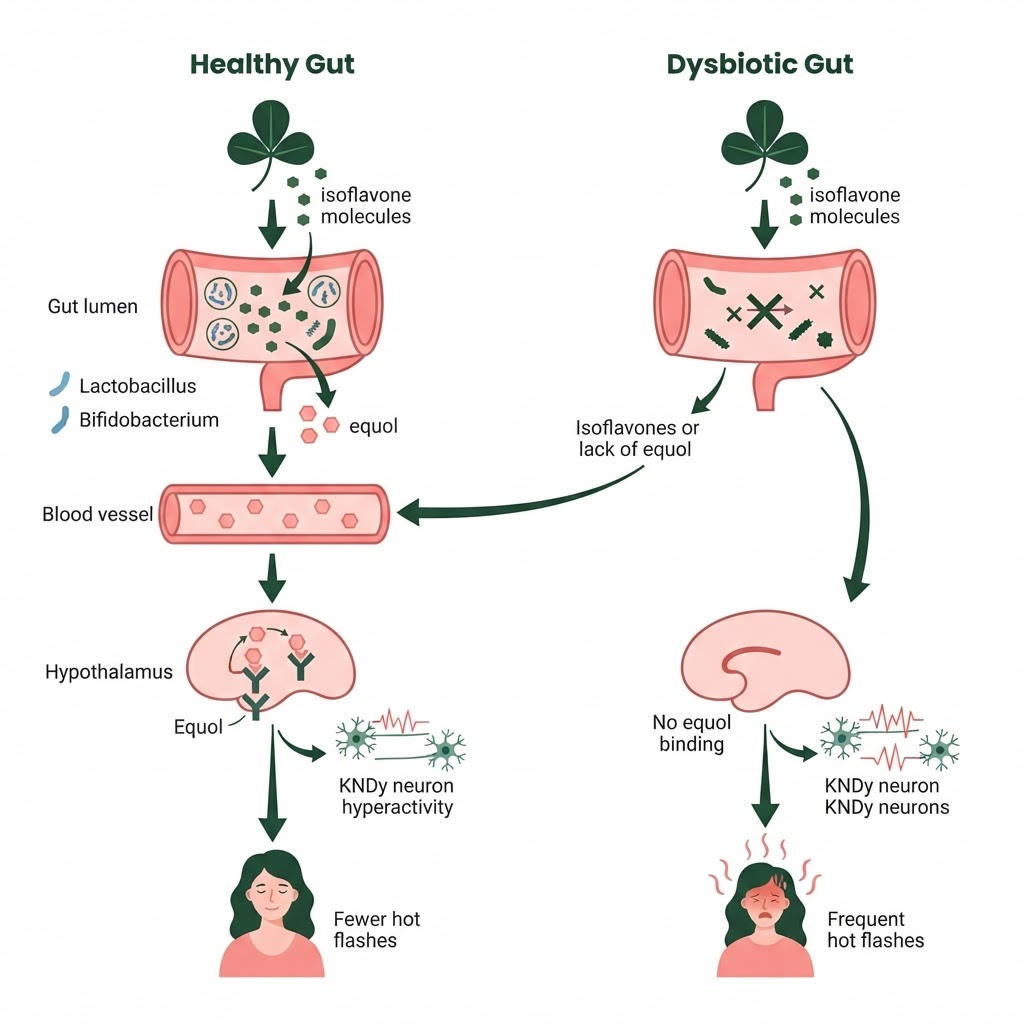
Recent neuroscience has refined our understanding of hot flashes considerably. We now know that a specific group of neurons in the hypothalamus — KNDy neurons (kisspeptin/neurokinin B/dynorphin neurons) — are directly regulated by estrogen. When estrogen falls, these neurons become hyperactive, firing signals that trigger the vasodilatory cascade we experience as a hot flash.
"The identification of KNDy neurons as the primary mediator of hot flashes has opened new therapeutic targets beyond hormone replacement — including the gut-brain axis." — Adapted from findings published in the journal Menopause, 2024
What connects KNDy neuron activity to the gut? Neurotransmitter balance, systemic inflammation, and estrogen metabolism — all of which are profoundly shaped by your gut bacteria.
2. The Estrobolome: Your Gut's Hidden Hormonal Laboratory
This is where the science becomes genuinely exciting. Within your gut microbiome lives a specific collection of bacterial species collectively called the estrobolome — bacteria that produce an enzyme called beta-glucuronidase, which plays a central role in estrogen metabolism and recirculation.
Here's how the process works:
- Your liver conjugates (packages) estrogens for excretion and sends them to the gut via bile.
- Beta-glucuronidase-producing bacteria deconjugate these estrogens, releasing free estrogen back into circulation.
- This reactivated estrogen is reabsorbed through the intestinal wall and re-enters the bloodstream.
- A healthy, diverse estrobolome helps maintain this cycle in balance — supporting optimal estrogen levels even as ovarian production declines.
A disrupted estrobolome means disrupted estrogen recycling. Studies have found that women with less diverse gut microbiomes — characterized by lower levels of Lactobacillus, Bifidobacterium, and Ruminococcus species — have lower circulating estrogen levels and report significantly more severe vasomotor symptoms, including hot flashes and night sweats.
According to research published by the National Institutes of Health, postmenopausal women with higher gut microbial diversity show more favorable estrogen metabolite profiles, suggesting that microbiome-targeted interventions may modulate menopause symptom severity. Read the study →
This is why a probiotic formulated specifically for hormonal health isn't a gimmick — it's a physiologically rational intervention.
How Gut Dysbiosis Amplifies Menopausal Symptoms
Menupause itself accelerates gut dysbiosis. As estrogen falls, the intestinal lining becomes more permeable (a phenomenon sometimes called "leaky gut"), inflammatory cytokines increase, and populations of beneficial bacteria decline. This creates a vicious cycle:
- Lower estrogen → gut dysbiosis
- Gut dysbiosis → impaired estrogen recycling → lower estrogen
- Increased intestinal permeability → systemic inflammation → worsened hot flashes
Breaking this cycle requires addressing the microbiome directly — not just the hormones.
3. Phytoestrogens: Plant Compounds That Work With Your Gut Bacteria
Phytoestrogens are plant-derived compounds that weakly mimic estrogen in the body by binding to estrogen receptors — particularly estrogen receptor beta (ERβ), which is abundant in the hypothalamus, bones, blood vessels, and bladder. Unlike synthetic estrogens, phytoestrogens act as selective modulators, providing estrogenic effects in some tissues while being neutral or even anti-estrogenic in others.
The most studied phytoestrogen classes relevant to menopause are:
- Isoflavones (found in soy, red clover) — converted to the active compound equol by specific gut bacteria
- Lignans (found in flaxseed, sesame) — converted to enterolactone and enterodiol in the gut
- Coumestans (found in sprouts and legumes)
The Equol Advantage — and Why Not Everyone Gets It
Here's a fascinating detail that most women never hear: the benefits of isoflavones (particularly from red clover) depend almost entirely on whether your gut bacteria can convert the precursor compound daidzein into equol — a more potent, bioavailable phytoestrogen.
Research shows that only 25–35% of Western women are "equol producers," compared to 50–60% of Asian women — a difference largely attributed to gut microbiome composition shaped by diet. Equol producers consistently report fewer and less severe hot flashes in clinical studies.
A landmark meta-analysis in Maturitas found that women who were equol producers experienced a 58% greater reduction in hot flash frequency from isoflavone supplementation compared to non-producers. View research summary →
This is precisely why combining phytoestrogens with targeted probiotics makes clinical sense: the probiotics help cultivate the gut environment needed to activate phytoestrogen benefits. It's not enough to take the plant compounds alone — you need the microbial machinery to unlock them.
4. Black Cohosh, Sage Leaf, and the Botanical Evidence Base
Beyond phytoestrogens, several botanical compounds have demonstrated meaningful efficacy for hot flash reduction through mechanisms that are distinct — and importantly, complementary.
Black Cohosh (Actaea racemosa)
Black Cohosh is arguably the most researched botanical for menopausal symptom relief. Despite early assumptions that it acted estrogenically, modern research reveals a more nuanced picture: Black Cohosh appears to act primarily on serotonin receptors and dopaminergic pathways in the hypothalamus — directly modulating the thermoregulatory dysfunction that drives hot flashes.
Key findings from clinical research:
- A 12-week randomized controlled trial found Black Cohosh reduced hot flash frequency by up to 47% compared to placebo
- Effects on mood, sleep quality, and vaginal dryness were also documented
- It does not appear to stimulate estrogen-sensitive tissues (breast, uterus), making it relevant even for women who cannot use HRT
- Onset of action is typically 4–8 weeks with consistent use
Important caveat: quality and standardization matter enormously with Black Cohosh. Products should be standardized to triterpene glycosides — the active constituent class — at validated doses.
Sage Leaf (Salvia officinalis)
Sage has been used for centuries for excessive sweating, and modern research is catching up to traditional wisdom. Sage leaf appears to work through acetylcholine receptor modulation — reducing the nerve signal intensity that triggers sweating responses. A Swiss clinical study found that a standardized fresh sage extract reduced intense hot flashes by 64% over 8 weeks.
Red Clover Isoflavones
Red Clover provides a particularly rich and diverse isoflavone profile — including biochanin A, formononetin, daidzein, and genistein — making it a more comprehensive phytoestrogen source than soy alone. Clinical trials using 40–80 mg/day of red clover isoflavones have shown reductions in hot flash frequency ranging from 35–60%.
The synergy between Red Clover isoflavones and a healthy, probiotic-supported microbiome is, as discussed above, where the real magic happens.
5. The Role of Vitamin D3, K2, and the Gut in Menopausal Bone and Vascular Health
Hot flashes are the most visible symptom of menopause, but the underlying hormonal and microbiome shifts affect multiple body systems simultaneously. Two nutrients deserve particular attention in this context: Vitamin D3 and Vitamin K2.
Vitamin D3 and the Microbiome
Vitamin D receptors are expressed throughout the gastrointestinal tract, and Vitamin D plays an active role in regulating the composition and diversity of gut bacteria. Vitamin D deficiency — extremely common in menopausal women — is associated with:
- Increased intestinal permeability
- Higher levels of inflammatory cytokines (IL-6, TNF-α)
- Reduced populations of Lactobacillus and Bifidobacterium
Emerging data also suggests Vitamin D may modulate the hypothalamic-pituitary axis, potentially reducing thermoregulatory instability. Ensuring adequate D3 status is therefore relevant not just for bone protection, but for hot flash management as well.
Vitamin K2 (MK-7)
Vitamin K2 works synergistically with D3 to direct calcium into bones and away from arterial walls — critical during menopause when vascular calcification risk rises sharply. Additionally, K2 has been shown to support gut microbiome balance by modulating the oxidation-reduction environment in the intestinal lumen.
The combination of D3 and K2 in a menopause-specific formula is not cosmetic — it addresses the systemic vulnerability that accompanies estrogen decline.
6. Why Standard Probiotics Fall Short — and What SCO2 Technology Changes
By this point, you may be wondering: if gut bacteria are so central to menopausal health, why hasn't taking a standard probiotic helped? The answer lies in viability and delivery.
Most probiotic supplements use conventional encapsulation or no encapsulation at all. By the time a standard probiotic capsule survives stomach acid, bile salts, and digestive enzymes, studies estimate that less than 1% of the original bacterial load reaches the colon alive. You're essentially paying for dead bacteria.
SCO2 (Supercritical Carbon Dioxide) microencapsulation — the patented technology at the heart of every Her-Biotics formula — works differently. Using pressurized CO2 in a supercritical state, each individual bacterial cell is coated in a protective lipid matrix at the microscopic level. This shield:
- Resists stomach acid (pH as low as 1.5) and bile salt degradation
- Maintains bacterial viability at room temperature without refrigeration
- Dissolves precisely in the alkaline environment of the lower intestinal tract — where the bacteria are needed
- Delivers 1000× more viable bacteria to the gut compared to standard encapsulation methods
For the estrobolome to function optimally, for equol production to occur, and for the anti-inflammatory bacterial metabolites that modulate hot flash pathways to be synthesized — the bacteria must arrive alive, in sufficient numbers, in the right location. SCO2 technology makes this possible in a way that standard probiotics simply cannot.
You can learn more about the science behind this delivery system on our Science Page.
7. Building Your Natural Hot Flash Protocol: A Practical Framework
Combining everything we've covered, here is a clinically informed framework for addressing hot flashes through a gut-microbiome-centred approach:
Dietary Foundations
- Increase fermented foods: yoghurt, kefir, kimchi, sauerkraut, miso — these seed the gut with beneficial bacteria
- Prioritize phytoestrogen-rich foods: edamame, tempeh, flaxseed, chickpeas, lentils
- Reduce ultra-processed foods and refined sugars: these selectively feed pro-inflammatory bacterial species
- Increase dietary fibre: prebiotic fibres (inulin, FOS) from garlic, onions, leeks, and asparagus feed the beneficial bacteria you're cultivating
- Limit alcohol: even moderate alcohol consumption significantly disrupts estrobolome function
Lifestyle Levers
- Sleep hygiene: poor sleep worsens hypothalamic dysregulation — prioritize 7–9 hours
- Resistance training: shown to reduce hot flash frequency and improve gut microbiome diversity
- Stress management: chronic cortisol elevation directly damages the intestinal lining and depletes Lactobacillus populations
- Core temperature management: cooling strategies (layering clothing, cooling pillow inserts) don't address root cause but meaningfully improve quality of life during the transition
Targeted Supplementation
For comprehensive, science-backed support that addresses both the microbiome and the hormonal dimensions of menopause, consider a formula specifically designed for this life stage — not a generic probiotic, and not isolated botanicals, but an integrated system.
You can also explore our full range of women's health formulas at Shop All Formulas or read more evidence-based articles in our Radiance Hub.
8. Her-Biotics Menopause Support: Designed Around the Science
Her-Biotics Menopause Support brings together every element of the science discussed in this article into a single, precisely formulated supplement:
The Probiotic Foundation (via SCO2 Technology): 16 clinically selected strains — including Lactobacillus reuteri, L. rhamnosus, L. acidophilus, Bifidobacterium longum, and B. breve — delivered with 1000× greater gut viability, specifically chosen to support estrobolome function and equol-producing capacity.
The Botanical Complex:
- Black Cohosh (standardized to 2.5% triterpene glycosides) — hypothalamic thermoregulation support
- Red Clover Isoflavones (standardized to 8% isoflavones) — phytoestrogen precursors for equol production
- Sage Leaf Extract (standardized to 1.5% rosmarinic acid) — sweating and hot flash intensity reduction
The Nutritional Matrix:
- Vitamin D3 (2000 IU) + K2 (MK-7, 100 mcg) — bone, vascular, and microbiome support
- Magnesium Glycinate — sleep quality and muscle relaxation
- Full B-vitamin complex for energy and neurological resilience
Every ingredient is present at doses that reflect clinical research, not token amounts added for label appeal. And because of our SCO2 delivery system, the probiotic strains that activate your phytoestrogen benefits actually reach your gut in viable, functional form.
A Final Word from Dr. Chomba Chuma
Menopause is not a disease. It is a profound biological transition — one that, with the right support, can be navigated with far more grace than our culture has traditionally led women to expect. The emerging science around gut bacteria, the estrobolome, and natural compounds like phytoestrogens and Black Cohosh gives us a genuinely exciting toolkit that goes beyond simply managing symptoms and instead addresses underlying physiology.
You deserve to understand what's happening in your body at this level. And you deserve a supplement formulated to match that understanding.
Ready to support your gut, your hormones, and your comfort through menopause? Explore Her-Biotics Menopause Support today — and give your microbiome the tools it needs to work for you, not against you. If you're earlier in your hormonal journey and curious about other formulas in our range, our Her-Biotics Original and Her-Biotics PMS Support offer targeted support for earlier life stages. Every formula is built on the same SCO2 foundation — because every stage of your health deserves the best possible delivery.
Dr. Chomba Chuma, MD, is a women's health physician and the founder of Her-Biotics. She specializes in the intersection of hormonal health, gut microbiome science, and integrative medicine. This article is for informational purposes and does not constitute medical advice. Please consult your healthcare provider before beginning any new supplement regimen, particularly if you have a history of hormone-sensitive conditions.
Enjoyed this? Get the next one first.
Science made simple, delivered to your inbox. No spam, unsubscribe anytime.