

You've decided a probiotic might help your gut, skin, mood, or cycle. Good instinct. But here's the question most women never get a straight answer to: what is actually in the capsule, and does it matter which strains you pick?
The short answer is yes. Probiotic strains are not interchangeable, and the name on the label (not just the word "probiotic") determines what a supplement can realistically do for your body. This guide walks through the her-biotics ingredients strains lineup in plain language, so you can make an informed, transactional decision instead of guessing.
If you haven't yet, it's worth reading our Best Probiotic Strains for Women: A Science-Backed Guide to Choosing What Actually Works first — this article builds directly on that foundation.
Why the Strain Name on the Label Is the Whole Story
Most shoppers glance at the front of a probiotic bottle, see a big CFU (colony-forming unit) number, and assume bigger means better. It doesn't work that way.
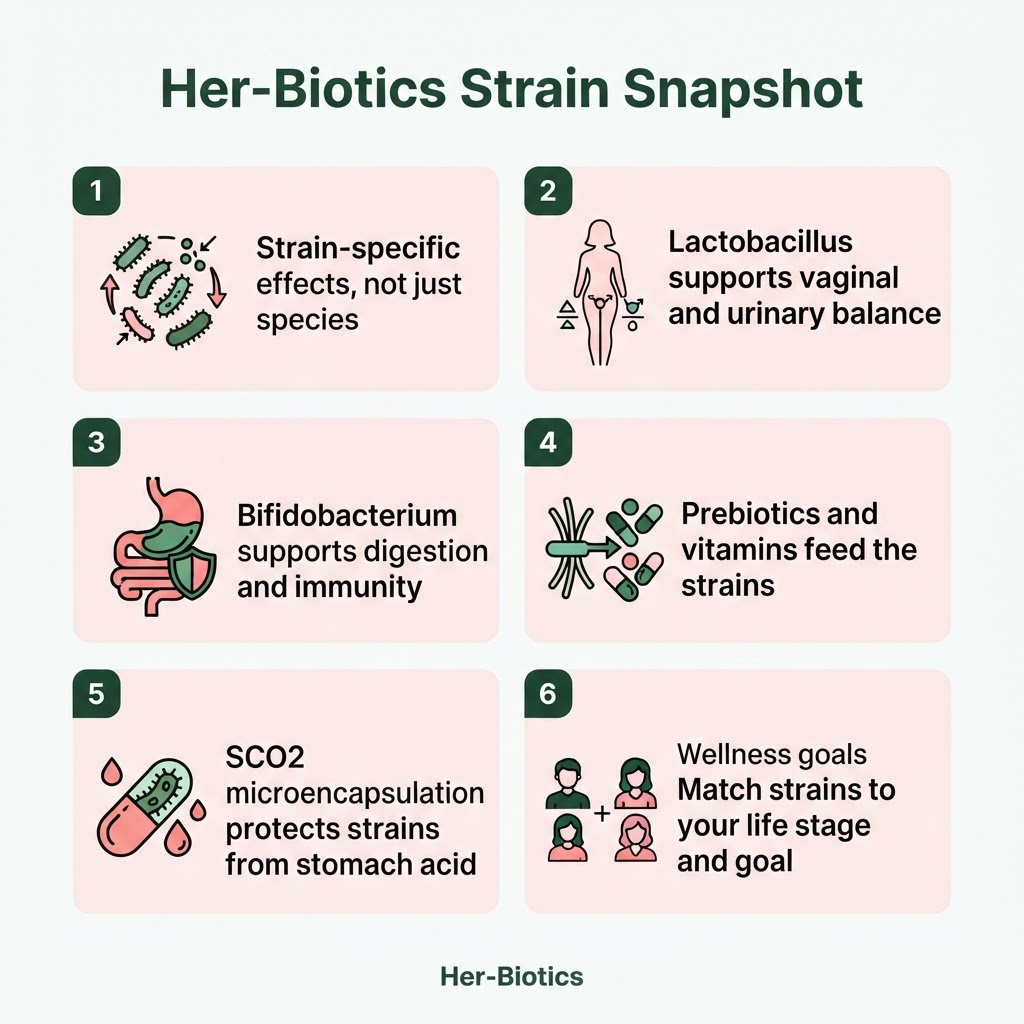
Probiotic research is strain-specific, not species-specific. That means Lactobacillus rhamnosus GG behaves differently than Lactobacillus rhamnosus GR-1, even though they share a species name. Benefits documented for one strain cannot be assumed for another, even a close cousin.
"Probiotics are live microorganisms that, when administered in adequate amounts, confer a health benefit on the host — but this benefit must be demonstrated for the specific strain in question." — FAO/WHO Joint Expert Consultation on Probiotics, 2006
This is why Her-Biotics formulas are built around named, researched strains rather than a vague "probiotic blend." When you know the strains, you know what you're actually paying for.
Here's what strain specificity means in practice:
- Different strains colonize different areas — some favor the small intestine, others the colon, others the vaginal microbiome.
- Different strains produce different compounds — short-chain fatty acids, B vitamins, or signaling molecules that interact with hormones.
- Clinical results don't transfer automatically between strains, even within the same bacterial family.
For a deeper look at how gut bacteria actually talk to your hormones, see our piece on the Gut and Hormones Connection in Women Explained.
The Core Strains Inside a Women's Probiotic Formula
Women's probiotic blends are typically built from a handful of well-studied genera, each contributing something different. Here's how the main categories break down.
Lactobacillus Strains for Vaginal and Urinary Balance
Lactobacillus species are the dominant bacteria in a healthy vaginal microbiome. Strains such as L. rhamnosus and L. reuteri have been studied for their association with a balanced vaginal pH and healthy urogenital flora.
- Help maintain the naturally acidic environment that supports vaginal health
- Associated with a more balanced microbial ecosystem during and after antibiotic use
- Often paired together because they've been studied as a duo in women's health research
Bifidobacterium Strains for Digestive and Immune Support
Bifidobacterium lactis and Bifidobacterium longum are among the most researched strains for general digestive comfort and immune-related gut function.
- May help support regularity and reduce occasional bloating
- Associated with a more diverse, resilient gut ecosystem
- Play a role in maintaining the gut lining, which is closely tied to immune signaling
Specialty Strains for Mood and Skin
Some strains, often called "psychobiotics," have been studied for their relationship with the gut-brain axis and stress response, while others are studied for skin-related markers via the gut-skin connection.
- Lactobacillus plantarum and Lactobacillus paracasei appear in research exploring mood and stress resilience
- Certain Bifidobacterium strains are studied for their association with skin hydration and inflammatory markers
- These additions are why a well-formulated women's probiotic looks different from a generic, unisex one
For the full picture on mood-related strains, our article on How Probiotics Reduce PMS Symptoms and Hormonal Mood Swings goes deeper into the gut-brain mechanism.
Beyond Bacteria: Prebiotics, Vitamins and Cofactors
Strains don't work in isolation. A well-designed formula feeds the bacteria you're swallowing and supports the systems those bacteria influence.
Common supporting ingredients in women's probiotic formulas include:
- Prebiotic fibers (like inulin or FOS) that act as food for beneficial bacteria
- Vitamin D and B vitamins, which interact with gut and immune function
- Iron or magnesium, depending on the formula's focus (common in active-lifestyle blends)
- Cranberry or D-mannose extracts in urinary-focused formulas
If you want to maximize what you're already taking, our guide to Prebiotic Foods That Supercharge Your Probiotic Supplement is a useful companion read.
Why Strain Count Means Nothing Without Delivery
Here's the part most labels conveniently leave out: most oral probiotics lose the majority of their live bacteria to stomach acid before they ever reach the gut. You can have the perfect strain list and still get a disappointing result if the organisms don't survive the trip.
"Survival through gastric transit is one of the central technical challenges in probiotic delivery — viability at the point of consumption does not guarantee viability at the site of action." — Journal of Functional Foods, peer-reviewed probiotic delivery research
This is the exact problem Velobiotics set out to solve. Our SCO2 microencapsulation process protects each strain inside a stable shell engineered to survive stomach acid and release in the intestine, where it actually counts. You can read the full science behind it in SCO2 Microencapsulation: Why Most Probiotics Never Reach Your Gut.
In other words, the strain list on the label is only half the equation. Delivery technology is the other half — and it's the half most competitors don't talk about.
Matching Strains to Your Life Stage and Goal
Different life stages call for different strain emphasis. Here's a practical way to think about it:
If your main concern is cycle-related bloating, cravings, or mood swings:
- Look for formulas emphasizing Lactobacillus strains studied alongside mood and digestive comfort
- Related reading: PMS and the Microbiome: How Gut Health Governs Your Cycle and Cycle Syncing Nutrition
If you're navigating perimenopause or menopause:
- Formulas often add strains and nutrients studied in relation to bone density and temperature regulation support
- Related reading: Menopause and the Microbiome: How to Reduce Hot Flashes Naturally
If you're managing PCOS or broader hormonal balance:
- Strain diversity and prebiotic support become especially relevant
- Related reading: PCOS and the Microbiome: A Root-Cause Approach to Hormonal Balance
If you're an active woman focused on recovery and iron status:
- Sport-focused blends often include strains studied for nutrient absorption support
- Related reading: Female Athlete Gut Health: How the Microbiome Drives Sports Performance, Recovery, and Iron Absorption
If you're over 50 and focused on long-term vitality:
- Formulas typically shift toward strains studied alongside cardiovascular and cognitive markers
- Related reading: Ageless Beauty After 50: How Your Gut Microbiome Holds the Secret to Longevity and Radiance
This is also where stress plays a quiet but real role in how well any strain performs — see Stress, Cortisol and the Gut: How Anxiety Is Destroying Your Microbiome for the mechanism.
How to Read Any Probiotic Label Like a Scientist
Next time you're comparing products — ours or anyone else's — run through this checklist:
- Are strains named specifically (genus, species, and strain code), or just listed as "probiotic blend"?
- Is there a stated CFU count at time of manufacture, not just "at time of production" with no expiry data?
- Is there any delivery technology protecting the strains from stomach acid?
- Are the strains relevant to your actual goal, or just generically labeled "for women"?
- Is there third-party testing or transparency about sourcing?
According to the Mayo Clinic, probiotic effectiveness can vary considerably by product and individual, which is exactly why strain transparency matters so much for making an informed choice.
The NIH Office of Dietary Supplements similarly notes that research results for probiotics are often strain- and dose-specific, reinforcing that labels matter more than marketing claims.
Your Simplest First Step
You don't need to become a microbiologist to make a good decision — you just need a formula built on named, researched strains with a delivery system that actually gets them where they need to go.
Her-Biotics Original was designed around exactly that principle: a focused strain lineup, supportive prebiotics, and our SCO2 microencapsulation to help more of each strain survive the trip to your gut. It's a sensible daily starting point whether your priority is digestion, energy, or that steady, from-the-inside glow.
As always, if you're pregnant, nursing, managing a medical condition, or taking medication, check with your healthcare provider before starting any new supplement — probiotics may help support gut balance, but they are not a substitute for medical care.
Ready to see what's actually inside? Explore Her-Biotics Original or browse the full range at the Her-Biotics collection.
And if you'd like ongoing, science-backed guidance on strains, hormones, and gut health delivered straight to your inbox, subscribe to the Her-Biotics newsletter below.
Enjoyed this? Get the next one first.
Science made simple, delivered to your inbox. No spam, unsubscribe anytime.