

If you've typed "probiotics for bloating women reviews" into a search bar at 11pm, stomach tight and jeans undone, you're not alone. Thousands of women do this every single day, scrolling through five-star ratings that all start to blur together.
The problem isn't a lack of reviews. It's that most of them tell you almost nothing useful. "Changed my life!" doesn't tell you which strain worked, how long it took, or whether that woman's bloating was even hormonal, dietary, or stress-related in the first place.
This guide isn't another list of five-star testimonials. It's a practical framework for reading probiotic reviews like someone who actually understands gut health — so you can separate marketing noise from genuine, reproducible results.
Why Probiotic Reviews for Bloating Are So Hard to Trust
Bloating is one of the most commonly searched digestive complaints among women, and also one of the most commonly exploited in supplement marketing. It's subjective, fluctuates daily, and responds to dozens of variables — which makes it easy to claim credit for improvement that may have come from something else entirely.
A few reasons reviews get murky fast:
- Bloating has multiple causes. Hormonal shifts, food intolerances, stress, and slow motility can all look identical from the outside.
- The placebo effect is real. Studies consistently show meaningful symptom improvement in placebo groups for digestive complaints.
- Most reviews are unverified. Anyone can post "10/10 would buy again" without ever opening the bottle.
- Timing isn't reported. A review posted three days after purchase can't reflect gut microbiome changes, which typically take two to four weeks to show up meaningfully.
Understanding these blind spots is the first step toward reading reviews with a more critical, useful eye.
"Most probiotic trials show modest but measurable improvements in bloating and gas, typically appearing after two to four weeks of consistent use — not overnight." — National Center for Complementary and Integrative Health, NIH
What the Science Actually Says About Probiotics and Bloating
Before trusting any review, it helps to understand the baseline research. Several clinical trials have looked specifically at probiotic strains and bloating in women, and the findings are genuinely encouraging — though nuanced.
Certain strains, particularly in the Lactobacillus and Bifidobacterium families, have been associated with reduced bloating, gas, and abdominal discomfort in women with functional digestive symptoms. The Mayo Clinic's overview of probiotic research notes that results vary by strain, dose, and individual gut composition — which is exactly why generic reviews that don't mention strains are hard to act on.
A systematic review published via PubMed found that probiotic supplementation may help reduce bloating severity in women with functional gastrointestinal symptoms, particularly when taken consistently for several weeks. The key word is may — not will, and certainly not cures.
This matters because viability is everything. A probiotic strain studied in a lab capsule with 90% survival through stomach acid behaves very differently from the same strain in a supplement that loses most of its potency before reaching the gut. That's one reason we built our SCO2 Microencapsulation process — to close that gap between lab results and real-world experience.
For more on how bloating connects to gut imbalance more broadly, our guide on Bloating, IBS and Leaky Gut breaks down the mechanisms in plain language.
7 Red Flags That Signal a Misleading Review
Not all five-star reviews are dishonest — but many are unhelpful at best. Here's what to watch for.
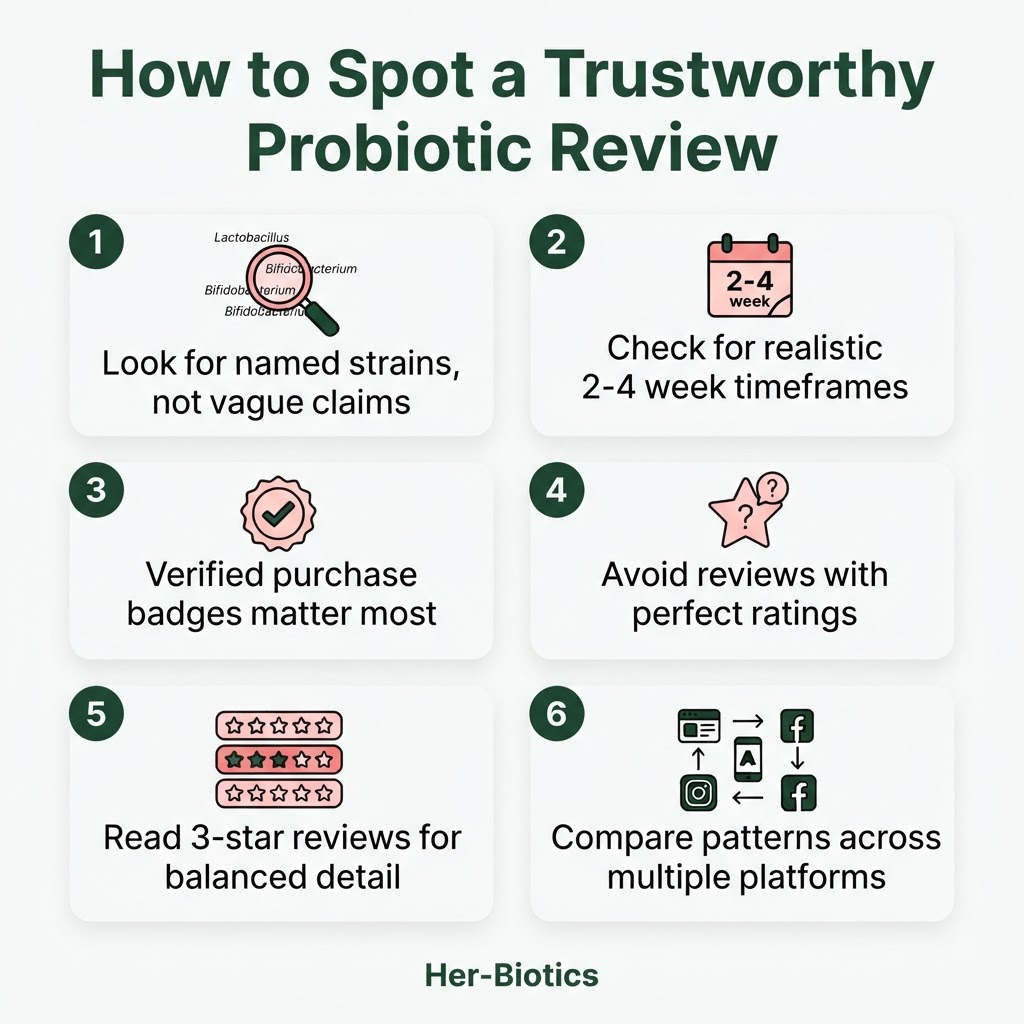
- No mention of a specific strain. "It has probiotics in it" tells you nothing. Genuine reviewers often reference the strain or at least the brand's labelled formula.
- Results claimed within 24–48 hours. Microbiome shifts take time. Overnight transformation claims are a red flag, not a win.
- Perfect, uniform language across multiple reviews. Repeated phrasing across "different" reviewers often signals incentivised or fabricated content.
- No mention of dosage or consistency. Someone who took it "a few times" isn't describing a real trial of the product.
- Absence of any neutral or mixed reviews. A 100% five-star rating, with zero three-star "it was fine" reviews, is statistically unusual.
- Vague before/after claims with no context. "My bloating is gone!" without mentioning diet, cycle timing, or stress levels is incomplete information.
- No verified purchase badge. Reviews without purchase verification are far easier to fabricate or incentivise.
"Consumer trust in supplement reviews should be proportional to specificity — vague praise is far less reliable than detailed, time-stamped reporting of symptoms and strain names." — Journal of Consumer Health on the Internet (2020)
The Questions Real Reviews Should Answer
When you're reading through probiotic reviews, use this mental checklist. A genuinely useful review usually answers most of these:
Did she mention a timeframe?
Look for phrases like "after three weeks" or "by day 20." This aligns with how long it typically takes for probiotic strains to establish and start influencing digestive symptoms.
Did she describe her starting point?
Someone who says "I'd been bloated daily for months despite cutting dairy and gluten" is giving you far more useful context than a one-line review.
Did she mention consistency?
Daily use matters. A review that casually says "I forgot most days but still felt better" is less credible than one describing a steady routine.
Did she connect it to her cycle, stress, or diet?
Women's bloating is often tied to hormonal fluctuation. If you want to understand this link more deeply, our piece on the gut and hormone connection explains why bloating often spikes at predictable points in the month.
Does the review read like it came from a real routine?
Mentions of water intake, fibre, sleep, or stress alongside the supplement suggest an honest, holistic account rather than a scripted testimonial.
How to Read Star Ratings Without Getting Fooled
Star ratings are useful, but only in context. Here's how to interpret them more accurately.
- Look at the distribution, not just the average. A 4.3-star rating with a wide spread of 5s and 2s is often more trustworthy than a suspiciously flat 4.9.
- Read the 3-star reviews first. These tend to be the most balanced and least emotionally charged, often containing the most practical detail.
- Check review dates. A sudden spike of five-star reviews in a short window can indicate a promotional push rather than organic feedback.
- Cross-reference platforms. Compare reviews across the brand's own site, retailer pages, and independent forums for consistency.
If you want a deeper breakdown of how Her-Biotics performs across real customer feedback, our dedicated page on Her-Biotics Probiotic Reviews walks through verified experiences alongside the clinical research behind each strain.
What Genuine Patterns Look Like Across Verified Reviews
Despite the noise, there are consistent, believable patterns that show up again and again in well-documented, verified reviews of probiotics for bloating:
- Gradual, not instant, relief — most women report noticeable change between week two and week four.
- Reduced bloating around the luteal phase — several reviewers specifically note improvement in the days before their period.
- Less reliance on other remedies — women mention needing fewer antacids, teas, or elimination diets over time.
- Improved regularity — more predictable bowel movements is one of the most frequently repeated, and most clinically plausible, outcomes.
- Skin and energy mentions — while secondary, many reviewers note improved skin clarity or steadier energy, which aligns with research on the broader gut-skin connection.
These patterns matter more than any single five-star post because they repeat across unrelated people, platforms, and timeframes — which is exactly what you'd expect from a biologically plausible effect rather than a marketing illusion.
If you'd like a shortcut to evaluating specific products sold locally, our no-nonsense buying guide for South African shoppers covers what to check on the label before you buy, and our breakdown of ingredient strains explains why strain specificity should influence your decision more than star ratings ever should.
It's also worth remembering that probiotics are one part of a bigger picture. Pairing supplementation with fibre-rich foods, consistent sleep, and stress management tends to produce better-reported outcomes — something our guide on debloating naturally covers in more depth.
A note on safety: probiotics are generally well tolerated, but individual responses vary, especially if you have an underlying digestive condition, are pregnant, or are immunocompromised. Always consult a healthcare provider before starting a new supplement, particularly if symptoms are severe or persistent.
Your Simplest First Step
You don't need to read another hundred reviews to make a confident decision. You need a formula that filters noise from substance — and now you have one.
Look for named strains, realistic timeframes, verified purchases, and a mix of ratings rather than a suspiciously perfect score. That's what separates a genuine result from a polished marketing claim.
If you're ready to experience the difference that properly protected, viable strains can make, explore Her-Biotics Original, formulated with SCO2 microencapsulation to support more live cultures reaching your gut where they matter most.
Or browse the full range at the Her-Biotics store and find the formula that matches your specific stage — whether that's daily digestion, PMS-related bloating, or menopause support.
And if you'd like ongoing, no-fluff guidance on women's gut health delivered straight to your inbox, subscribe to the Her-Biotics newsletter below — no hype, just the research and real talk you actually need.
Enjoyed this? Get the next one first.
Science made simple, delivered to your inbox. No spam, unsubscribe anytime.