

If your digestion has started acting like a stranger—bloating that wasn't there before, constipation one week and looseness the next, new reactions to foods you've eaten your whole life—you're not imagining it. Perimenopause gut changes are real, common, and directly tied to the hormonal shifts happening in your body right now.
This isn't about one symptom. It's about understanding the pattern so you're not caught off guard every time your body does something new. Let's walk through what's actually happening, when it tends to show up, and what you can realistically do about it.
Why Perimenopause Changes Your Gut in the First Place
Your gut has estrogen receptors. So does your gut lining, your gut muscles, and even many of the bacteria living in your digestive tract. When estrogen and progesterone start fluctuating—often years before your periods actually stop—your gut feels it almost immediately.
Three main systems get affected:
- Motility — how quickly or slowly food moves through your digestive tract
- The gut lining — the barrier that keeps digestion contained and nutrients moving in the right direction
- Microbial diversity — the variety and balance of bacteria living in your colon
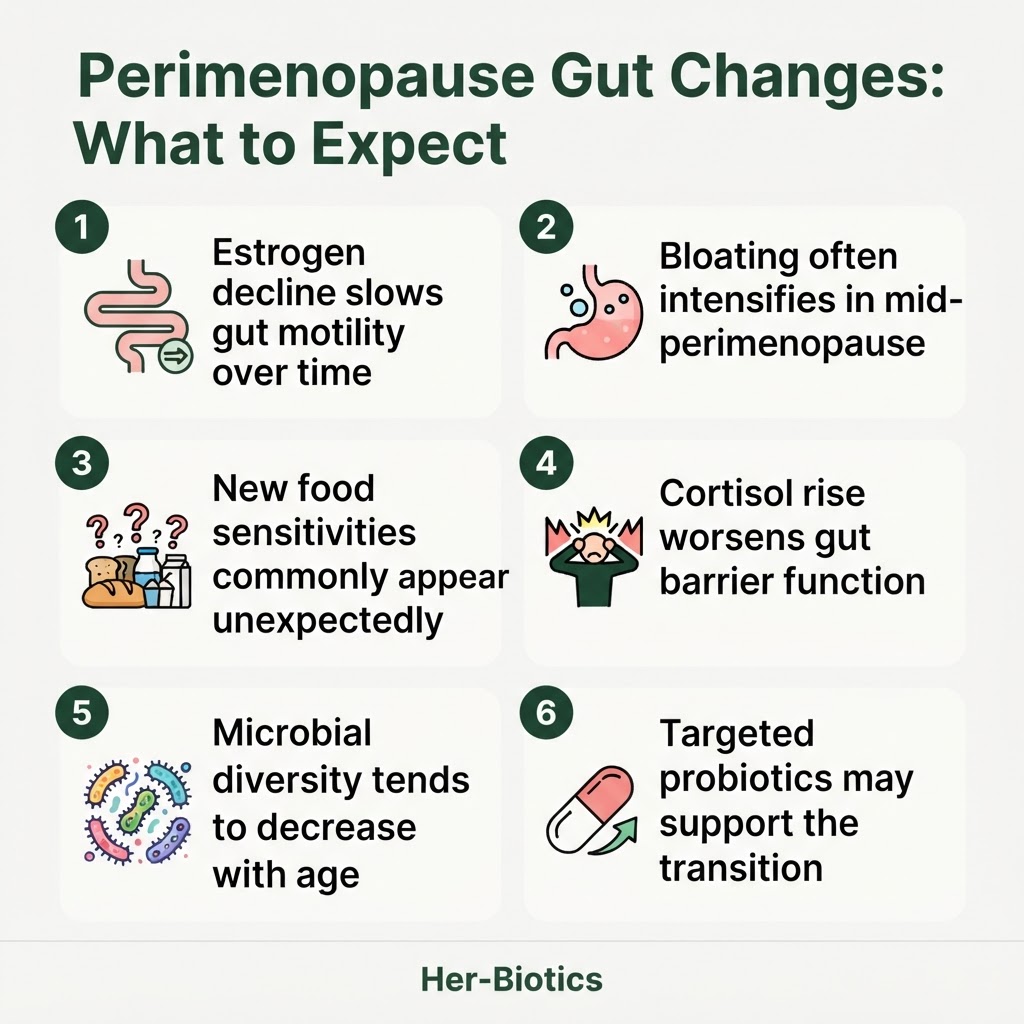
Estrogen helps regulate the speed of digestion. As levels become erratic, some women notice things slow down (hello, constipation), while others find things speed up unpredictably. Progesterone, which also fluctuates heavily in perimenopause, relaxes smooth muscle—including the muscle lining your gut—which is part of why bloating becomes more noticeable.
"Estrogen and progesterone fluctuations during the menopausal transition are associated with measurable changes in gastrointestinal motility and symptom reporting in women." — Climacteric (2019), peer-reviewed menopause research journal
For a deeper look at how hormones and gut bacteria talk to each other, our piece on the gut and hormones connection in women breaks down the mechanics in more detail.
The Perimenopause Timeline: What Shifts When
Perimenopause isn't a single event—it's a gradual transition that can last anywhere from four to ten years. Gut symptoms tend to track loosely with where you are in that window.
Early Perimenopause (Subtle Shifts)
This is often the stage where periods are still fairly regular, but you might notice:
- Slightly more bloating before your period than usual
- Mild changes in bowel regularity
- New sensitivity to foods that never bothered you before
These early signals are easy to dismiss because they're subtle. But they're often the first sign that hormone fluctuation has started.
Mid Perimenopause (More Noticeable Disruption)
Periods become less predictable, and so does digestion. Many women describe this as the stage where symptoms feel genuinely disruptive:
- Bloating that shows up daily, not just cyclically
- Alternating constipation and loose stools
- Increased gas or a feeling of "fullness" after small meals
- New or worsening acid reflux
If this sounds familiar, you may also want to read why bloating happens every afternoon—there's a daily rhythm element that often layers on top of the hormonal one.
Late Perimenopause (Closer to Menopause)
As estrogen drops more consistently (rather than just fluctuating), some women find certain symptoms stabilize, while others—particularly related to the gut lining and microbial diversity—can persist or intensify.
"Reduced gut microbial diversity has been observed in postmenopausal women compared to premenopausal women, with estrogen decline proposed as a contributing factor." — National Institutes of Health, PubMed-indexed review
The Specific Symptoms Worth Knowing About
Here's a practical rundown of what tends to show up, organized by what's actually driving it.
Bloating and gas Often linked to slower motility and shifts in the bacteria that produce gas during fermentation of fibers and sugars.
Constipation Falling progesterone and estrogen can both affect the smooth muscle contractions that move waste through your colon.
New food sensitivities Some women develop a lower tolerance for foods like dairy, gluten, or high-FODMAP vegetables during this stage—not because the food changed, but because gut sensitivity did.
Acid reflux Slower digestion and changes in the muscle at the top of the stomach can allow more backflow than before.
Changes in regularity or stool consistency Many women describe this stage as "unpredictable" rather than consistently one direction or another.
If you're dealing with ongoing fatigue alongside these digestive shifts, it's worth running through the broader list in Always Tired as a Woman? The Causes Checklist, since gut discomfort and low energy often travel together during this transition.
Why This Isn't "Just Stress" or "Just Getting Older"
It's tempting—for you and sometimes for the people you talk to about it—to chalk these changes up to stress or aging in general. But the hormone-gut connection here is specific and measurable.
Estrogen influences the estrobolome, the collection of gut bacteria responsible for metabolizing and recycling estrogen in your body. When estrogen fluctuates, this bacterial community shifts too, which can create a feedback loop: hormone changes affect gut bacteria, and gut bacteria changes affect how your body processes hormones. We cover this relationship in detail in How Gut Bacteria Affect Oestrogen in Women.
Cortisol also tends to rise during perimenopause as sleep becomes less reliable and the body manages more internal fluctuation. Elevated cortisol is independently linked to changes in gut motility and barrier function. If this sounds like it overlaps with midsection changes you've noticed too, Cortisol Belly Women explains that connection.
"Chronic stress and elevated cortisol are associated with increased intestinal permeability and altered gut microbial composition." — Mayo Clinic Proceedings, gastroenterology research summary
What You Can Actually Do About It
You can't stop hormone fluctuation—that's the nature of perimenopause. But you can support your gut's ability to adapt to it. Here's where to start.
Support Fiber and Microbial Diversity
- Aim for a wide variety of plant fibers across the week, not just one or two staples
- Include fermented foods like yoghurt, kefir, or sauerkraut where tolerated
- Introduce prebiotic fibers gradually to avoid overwhelming a sensitive gut
For specific food ideas that work alongside a probiotic routine, see Prebiotic Foods That Supercharge Your Probiotic Supplement.
Prioritize Sleep Where You Can
Sleep disruption is common in perimenopause and has a direct bidirectional relationship with gut health—poor sleep worsens gut symptoms, and gut imbalance can worsen sleep. Our article on Sleep and Gut Health goes deeper into this loop.
Move Your Body Regularly
Gentle, regular movement supports gut motility and may help ease the constipation many women experience in this stage. It doesn't need to be intense—walking after meals is a well-supported, low-effort habit.
Consider a Targeted Probiotic
Not all probiotics are created equal, and perimenopause is a period where strain specificity matters more, not less. Look for formulations designed with hormone-stage needs in mind—our guide on Best Probiotic Strains for Women walks through what to look for, and Best Probiotic for Women Over 40 narrows it down specifically for this life stage.
Her-Biotics Menopause Support was formulated with this exact transition in mind, combining targeted probiotic strains with ingredients that support hormonal balance and bone health as estrogen shifts. You can view the full formulation here: Her-Biotics Menopause Support.
When to See a Healthcare Provider
Most perimenopause-related gut changes are uncomfortable but not dangerous. That said, certain symptoms deserve a conversation with your doctor rather than a wait-and-see approach:
- Unexplained weight loss alongside digestive changes
- Blood in stool or persistent, severe abdominal pain
- Symptoms that disrupt daily life for more than a few weeks despite diet and lifestyle changes
- New symptoms that feel distinctly different from typical bloating or irregularity
The World Health Organization and Mayo Clinic both offer reliable overviews of what's typical during this transition versus what warrants medical attention. This article is intended as general information, not a replacement for personalized medical advice—please consult a healthcare provider about your specific symptoms.
If bloating specifically is your biggest daily frustration, our breakdown on debloating fast naturally offers same-day strategies you can layer on top of longer-term support.
Your Next Simple Step
You don't need to overhaul your entire routine overnight. The most useful thing you can do right now is start supporting your gut with consistency—through food, movement, sleep, and a probiotic formulated for exactly this stage of life.
Explore Her-Biotics Menopause Support to see how targeted strains and SCO2 microencapsulation technology are designed to actually survive the journey to your gut—or browse the full range at the Her-Biotics store to find the formula that matches where you are right now.
Want more guidance like this delivered straight to your inbox? Subscribe to the Her-Biotics newsletter below for practical, science-backed insights on gut health, hormones, and feeling like yourself again through every stage of this transition.
Enjoyed this? Get the next one first.
Science made simple, delivered to your inbox. No spam, unsubscribe anytime.