

If you've ever felt your stomach knot before a big meeting, or noticed your anxiety spikes right alongside digestive flare-ups, you've already experienced the gut-brain conversation firsthand. This isn't a coincidence or "just stress." It's a well-documented biological relationship — and women appear to feel it more acutely than men.
This article breaks down what researchers currently understand about the anxiety and gut health in women link, why female physiology adds extra layers to the story, and what you can realistically do to support both sides of the equation.
"The gut and the brain are in constant bidirectional communication, and disruptions to gut microbiota composition have been linked to altered stress reactivity and anxiety-like behaviour." — Foster & Neufeld, Trends in Neurosciences (2013)
You're Not "Just Anxious" — There's a Biological Conversation Happening
Anxiety has long been treated as something that lives purely in the mind. But a growing body of research suggests it's shaped just as much by what's happening in your digestive tract.
Your gut houses:
- Roughly 100 trillion microorganisms, collectively called the gut microbiome
- A dense network of nerve cells often called the "second brain" or enteric nervous system
- Cells that produce the majority of your body's serotonin, a neurotransmitter closely tied to mood regulation
When this ecosystem is out of balance, the signals travelling between gut and brain can shift — and for many women, that shift shows up as racing thoughts, restlessness, or a persistent sense of unease.
According to the World Health Organization, anxiety disorders affect women at notably higher rates than men globally. That disparity is part of what makes this gut-brain link so relevant specifically for female health.
Meet the Vagus Nerve: Your Gut's Direct Line to Your Brain
The vagus nerve is the longest cranial nerve in the body, running from your brainstem down through your neck, chest, and into your digestive organs. Think of it as a two-way information highway.
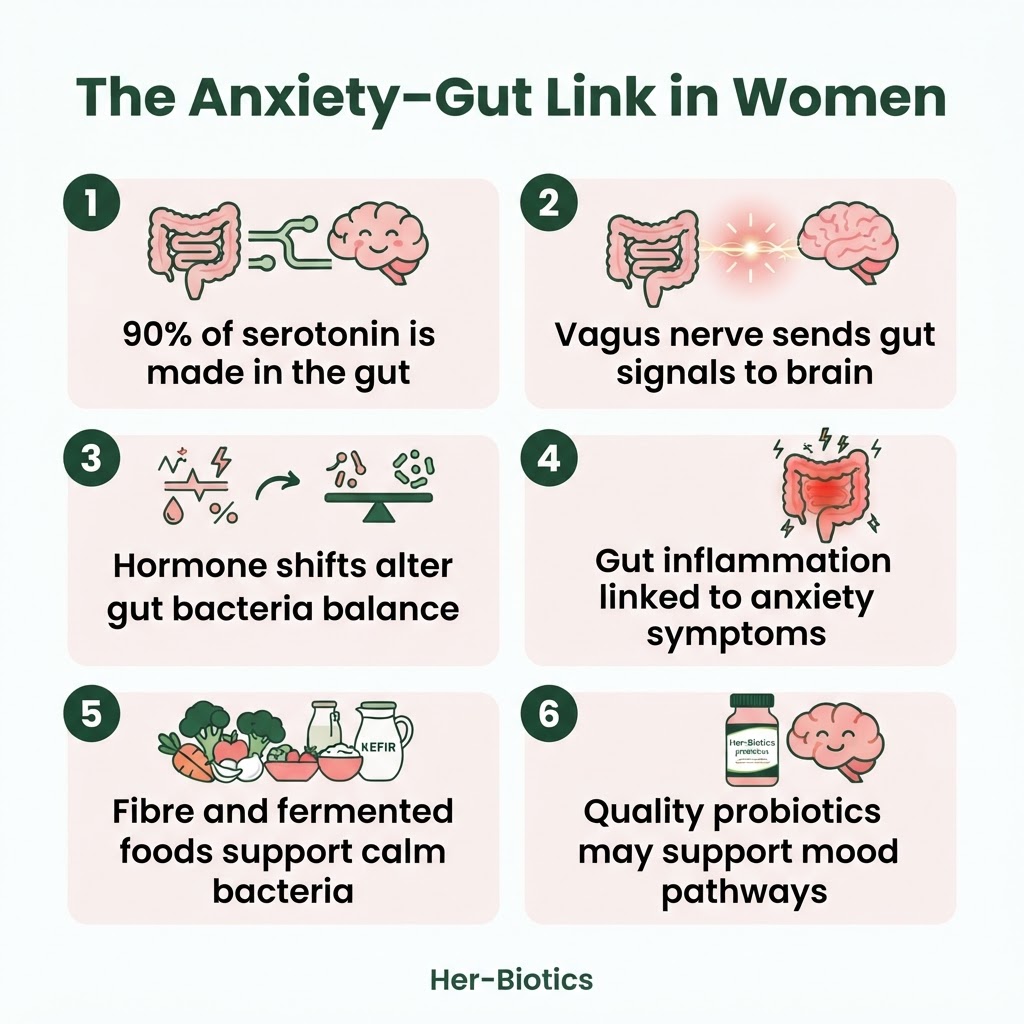
About 80–90% of the signals travelling along this nerve go from the gut to the brain, not the other way around. That means your gut isn't just a passenger receiving stress signals — it's actively sending information upward that can shape how anxious or calm your brain feels.
What influences vagal signalling:
- The diversity and balance of your gut bacteria
- Levels of inflammation in the gut lining
- How well food moves through your digestive tract
- Chronic stress and poor sleep patterns
If you've read our piece on Stress, Cortisol and the Gut: How Anxiety Is Destroying Your Microbiome (And What to Do About It), you'll know this relationship runs in both directions — anxiety disrupts the gut, and gut disruption can feed back into anxiety.
Serotonin and GABA: The Calming Chemicals Your Gut Helps Produce
Here's a fact that surprises most people: an estimated 90–95% of your body's serotonin is produced in the gut, not the brain. Certain gut bacteria strains are directly involved in this production process, alongside influencing levels of GABA, a neurotransmitter known for its calming, anxiety-reducing effects.
When the microbiome is diverse and well-balanced, it tends to support healthier levels of these mood-related compounds. When beneficial bacteria are depleted — through poor diet, antibiotic use, or chronic stress — this production line can be disrupted.
"Specific bacterial species can produce or stimulate the production of neurotransmitters such as GABA and serotonin, suggesting a plausible biological pathway between microbiota composition and anxiety-related behaviour." — Nature Reviews Neuroscience, Cryan & Dinan (2012)
This doesn't mean gut bacteria alone cause anxiety. But it does mean gut health is a meaningful piece of a much larger puzzle — one that's often overlooked in conversations about mood.
Why Women Carry a Heavier Load
Several factors converge to make this gut-anxiety relationship particularly relevant for women.
Hormones Add Another Layer
Oestrogen and progesterone both influence gut motility, gut permeability, and the composition of gut bacteria. As these hormones fluctuate across the menstrual cycle, pregnancy, and perimenopause, the gut environment shifts too — and so, often, does anxiety.
This is closely tied to the estrobolome, the collection of gut bacteria that help metabolise oestrogen. For a deeper dive into this mechanism, see How Gut Bacteria Affect Oestrogen in Women: Meet Your Estrobolome.
The Immune Connection
Women are statistically more likely to experience autoimmune and inflammatory conditions, many of which originate in or involve the gut. Since inflammation is increasingly recognised as a contributor to anxiety symptoms, this immune-gut overlap may partly explain why anxiety disorders are more common in women.
Research published via the National Center for Biotechnology Information highlights how gut-derived inflammatory markers are associated with anxiety-like symptoms in multiple studies — though researchers stress more work is needed to fully map these pathways in humans.
Signs Your Anxiety Might Have a Gut Component
Not all anxiety is gut-related, but certain patterns are worth paying attention to:
- Anxiety that worsens alongside bloating, constipation, or irregular digestion
- Mood dips that track closely with your menstrual cycle
- Anxiety flares after antibiotic courses or periods of poor eating
- Digestive symptoms that intensify during stressful periods
- A sense of "wired but tired" alongside gut discomfort
If several of these feel familiar, it may be worth looking at your gut health as part of a broader picture — alongside sleep, which plays its own major role, as explored in Sleep and Gut Health: The Bidirectional Relationship Every Woman Needs to Understand.
What You Can Actually Do About It
There's no single fix here, but there are several evidence-informed habits that may help support both gut balance and nervous system calm.
Feed the Calm-Supporting Bacteria
- Prioritise fibre-rich foods — vegetables, legumes, oats, and berries — which feed beneficial bacteria
- Include fermented foods like yoghurt, kefir, or sauerkraut where possible
- Limit ultra-processed foods and excess added sugar, which may favour less helpful bacterial strains
Support the Vagus Nerve Directly
- Slow, deep breathing (even 2–3 minutes) can stimulate vagal activity
- Gentle movement like walking or yoga may support both digestion and nervous system regulation
- Cold exposure, such as a brief cool shower, is sometimes used as a simple vagal-toning practice
Consider Targeted Probiotic Support
Certain probiotic strains have been studied specifically for their potential role in mood and stress response, often referred to informally as "psychobiotics." While research is still developing, choosing a high-quality, well-researched probiotic may be a sensible addition to a broader gut-support routine.
This is where delivery matters. Many probiotic capsules lose the majority of their live cultures to stomach acid before ever reaching the intestines where they're needed. Her-Biotics uses patented SCO2 microencapsulation specifically to protect probiotic strains through digestion — you can read more in SCO2 Microencapsulation: The Science Behind 1000× More Probiotics.
For daily, whole-body gut support that also touches on energy and skin, our Her-Biotics Original capsules are formulated as a practical starting point.
"Psychobiotic research is promising, but it remains an emerging field — probiotics should be viewed as a supportive measure alongside, not a replacement for, established anxiety management strategies." — Mayo Clinic patient education guidance
If your symptoms relate more specifically to cycle-driven mood changes, it may also help to read How Probiotics Reduce PMS Symptoms and Hormonal Mood Swings: The Gut-Brain Connection Explained.
When to See a Professional
Gut-support strategies can be a genuinely useful piece of the puzzle, but anxiety that's persistent, intense, or interfering with daily life deserves proper clinical attention. A healthcare provider can help rule out underlying conditions, discuss therapy options, and determine whether additional support — medical, nutritional, or psychological — is appropriate for your situation.
This article is intended for general education and does not replace personalised medical advice. Please consult your doctor or a qualified healthcare provider before making significant changes to your diet, supplement routine, or mental health care plan.
Start With One Gut-Supporting Step Today
You don't need to overhaul your entire life to begin supporting the anxiety and gut health in women link. Start small: add one fibre-rich meal, try two minutes of slow breathing, or introduce a quality daily probiotic into your routine.
Ready to take that first step? Explore the Her-Biotics Original capsules or browse the full Her-Biotics range to find the formula that matches where you are right now.
And if you'd like ongoing, practical gut-and-mood insights delivered straight to your inbox, subscribe to the Her-Biotics newsletter below — it's a simple way to stay informed on your terms.
Enjoyed this? Get the next one first.
Science made simple, delivered to your inbox. No spam, unsubscribe anytime.