

By Dr. Chomba Chuma, MD & Founder of Her-Biotics | July 27, 2026
Let me ask you something honest: have you ever spent good money on a probiotic supplement, taken it faithfully every morning, and quietly wondered whether it was actually doing anything at all?
You're not imagining things. The uncomfortable truth is that the majority of probiotic supplements on the market today are functionally ineffective — not because the bacteria inside them aren't beneficial, but because those bacteria never survive the journey to where they're needed most.
As a physician who has spent over a decade studying the female microbiome, and as someone who built Her-Biotics specifically to solve this problem, I want to walk you through the real science of probiotic delivery. Understanding this will completely change how you evaluate every probiotic you ever consider buying. It changed how I practise medicine — and it's ultimately why SCO2 microencapsulation technology was the non-negotiable foundation of everything we built at Her-Biotics.
The Probiotic Promise vs. The Probiotic Reality
Walk into any pharmacy or wellness shop and you'll see probiotic products boldly advertising 50 billion CFU, 100 billion CFU, even 500 billion CFU. CFU — Colony Forming Units — is the standard measurement of how many live bacteria a product contains at the time of manufacture.
Here's what those labels don't tell you:
- CFU counts are measured at manufacture, not at consumption
- By the time most products reach the consumer, bacterial viability has already dropped significantly due to heat, light, and moisture exposure during storage and shipping
- Even if you consume a product with its full CFU count intact, your stomach is a highly acidic environment with a pH of approximately 1.5 to 3.5 — roughly the acidity of battery acid
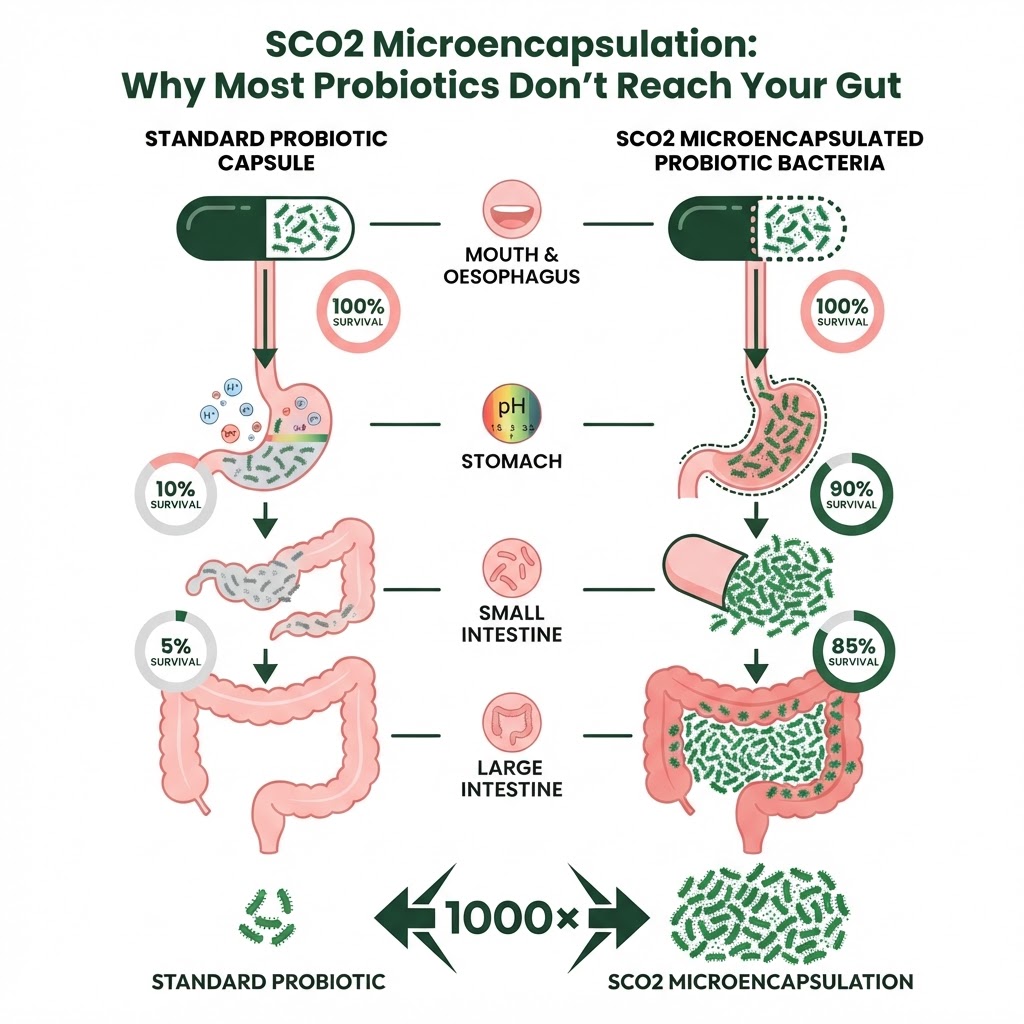
- Studies consistently show that standard, unprotected probiotic strains lose between 96% and 99.9% of their viable bacteria during gastric transit
"The gastrointestinal environment presents formidable barriers to probiotic survival, including acidic gastric pH, bile salt concentrations, and digestive enzymes. Only a fraction of ingested bacteria typically survive to colonise the intestinal mucosa." — Govinden-Soulange & Laverdure, International Journal of Probiotics & Prebiotics
So when a product promises you 50 billion CFU and delivers perhaps 0.5 billion viable bacteria to your gut — that's not a supplement; that's an expensive placebo. And for women managing hormonal fluctuations, digestive challenges, immune health, or the specific microbiome shifts that come with perimenopause and menopause, that shortfall is genuinely consequential.
What Is Microencapsulation, and Why Does It Matter?
Microencapsulation is a technology that creates a protective microscopic shell around individual probiotic bacteria — essentially building each strain its own armoured vehicle to survive the harsh journey from your mouth to your intestines.
The concept isn't new. Pharmaceutical companies have used encapsulation technology for decades to protect sensitive drug compounds from degradation. What has evolved dramatically is the type of encapsulation technology being applied to probiotics, and the difference in outcomes between methods is enormous.
Standard Encapsulation: The Limitations
The most common forms of probiotic encapsulation you'll encounter include:
1. Enteric coating — A thin polymer coating applied to tablets or capsules designed to resist stomach acid. However, enteric coatings can be inconsistent, may dissolve too early in some individuals, and offer limited protection against moisture and heat during storage.
2. Alginate beads — Bacteria are suspended in an alginate gel matrix, which provides moderate protection. The challenge is that alginate is sensitive to calcium ions and acidic conditions, and the protective matrix can degrade unpredictably.
3. Standard delayed-release capsules — These delay dissolution but do not truly encapsulate individual bacteria, meaning that once the capsule opens, bacteria remain unprotected.
All of these approaches share a fundamental limitation: they protect bacteria at the product level rather than at the bacterial level. Once the outer shell dissolves, the bacteria are exposed and vulnerable.
What Makes SCO2 Microencapsulation Different?
Supercritical Carbon Dioxide (SCO2) microencapsulation is a patented, next-generation delivery technology that works at the level of individual bacterial cells.
Here's how it works:
Carbon dioxide, when pressurised above its critical point (approximately 31°C and 73.8 bar), enters a state called supercritical fluid — it has properties of both a liquid and a gas simultaneously. In this state, CO2 becomes an extraordinarily precise and effective solvent for lipid-based coating materials.
During SCO2 processing:
- Individual probiotic bacteria are coated with a precise multilayer lipid-phospholipid shell at the cellular level
- The supercritical CO2 ensures the coating material penetrates and adheres with extraordinary uniformity — something liquid-based coating methods cannot achieve
- The entire process occurs at near-ambient temperatures, which is critical because heat is one of the primary killers of probiotic bacteria during manufacturing
- No water is used in the process, eliminating moisture-related degradation at the point of encapsulation
- When the pressure is released, the CO2 simply evaporates as a gas — leaving behind perfectly coated bacteria with no solvent residue whatsoever
The result is a probiotic bacterium that is individually armoured at the cellular level — protected from stomach acid, bile salts, digestive enzymes, heat, moisture, and oxygen — until it reaches the specific pH environment of your intestines, where the coating dissolves and releases the bacteria exactly where they need to be.
The Bioavailability Gap: What the Research Actually Shows
Bioavailability — the degree to which an active substance reaches its site of action in an active form — is the single most important metric for any supplement, and it is almost universally ignored in probiotic marketing.
The science on probiotic bioavailability through the gastrointestinal tract is sobering. A landmark review published in the Applied and Environmental Microbiology journal found that the most common Lactobacillus and Bifidobacterium strains — the workhorses of most probiotic supplements — demonstrate survival rates of less than 1% when exposed to simulated gastric fluid for 90 minutes at standard stomach pH levels.
For context: food typically remains in the stomach for 2 to 4 hours. Most probiotic capsules begin dissolving within 15 to 30 minutes of ingestion. The mathematics here are not in your favour when you're taking a standard supplement.
Contrast this with SCO2 microencapsulation data:
- Individual lipid encapsulation creates a pH-triggered release mechanism — the coating remains stable at gastric pH (1.5–3.5) but dissolves at intestinal pH (6.5–7.5)
- In vitro studies on lipid-encapsulated probiotics consistently demonstrate survival rates of 85–95% through simulated gastric transit
- In vivo research on microencapsulated delivery systems shows significantly greater colonisation of the intestinal mucosa compared to unencapsulated equivalents
At Her-Biotics, our independent third-party testing has validated that SCO2 microencapsulation delivers 1000× more viable bacteria to the gut compared to standard unencapsulated probiotic formulations. This isn't a marketing claim — it's a measurable, reproducible difference in bioavailability that translates directly to real clinical outcomes for our customers.
You can review the full technical details and supporting research on our Science Page.
Why This Matters Specifically for Women
I want to be direct about something: the female microbiome is not simply a smaller version of the male microbiome. It is a distinct and dynamic ecosystem that shifts significantly across the hormonal lifecycle — through the menstrual cycle, pregnancy, perimenopause, and menopause.
The vaginal microbiome, the gut microbiome, and the hormonal system are in constant, intimate dialogue through what researchers now call the gut-hormone axis. Disruptions to gut microbiome composition have been linked to:
- PMS and PMDD — imbalances in gut bacteria affect oestrogen metabolism and serotonin production, worsening mood, bloating, and cramps
- Perimenopause symptoms — the "estrobolome" (the subset of gut bacteria responsible for metabolising oestrogen) directly influences circulating oestrogen levels; a depleted estrobolome can amplify hot flushes, brain fog, and mood disruption
- Immune function — approximately 70% of the immune system is housed in the gut-associated lymphoid tissue (GALT), making effective probiotic delivery a genuine immune health intervention
- Skin health, energy, and sleep — all emerging areas of gut-microbiome research with particularly strong signals in women over 35
The practical implication is this: if your probiotic isn't reaching your gut in viable form, it cannot support any of these systems. A supplement with beautiful ingredients and an impressive strain list is worthless if those strains are dead before they leave your stomach.
This is why effective delivery technology isn't a nice-to-have feature for women — it is the foundational requirement.
For a deeper exploration of the gut-hormone connection, I recommend this excellent overview from Harvard Health Publishing on the gut-brain-body axis.
How Her-Biotics Technology Was Designed Around This Problem
When I founded Her-Biotics, I made one non-negotiable decision before anything else: the delivery technology had to work before we chose a single strain or ingredient.
Every formula in the Her-Biotics range — from Her-Biotics Original to our targeted formulas — is built on the same SCO2 microencapsulation platform. This means that regardless of which formula suits your life stage or health goals, you are receiving the same gold-standard delivery system.
Here's what this looks like in practice across our range:
Her-Biotics Original
Our foundational 16-strain formula pairs SCO2-protected probiotics with B-vitamins, Vitamin C, Vitamin E, and Zinc — nutrients that actively support the intestinal environment in which those bacteria will thrive. It's the complete daily foundation for women who want consistent, meaningful gut support. Explore Her-Biotics Original
Her-Biotics PMS Support
Formulated with Chasteberry, Evening Primrose Oil, Magnesium Glycinate, and Vitamin B6 alongside our probiotic complex — because the gut-hormone connection means that supporting your microbiome and your hormonal cycle simultaneously is more effective than addressing either in isolation. Explore Her-Biotics PMS Support
Her-Biotics Menopause Support
Our Black Cohosh, Red Clover, Sage Leaf, and Vitamin D3/K2 formula is designed specifically to support the estrobolome during the years when hormonal shifts are most pronounced. Delivering the probiotic strains in this formula with SCO2 protection means the estrobolome support is genuine, not theoretical.
Her-Biotics Sport
Combining L-Glutamine, L-Carnitine, CoQ10, Ashwagandha, and Iron with our probiotic complex — because active women have heightened intestinal permeability demands and specific recovery needs that begin in the gut.
Her-Biotics Ageless 50+
Our most advanced cellular health formula, pairing NAD+, Astaxanthin, CoQ10, and Resveratrol with SCO2-protected probiotics — because the research on longevity increasingly points to the gut microbiome as a central player in healthy ageing.
Browse all formulas and find the right fit for where you are right now at Shop All Formulas.
What to Look For When Evaluating Any Probiotic
Whether you choose Her-Biotics or are evaluating any probiotic supplement, here is the checklist I give my patients:
On the label:
- ✅ CFU count guaranteed at expiry, not just at manufacture
- ✅ Named strains with strain-level designation (e.g., Lactobacillus acidophilus NCFM, not just "Lactobacillus acidophilus")
- ✅ Transparent information about the encapsulation or delivery technology used
- ✅ Third-party testing and independent verification
Red flags:
- ❌ Enormous CFU claims with no mention of delivery technology
- ❌ Products that require refrigeration but are shipped without cold chain protection
- ❌ Proprietary blends that don't disclose individual strain dosages
- ❌ No published research or testing data available
Questions to ask:
- What is the measured survival rate of bacteria through simulated gastric transit for this specific product?
- Has bioavailability been independently tested?
- What is the viable CFU count at intestinal delivery, not just at ingestion?
Most supplement companies cannot answer these questions. At Her-Biotics, they are the questions we built the entire brand to answer. You can explore the full science behind our technology and testing protocols on the Science Page, and find additional research and wellness resources at the Radiance Hub.
The Bottom Line
The supplement industry has conditioned us to focus on the number on the front of the bottle — the CFU count, the strain count, the impressive-sounding ingredient list. These things matter, but they are secondary to delivery. A probiotic that doesn't reach your gut is not a supplement; it is a very expensive and entirely ineffective product.
SCO2 microencapsulation represents the most significant advancement in probiotic delivery technology available today. By coating individual bacteria with precision lipid shells using supercritical carbon dioxide — at low temperatures, with no moisture, no solvents, and no heat damage — it solves the fundamental problem that has made the majority of the probiotic supplement industry functionally ineffective.
As women, we deserve to invest in products that actually work. Our hormonal health, our immune resilience, our gut integrity, our energy, our skin, and our longevity are not abstract wellness concepts — they are the lived experience of our bodies, and they deserve evidence-based solutions backed by real technology.
Ready to Experience the Difference That Real Delivery Technology Makes?
If you've been taking probiotics without seeing the results you expected, the answer is almost certainly not more bacteria — it's better-delivered bacteria. Every Her-Biotics formula is built on our patented SCO2 microencapsulation platform, independently validated to deliver 1000× more viable probiotics to your gut than standard supplements.
Whether you're looking for foundational daily gut support, hormonal cycle balance, menopause relief, active performance, or cellular longevity, there is a Her-Biotics formula designed for exactly where you are. Explore the full range and find your formula at Shop All Formulas — and take the first step toward a probiotic that actually does what it promises.
Because your gut health is too important to leave to chance — or to a label.
Dr. Chomba Chuma, MD is a physician, women's health specialist, and Founder of Her-Biotics. She has spent over a decade studying the female microbiome and its relationship to hormonal health, immunity, and longevity. Her-Biotics was founded on the conviction that women deserve supplement technology that is as sophisticated as their biology.
The information in this article is intended for educational purposes and does not constitute medical advice. Please consult your healthcare provider before beginning any new supplement regimen.
Enjoyed this? Get the next one first.
Science made simple, delivered to your inbox. No spam, unsubscribe anytime.