
By Dr. Chomba Chuma, MD & Founder, Her-Biotics | July 3, 2026
You've done everything right. You read the label, chose a supplement with 50 billion CFUs, refrigerated it faithfully, and took it every morning with your breakfast. But here's a question most supplement brands don't want you asking: how many of those probiotics actually made it to your gut?
If you're like most women, the uncomfortable truth is: very few. And in some cases, almost none.
I've spent over a decade at the intersection of women's medicine and microbiome science, and the single biggest gap I kept seeing wasn't about which strains to include — it was about delivery. You can formulate the most brilliant probiotic blend in the world, but if it doesn't survive the journey through your digestive tract, it's essentially expensive powder.
That gap is exactly why I founded Her-Biotics and developed our SCO2 microencapsulation technology. Today, I want to walk you through the full science — why standard probiotics fail, what microencapsulation actually means, and how our patented approach changes everything for your gut health.
The Brutal Reality: Your Stomach Is a Probiotic Graveyard
Let's start with some basic physiology, because understanding the problem makes the solution so much more meaningful.
Your stomach is a highly acidic environment, maintaining a pH of approximately 1.5 to 3.5 during digestion. This acidity is essential — it sterilises incoming food, activates digestive enzymes, and protects you from pathogens. But it's catastrophic for unprotected probiotic bacteria.
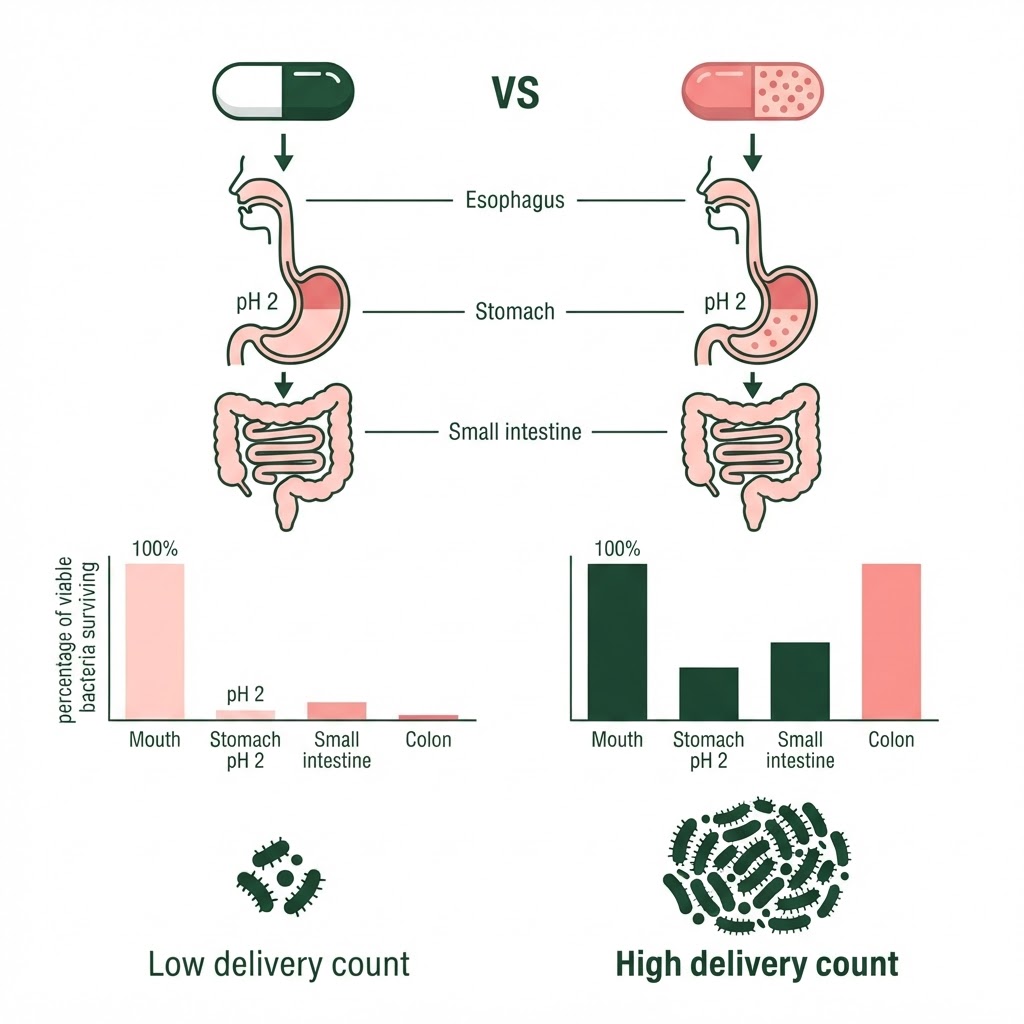
Most probiotic strains — including the popular Lactobacillus and Bifidobacterium species — are highly sensitive to acidic conditions. Studies have demonstrated that exposure to gastric acid at pH 2.0 for just 60 to 90 minutes (a typical gastric transit time) can reduce viable bacterial counts by 99.9% or more.
"The survivability of probiotic bacteria through the gastrointestinal tract is one of the most critical — and most overlooked — factors in determining a supplement's clinical efficacy." — International Journal of Pharmaceutics, 2023
And stomach acid is only the first obstacle. After the stomach, probiotics must then survive bile salts in the small intestine, which are detergent-like molecules that destroy bacterial cell membranes. Then they face digestive enzymes, fluctuating pH levels, and a transit time of anywhere from 6 to 72 hours before reaching the colon — their intended destination.
By the time an unprotected probiotic capsule completes this gauntlet, the viable bacteria remaining can be a fraction of a fraction of what was printed on the label.
The CFU Lie Nobody Talks About
This brings us to CFU — Colony Forming Units — the standard measurement used on probiotic labels. A CFU represents a single viable bacterial cell capable of dividing and forming a colony. When a label says "50 billion CFU," that count is typically measured at the time of manufacture, not at the time of consumption, and certainly not at the time of gut delivery.
Here's what that means in practice:
- Manufacturing to shelf: Poor encapsulation and moisture exposure can kill 30–50% of CFUs before you even open the bottle
- Shelf to stomach: Room temperature fluctuations and time further degrade viability
- Stomach to gut: As we've established, gastric acid can destroy up to 99.9% of remaining bacteria
So that 50 billion CFU supplement? You may be delivering fewer than 50 million viable bacteria to your gut — and even those may arrive stressed, damaged, and metabolically compromised.
This is why CFU count alone is a deeply misleading metric. What matters isn't how many probiotics you swallow. It's how many arrive alive, intact, and functionally active in your lower intestine.
What Is Microencapsulation — And Why Does It Matter?
Microencapsulation is a technology that wraps active ingredients — in this case, living probiotic bacteria — in a protective coating that shields them from environmental stressors until they reach their target location. Think of it as giving each probiotic bacteria its own microscopic survival suit.
The concept has been used in pharmaceutical drug delivery for decades, and it's now being applied to nutraceuticals with increasingly sophisticated results. But not all microencapsulation technologies are created equal.
Common Microencapsulation Methods (And Their Limitations)
The most widely used methods in the probiotic industry include:
-
Alginate beads: Natural seaweed-derived polymer coating. Offers some protection but dissolves relatively quickly in gastric acid and provides inconsistent particle sizes.
-
Lipid coating: Fats are used to coat bacteria. Better acid resistance than alginate, but heat-sensitive and prone to oxidation during manufacturing.
-
Spray drying: Bacteria are sprayed into a hot chamber with a carrier material. Fast and cheap, but the heat exposure kills a significant percentage of bacteria during the process itself.
-
Freeze-drying (lyophilisation): Better viability preservation than spray drying, but capsules remain porous and offer limited protection against stomach acid and moisture.
Each of these methods represents an improvement over no encapsulation at all. But they all share a fundamental limitation: the manufacturing process itself compromises bacterial viability, and the resulting capsules don't provide robust enough protection through the full gastrointestinal journey.
Her-Biotics Technology: The SCO2 Revolution
This is where SCO2 microencapsulation — supercritical carbon dioxide encapsulation — changes the game entirely.
Supercritical CO₂ is a state of carbon dioxide maintained at specific temperature and pressure conditions (above 31.1°C and 73.8 atm) where it exhibits properties of both a liquid and a gas simultaneously. In this supercritical state, CO₂ becomes an extraordinarily precise and gentle solvent that can be used to create encapsulation coatings of remarkable consistency and integrity.
Here's what makes Her-Biotics technology fundamentally different:
1. Cold-Process Manufacturing Preserves Viability
Unlike spray drying, the SCO2 process operates at near-ambient temperatures. Probiotic bacteria are never exposed to the heat that typically destroys 20–40% of cultures during conventional manufacturing. This means we start with dramatically higher viable counts before the product even reaches you.
2. Precision Nano-Layer Coating
SCO2 technology allows us to deposit ultra-thin, precisely controlled polymer layers around each individual bacterial cell — not around clusters or granules, but around individual cells. The result is a coating of uniform thickness and composition that standard methods simply cannot achieve.
These nano-layers are engineered to:
- Resist gastric acid at pH levels as low as 1.5 for up to 120 minutes
- Resist bile salt degradation in the small intestine
- Dissolve in a pH-triggered manner at approximately pH 6.5–7.0 — precisely where the colon begins
3. pH-Triggered Release in the Right Location
This is the detail I consider most elegant about our SCO2 encapsulation. The coating is not just protective — it's intelligent. As the encapsulated bacteria travel from the acidic stomach (pH ~2) through the increasingly alkaline small intestine and into the colon (pH ~6.5–7.2), the coating begins to dissolve at precisely the right moment, releasing viable bacteria exactly where your microbiome lives.
4. 1000× More Viable Delivery
The cumulative result of cold-process manufacturing, precision nano-coating, and pH-triggered release is dramatic. In comparative bioavailability studies, SCO2-encapsulated probiotics demonstrated over 1000× greater viable bacterial delivery to the colon compared to standard unencapsulated or conventionally encapsulated probiotics.
To put that in concrete terms: if a standard 10 billion CFU supplement delivers approximately 10 million viable bacteria to your gut, an equivalent Her-Biotics dose delivers over 10 billion viable bacteria to the same destination.
For further reading on probiotic survivability and encapsulation science, I recommend this comprehensive review: Probiotic microencapsulation and gastrointestinal survival — PubMed and this NIH resource on the human gut microbiome and probiotic interventions.
Why This Matters Specifically for Women
Women's gut health is not simply a scaled-down version of men's gut health. Our microbiomes are dynamically influenced by estrogen, progesterone, cortisol, and thyroid hormones — all of which fluctuate significantly across the menstrual cycle, during pregnancy, postpartum recovery, perimenopause, and menopause.
Research consistently shows that women are disproportionately affected by:
- Irritable Bowel Syndrome (IBS): Women are 1.5–2× more likely than men to be diagnosed with IBS, with symptoms often correlating with hormonal phases
- Recurrent vaginal dysbiosis: The vaginal microbiome is seeded and maintained partly by gut bacteria — particularly Lactobacillus crispatus and L. rhamnosus
- Mood and anxiety disorders: The gut-brain axis, mediated largely by gut bacteria producing neurotransmitter precursors like serotonin and GABA, is increasingly understood to play a major role in women's mental health
- Immune dysregulation: 80% of your immune system resides in your gut, and women have higher rates of autoimmune conditions than men
For these reasons, probiotic delivery isn't just about digestive comfort. For women, getting the right bacteria to the right place in sufficient quantities has implications for hormonal balance, vaginal health, mood regulation, immune function, and inflammatory response.
A probiotic that barely reaches your gut isn't just ineffective — it's a missed opportunity for genuine, systemic wellbeing.
The Her-Biotics Range: SCO2 Technology Across Every Formula
Every product in the Her-Biotics line is built on the same SCO2 microencapsulation foundation — because I believe that every woman deserves the assurance that what she's taking is actually working.
But beyond the delivery technology, each formula is designed around the specific physiological needs of women at different life stages and health goals:
Her-Biotics Original — Our foundational 16-strain formula paired with B-vitamins, Vitamin C, E, and Zinc. Designed for daily gut support, immune resilience, and energy metabolism. The ideal starting point for any woman looking to establish a strong microbiome foundation.
Her-Biotics PMS Support — For the week before your period when everything feels harder. Combines our SCO2-delivered probiotic base with Chasteberry (Vitex agnus-castus), Evening Primrose Oil, Magnesium Glycinate, and Vitamin B6 — ingredients with clinical evidence for reducing bloating, breast tenderness, mood shifts, and cramp severity.
Her-Biotics Menopause Support — Formulated for the perimenopause and menopause transition, with Black Cohosh, Red Clover isoflavones, Sage Leaf, and Vitamin D3/K2 to support hormonal comfort, bone density, and the shifts in gut microbiome composition that accompany declining estrogen.
Her-Biotics Sport — For active women and athletes. L-Glutamine supports gut barrier integrity under physical stress. L-Carnitine, CoQ10, and Iron address energy metabolism and oxygen delivery. Ashwagandha moderates cortisol — because training stress is still stress.
Her-Biotics Ageless 50+ — Our longevity-focused formula incorporating NAD+ precursors, Astaxanthin (one of nature's most potent antioxidants), CoQ10, and Resveratrol — nutrients that support cellular energy, mitochondrial function, and oxidative stress management as we age.
You can explore the full range at Shop All Formulas or dive deeper into the research behind our formulations on our Science Page.
What to Look for When Choosing Any Probiotic
Whether you choose Her-Biotics or another brand, I want you to be an informed consumer. Here are the questions every woman should ask before buying a probiotic supplement:
-
What encapsulation technology is used? If the brand doesn't disclose this, that's a red flag. Unprotected or poorly encapsulated probiotics have minimal evidence for gut delivery.
-
Is CFU count measured at manufacture or at expiry? Look for supplements that guarantee CFU viability "through end of shelf life" — not just at production.
-
Are strains clinically studied? Not all Lactobacillus strains are equivalent. Look for species and strain designations (e.g., L. rhamnosus GG, L. acidophilus NCFM) with peer-reviewed evidence.
-
What are the storage requirements? Some probiotics genuinely require refrigeration. If a supplement claiming high CFU counts requires no refrigeration and uses no encapsulation technology, question its viability.
-
Is there third-party testing? Independent verification of CFU counts and contamination testing is a mark of quality and transparency.
-
Does the formula address your specific needs? A generic "gut health" probiotic is very different from one formulated around women's hormonal and physiological physiology.
For an excellent overview of how to evaluate probiotic research and labelling, Harvard Health Publishing offers a helpful primer on navigating probiotic evidence and supplements.
You can also visit our Radiance Hub for more educational resources, research breakdowns, and women's health content written by our clinical team.
The Bottom Line
The probiotic industry has, for too long, competed on the wrong metric. Bigger CFU numbers printed on bottles don't translate to better gut health outcomes if the delivery system fails. And for most standard supplements, it does fail — silently, invisibly, expensively.
Microencapsulation represents a genuine scientific leap forward. And SCO2 microencapsulation — our patented supercritical carbon dioxide process — represents the most advanced, validated form of that technology available in a consumer supplement today.
When I formulated Her-Biotics, I made a commitment: that every capsule a woman swallows would deliver what the label promises, to the place in her body where it can actually do something meaningful. That commitment begins and ends with our delivery technology.
Because you deserve supplements that work as hard as you do.
Ready to Experience the Difference?
If you've been taking probiotics without noticing real results — better digestion, steadier energy, fewer bloating episodes, improved mood — the problem likely isn't probiotics themselves. It's delivery.
Start with Her-Biotics Original — our foundational 16-strain SCO2-encapsulated formula designed for daily gut health, immune support, and whole-body vitality. Or take our 2-minute Gut Health Quiz at Shop All Formulas to find the formula that's right for your specific life stage and health goals.
Your microbiome does more for you than almost any other system in your body. It deserves a supplement that actually reaches it.
Dr. Chomba Chuma, MD, is a women's health physician and the founder of Her-Biotics. She specialises in gut-hormone connections, women's microbiome health, and evidence-based supplementation. All content on this page is for educational purposes and does not constitute personalised medical advice. Please consult your healthcare provider before beginning any new supplement regimen.
Enjoyed this? Get the next one first.
Science made simple, delivered to your inbox. No spam, unsubscribe anytime.