
By Dr. Chomba Chuma, MD & Founder, Her-Biotics | July 20, 2026
If you've been diagnosed with PCOS, you've probably been handed a prescription for the contraceptive pill or metformin, told to lose weight, and sent on your way. Perhaps you've been cycling through these same conversations for years — frustrated, exhausted, and still searching for answers that go deeper than symptom management.
I see you. And I want to offer you something different.
Polycystic ovary syndrome (PCOS) is the most common endocrine disorder in women of reproductive age, affecting an estimated 8–13% of women globally. Yet despite its prevalence, we've spent decades treating the downstream effects — irregular periods, acne, excess androgens, fertility challenges — while largely ignoring the upstream drivers. One of the most significant of those drivers, now backed by a rapidly growing body of research, is gut bacteria and the microbiome.
This article is your comprehensive guide to understanding the gut-PCOS connection, the science behind it, and practical, evidence-informed steps you can take to support your hormonal health from the inside out.
What Is PCOS, Really? Moving Beyond the Textbook Definition
Most women are told PCOS is a hormonal condition characterised by elevated androgens (male hormones), irregular ovulation, and polycystic-appearing ovaries on ultrasound. That's accurate — but it's incomplete.
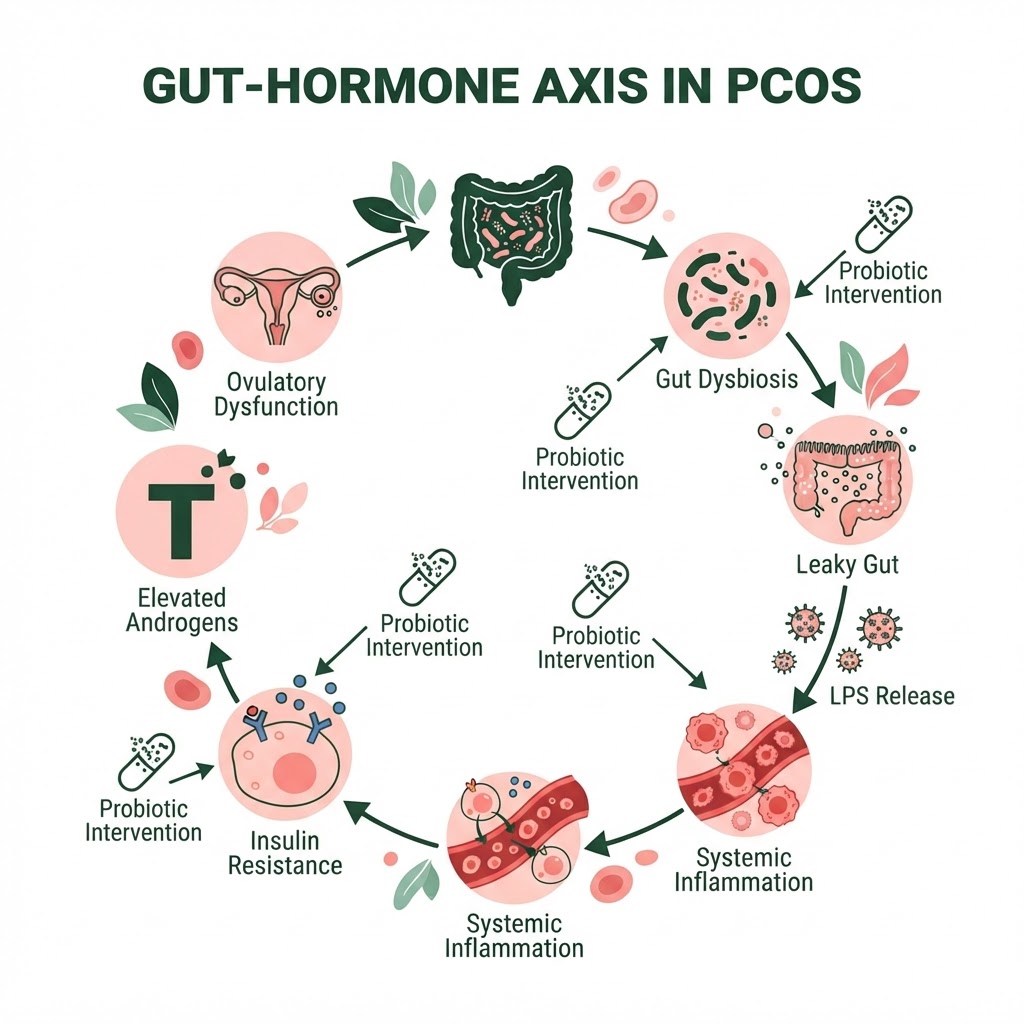
At its physiological core, PCOS is a metabolic and inflammatory disorder with hormonal consequences. The majority of women with PCOS — up to 70%, according to some estimates — have underlying insulin resistance, meaning their cells don't respond efficiently to insulin. When insulin spikes, the ovaries are stimulated to produce more testosterone. Elevated testosterone disrupts ovulation. The cycle perpetuates itself.
But here's what your doctor may not have told you: insulin resistance doesn't emerge in a vacuum. Chronic low-grade inflammation, disrupted gut barrier integrity, and an imbalanced microbiome are all well-documented contributors to insulin resistance — and all three are demonstrably altered in women with PCOS.
The PCOS Phenotype Spectrum
It's worth noting that PCOS is not one-size-fits-all. There are four recognised phenotypes based on the Rotterdam Criteria:
- Phenotype A: Hyperandrogenism + irregular ovulation + polycystic ovaries (classic, most severe)
- Phenotype B: Hyperandrogenism + irregular ovulation (no PCO morphology)
- Phenotype C: Hyperandrogenism + polycystic ovaries (ovulatory PCOS)
- Phenotype D: Irregular ovulation + polycystic ovaries (non-androgenic)
While the presentations differ, gut dysbiosis and metabolic dysfunction are consistently present across phenotypes, which tells us that the microbiome isn't a peripheral player — it's a central one.
The Gut-PCOS Connection: What the Research Actually Shows
The relationship between the microbiome and PCOS has been one of the most exciting areas of women's health research over the past decade. Let's look at what we actually know.
Gut Dysbiosis Is Measurable in Women with PCOS
Multiple studies have now demonstrated that women with PCOS have a distinctly different gut microbial composition compared to healthy controls. A landmark 2019 meta-analysis published in Frontiers in Endocrinology found that women with PCOS consistently showed:
- Reduced microbial diversity — a hallmark of poor gut health
- Decreased abundance of beneficial bacteria, particularly Lactobacillus and Bifidobacterium species
- Increased abundance of pro-inflammatory bacteria such as Bacteroides and certain Firmicutes species
- Altered Firmicutes-to-Bacteroidetes ratio — a pattern also seen in obesity and metabolic syndrome
"The gut microbiota of PCOS patients shows significantly lower species diversity and richness, with a marked reduction in short-chain fatty acid-producing bacteria. This dysbiosis pattern closely parallels metabolic syndrome and may be a key driver of the insulin resistance characteristic of PCOS." — Liu et al., Frontiers in Endocrinology, 2022
See the full research on our Science Page for an overview of the studies that inform the Her-Biotics formulation philosophy.
The Leaky Gut Link
One mechanism connecting gut dysbiosis to PCOS involves what researchers call increased intestinal permeability — commonly known as leaky gut. When the microbial balance is disrupted, the tight junctions between intestinal cells can loosen, allowing bacterial fragments — particularly lipopolysaccharides (LPS) from gram-negative bacteria — to enter systemic circulation.
LPS triggers a powerful inflammatory immune response. This chronic, low-grade inflammation:
- Impairs insulin receptor signalling → worsening insulin resistance
- Stimulates the hypothalamic-pituitary-ovarian axis → disrupting hormones including LH and FSH
- Increases androgen production in the ovaries and adrenal glands
- Perpetuates the inflammatory environment that drives acne, weight gain, and fatigue
A 2021 study in The Journal of Clinical Endocrinology & Metabolism found that serum LPS levels were significantly elevated in women with PCOS compared to controls, and correlated directly with androgen levels and insulin resistance markers. Read the full study on PubMed.
The Estrobolome: Your Gut's Hormonal Recycling System
Your gut microbiome doesn't just influence insulin — it actively metabolises and regulates oestrogen. A specific collection of gut bacteria called the estrobolome produces an enzyme called beta-glucuronidase, which deconjugates oestrogens in the gut, allowing them to be reabsorbed into circulation.
When the estrobolome is disrupted:
- Too little beta-glucuronidase activity → oestrogen is excreted rather than recirculated → relative oestrogen deficiency
- Too much activity → excess oestrogen recirculates → oestrogen dominance
In PCOS, the picture is complex — many women present with relative oestrogen excess alongside androgen excess. A dysregulated estrobolome can amplify this hormonal chaos. Restoring microbial balance isn't just about digestion; it is, quite literally, hormonal medicine.
Insulin Resistance, the Microbiome, and Why Standard Advice Falls Short
We cannot talk about PCOS without talking about insulin resistance — and we cannot meaningfully address insulin resistance without addressing the gut.
Short-chain fatty acids (SCFAs) — including butyrate, propionate, and acetate — are produced when beneficial gut bacteria ferment dietary fibre. These SCFAs are profoundly important for metabolic health:
- Butyrate is the primary fuel for colonocytes (gut lining cells) and activates receptors that enhance insulin sensitivity
- Propionate travels to the liver and modulates gluconeogenesis (glucose production)
- Acetate signals satiety hormones including GLP-1 and PYY
Women with PCOS consistently show reduced SCFA production due to lower populations of SCFA-producing bacteria such as Faecalibacterium prausnitzii, Roseburia, and Akkermansia muciniphila. This reduction directly undermines insulin sensitivity — independent of diet or body weight.
This is a critical point. It explains why two women can eat identical diets and have identical BMIs, yet one develops insulin resistance and the other doesn't. The microbiome is a significant part of that answer.
Why Metformin Works (and Why It's Not the Whole Answer)
Metformin, the most commonly prescribed drug for PCOS-related insulin resistance, is interesting from a microbiome perspective. Research published in Nature Medicine has shown that a significant portion of metformin's glucose-lowering effect is mediated through changes to the gut microbiome — specifically by increasing Akkermansia muciniphila populations.
In other words, metformin may be working, at least partly, as an indirect prebiotic. This doesn't mean you should stop your medication — far from it. But it does suggest that targeting the microbiome directly, through diet and targeted probiotics for PCOS, may offer complementary and synergistic benefits. Learn more at the NIH's comprehensive PCOS research overview.
How Probiotics Can Help Women with PCOS: The Evidence
So we know the microbiome is dysregulated in PCOS. The logical next question is: can restoring it make a measurable clinical difference?
The answer, increasingly, is yes.
Clinical Trials on Probiotics for PCOS
Several randomised controlled trials have now examined the effects of probiotic supplementation in women with PCOS. Here is what the evidence consistently shows:
Metabolic markers:
- Significant reductions in fasting insulin and HOMA-IR (a measure of insulin resistance)
- Improved fasting blood glucose
- Reductions in total cholesterol and LDL cholesterol
- Modest reductions in BMI and waist circumference
Hormonal markers:
- Reductions in total testosterone and free androgen index
- Improvements in LH:FSH ratio
- In some trials, increases in SHBG (sex hormone binding globulin), which naturally lowers free androgen availability
Inflammatory markers:
- Significant reductions in CRP (C-reactive protein) — a key marker of systemic inflammation
- Reductions in TNF-α and IL-6 — pro-inflammatory cytokines elevated in PCOS
Psychological and quality-of-life outcomes:
- Improvements in depression and anxiety scores — important given the 4× higher rates of anxiety and depression in women with PCOS
- Improved sleep quality
A 2023 systematic review and meta-analysis in Nutrients concluded that probiotic supplementation produced statistically significant improvements in insulin sensitivity, androgen levels, and inflammatory markers in women with PCOS, with effects enhanced when combined with dietary interventions.
Strain Specificity Matters
Not all probiotics are created equal — and this is where the science gets nuanced. The strains most consistently associated with benefit in PCOS research include:
- Lactobacillus acidophilus — improves insulin sensitivity and reduces LPS translocation
- Lactobacillus rhamnosus — modulates gut-brain axis, reduces anxiety, supports oestrogen metabolism
- Bifidobacterium longum — reduces systemic inflammation and supports SCFA production
- Lactobacillus gasseri — associated with reductions in visceral fat and androgen levels
- Bifidobacterium breve — supports gut barrier integrity and immune regulation
The challenge with most commercial probiotic supplements is survivability. The vast majority of probiotic bacteria are destroyed by stomach acid before they ever reach the colon where they need to work. This is why delivery technology is not an afterthought — it's foundational.
The Her-Biotics Difference: Why SCO2 Microencapsulation Changes Everything
At Her-Biotics, we built our entire formulation philosophy around one non-negotiable principle: a probiotic that doesn't survive the journey to your gut is a probiotic that doesn't work.
Our patented SCO2 (supercritical carbon dioxide) microencapsulation technology creates a protective lipid shell around each probiotic cell using supercritical CO₂ — a process that operates at low temperatures, preserving bacterial viability while creating a casing that is:
- Acid-resistant — survives gastric pH as low as 1.5
- Bile-resistant — withstands bile salts in the small intestine
- Temperature-stable — no refrigeration required
- Time-released — dissolves specifically in the slightly alkaline environment of the colon
The result: 1000× more viable probiotics delivered to where they actually matter. In independent laboratory testing, SCO2-encapsulated strains showed a 99.9% survival rate through simulated gastric transit, compared to less than 0.1% for unencapsulated strains.
This is not a marketing claim — it's chemistry. And for women with PCOS, who need consistent, high-density colonisation of the gut to meaningfully shift their microbiome, this difference is clinically significant.
A Root-Cause Protocol: Practical Steps for Women with PCOS
Probiotics are powerful — but they work best as part of a comprehensive root-cause strategy. Here is how I approach PCOS from an integrative standpoint with my patients:
1. Nourish Your Microbiome with Fibre Diversity
Aim for 30+ different plant foods per week — this is the single most evidence-based dietary intervention for microbiome diversity. Include:
- Legumes (lentils, chickpeas, black beans)
- Fermented foods (kefir, sauerkraut, kimchi, natural yoghurt)
- Colourful vegetables and low-glycaemic fruits
- Prebiotic-rich foods: garlic, onion, leeks, asparagus, green banana
2. Stabilise Blood Sugar at Every Meal
- Protein-first eating — start each meal with protein before carbohydrates
- Prioritise low-glycaemic index carbohydrates
- Add healthy fats (avocado, olive oil, nuts) to slow glucose absorption
- Consider inositol (myo-inositol and D-chiro-inositol), extensively studied for PCOS insulin sensitivity
3. Address Inflammation Systematically
- Reduce ultra-processed foods, refined seed oils, and added sugars
- Prioritise omega-3 fatty acids (oily fish, flaxseed, walnuts)
- Consider anti-inflammatory botanicals including turmeric and ginger
4. Support Your Stress Response
- Chronic cortisol elevation worsens both insulin resistance and androgen production
- Evidence-based interventions: breathwork, resistance training, adequate sleep (7–9 hours), and adaptogenic herbs such as ashwagandha
5. Supplement Strategically and Smartly
This is where a targeted probiotic formulation earns its place. For women with PCOS, I recommend Her-Biotics Original as the foundational microbiome support — 16 clinically relevant strains including the key PCOS-associated species outlined above, delivered via SCO2 technology for maximum colonisation. Pair this with our Her-Biotics PMS Support formula if hormonal cyclical symptoms (mood shifts, bloating, breast tenderness) are significant features of your PCOS presentation. Visit the Radiance Hub for our complete PCOS nutrition and lifestyle guides.
What to Expect: A Realistic Timeline
I want to be honest with you, because you deserve honesty more than hype.
The microbiome does not transform overnight. Here is a realistic expectation framework:
- Weeks 1–2: Some women notice improvements in bloating, regularity, and energy as the gut environment begins to shift
- Weeks 4–8: Emerging improvements in mood, skin clarity, and sleep — inflammatory markers begin to reduce
- Months 3–6: Measurable changes in fasting insulin, androgen markers, and menstrual regularity — these are the deeper metabolic shifts that take consistent effort
- 6–12 months: Sustained microbiome remodelling, with lasting improvements in hormonal balance and metabolic function
Consistency is the variable that matters most. The women who see the most profound results are those who commit to the full lifestyle and supplementation protocol over a meaningful timeframe.
Your Next Step: Root-Cause PCOS Support Starts Here
If you've read this far, you already understand something most conventional medicine hasn't caught up to yet: PCOS is not a life sentence, and your gut health is one of the most powerful levers you have. The science is no longer emerging — it has arrived. Dysbiosis drives inflammation, inflammation drives insulin resistance, insulin resistance drives androgen excess, and androgen excess drives the symptoms that have disrupted your life.
You can interrupt that cycle. And you can start today.
Her-Biotics Original was formulated specifically to address this root-cause pathway — 16 rigorously selected probiotic strains, delivered alive and in therapeutic numbers to your colon via our patented SCO2 technology, alongside B-vitamins, Vitamin C, E, and Zinc to support immune regulation and metabolic function. It's not just a probiotic. It's a precision tool for hormonal resilience.
Explore the full Her-Biotics range and find your formula →
Because you deserve a solution that actually works — from the inside out.
Dr. Chomba Chuma is a medical doctor and the founder of Her-Biotics. This article is for informational purposes only and does not constitute medical advice. Always consult your healthcare provider before starting any new supplement, particularly if you have a diagnosed medical condition or are taking prescription medications.
References available on our Science Page.
Enjoyed this? Get the next one first.
Science made simple, delivered to your inbox. No spam, unsubscribe anytime.