
By Dr. Chomba Chuma, MD & Founder, Her-Biotics | July 13, 2026
If you've ever woken at 3 a.m. drenched in sweat, heart racing, or felt a wave of intense heat sweep up your chest and flood your face mid-conversation, you already know that hot flashes are not a minor inconvenience. They are disruptive, exhausting, and for millions of women, they signal the beginning of one of the most significant biological transitions of their lives: menopause.
But here's something that most women — and even many conventional healthcare providers — don't yet fully appreciate: what's happening in your gut may be just as important as what's happening in your ovaries.
Over the last decade, research into the gut microbiome has quietly revolutionised our understanding of female hormonal health. There is now compelling evidence that the trillions of bacteria living in your digestive tract play a direct role in oestrogen metabolism, inflammation regulation, and — critically — the frequency and severity of hot flashes. This isn't fringe science. It is published, peer-reviewed, and it is changing the conversation around menopause care.
In this article, I want to walk you through the real science behind the menopause-gut connection, explore the evidence for natural interventions like phytoestrogens and Black Cohosh, and explain how a precision probiotic approach can help you navigate this transition with far more grace than you might think possible.
1. What Actually Causes Hot Flashes? It's More Complex Than You Think
The standard explanation goes something like this: oestrogen levels drop during menopause, the hypothalamus (the brain's thermostat) becomes hypersensitive to small changes in core body temperature, and boom — a hot flash. That part is largely accurate.
But it doesn't explain why some women have dozens of hot flashes per day while others have none, even with similar levels of circulating oestrogen. It doesn't explain why body weight, stress levels, diet quality, and — yes — gut bacteria composition all appear to significantly influence hot flash frequency and severity.
Research published in Menopause: The Journal of the North American Menopause Society has demonstrated that women with higher gut microbial diversity tend to report fewer and less severe vasomotor symptoms (the medical term for hot flashes and night sweats). Meanwhile, women with dysbiosis — an imbalance in gut bacteria — show altered oestrogen metabolism patterns that may amplify hormonal fluctuations.
Key finding: A 2023 study in the journal mSystems identified specific bacterial genera — including Lactobacillus, Bifidobacterium, and Clostridiales — as key players in oestrogen recycling. Women with lower abundance of these bacteria had significantly higher rates of vasomotor symptoms. (Source: NIH/mSystems)
This is not coincidence. This is biology — and understanding it gives us real, actionable tools.
2. Meet the Estrobolome: Your Gut's Hidden Hormone Lab
If there is one concept I want every woman over 40 to understand, it is the estrobolome.
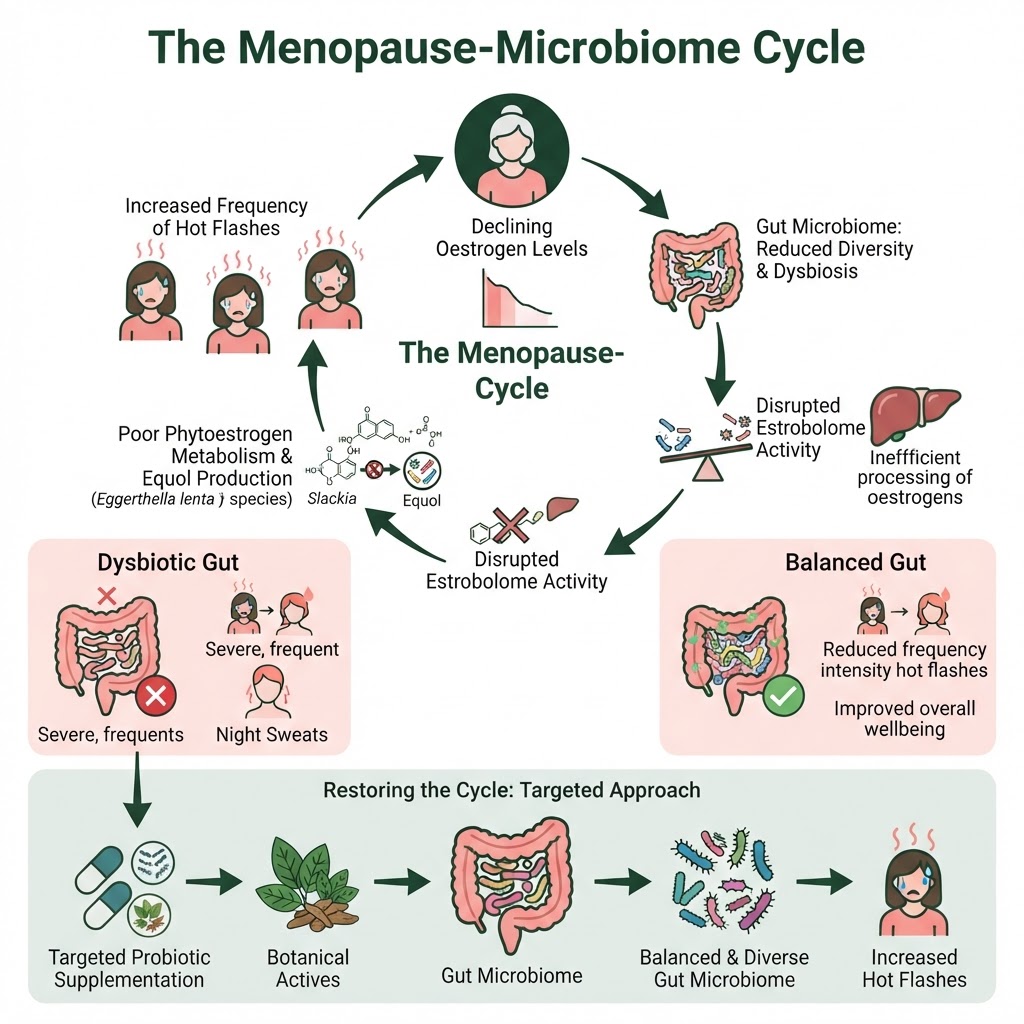
The estrobolome refers to the collection of gut bacteria that are capable of metabolising and modulating oestrogen. Here's how it works in practice:
- Your liver processes used oestrogen and conjugates it — essentially tagging it for excretion — then sends it to the gut via bile.
- Certain gut bacteria produce an enzyme called beta-glucuronidase, which deconjugates this oestrogen, freeing it to be reabsorbed into circulation.
- The balance between oestrogen excretion and reabsorption is therefore directly controlled by your gut bacteria.
Why This Matters During Menopause
During the menopausal transition, your ovaries dramatically reduce oestrogen production. But this doesn't mean oestrogen disappears entirely — your body continues to produce smaller amounts via the adrenal glands and adipose tissue. The estrobolome determines how efficiently this residual oestrogen is utilised.
A healthy, diverse microbiome can help moderate the hormonal swings of perimenopause and menopause by:
- Optimising recirculation of available oestrogen through the enterohepatic cycle
- Reducing systemic inflammation, which independently triggers vasomotor symptoms
- Supporting serotonin and GABA production — neurotransmitters that directly influence the hypothalamic thermostat
- Metabolising phytoestrogens into their most biologically active forms
A disrupted estrobolome, on the other hand, can lead to what researchers describe as a "hormonal chaos" effect — erratic oestrogen signalling that may trigger more frequent and more severe hot flashes.
For a deeper dive into the science behind our approach, visit our Science Page.
3. Phytoestrogens and Gut Bacteria: A Partnership You Need to Know About
You may have heard that foods like soy, flaxseed, and red clover contain phytoestrogens — plant-based compounds that weakly mimic oestrogen in the human body. The science around phytoestrogens has historically been confusing, with studies producing wildly inconsistent results.
Here's why: the benefit of phytoestrogens depends almost entirely on your gut bacteria.
Take isoflavones — the phytoestrogens found in soy and red clover. To exert their hormonal effects, isoflavones must be converted by specific gut bacteria into equol, a compound with genuine oestrogenic activity. The problem? Only about 30–50% of Western women have the gut bacteria necessary to produce equol.
This is why two women can eat the same soy-rich diet and have completely different outcomes. One woman's gut microbiome converts isoflavones to equol effectively; the other's does not. The result: dramatically different relief from hot flashes.
A landmark study published in The Journal of Nutrition found that equol-producers had significantly lower rates of vasomotor symptoms compared to non-producers — independent of isoflavone intake. (Source: Oxford Academic/Journal of Nutrition)
What This Means for You
Simply eating more soy or taking an isoflavone supplement is not enough if your gut doesn't have the microbial machinery to convert these compounds into their active forms. The missing piece is rebuilding the gut bacteria that make phytoestrogen metabolism possible.
This is one of the core reasons we designed Her-Biotics Menopause Support — not just as a probiotic, but as a complete system that pairs clinically relevant bacterial strains with plant-based actives that work synergistically with the microbiome.
4. Black Cohosh, Sage Leaf, and the Gut Connection
Let's talk about some of the most evidence-backed botanical ingredients for menopause support — and why their relationship with gut health matters.
Black Cohosh (Actaea racemosa)
Black Cohosh is arguably the most studied herbal remedy for menopausal symptoms, with dozens of clinical trials examining its effects on hot flashes, sleep disruption, and mood changes. A comprehensive meta-analysis published in Menopause found that Black Cohosh significantly reduced hot flash frequency and severity compared to placebo in perimenopausal and postmenopausal women.
For years, researchers assumed Black Cohosh acted as a phytoestrogen. We now know that's not quite right. Its primary mechanisms appear to include:
- Serotonergic activity — binding to serotonin receptors in the hypothalamus and modulating the thermoregulatory set point
- Dopaminergic effects — influencing the brain's reward and temperature regulation pathways
- Anti-inflammatory action — reducing the systemic inflammation that amplifies vasomotor symptoms
Importantly, emerging research suggests that gut bacteria influence the bioavailability and metabolism of Black Cohosh's active compounds (primarily triterpene glycosides). A healthier gut environment may enhance the absorption and efficacy of these compounds — meaning your probiotic baseline matters when taking botanical supplements.
Sage Leaf (Salvia officinalis)
Sage has been used for centuries to reduce excessive sweating — and modern research is catching up. A 2011 study published in Advances in Therapy found that a standardised sage leaf preparation reduced the intensity of hot flashes by up to 64% over 8 weeks.
Sage contains oestrogenic flavonoids and appears to act on muscarinic acetylcholine receptors involved in thermoregulation. Like Black Cohosh, its efficacy is likely enhanced in a gut environment populated with diverse, health-promoting bacteria.
Red Clover (Trifolium pratense)
Red clover is one of the richest dietary sources of isoflavones, including formononetin and biochanin A. As discussed above, these require gut bacterial conversion to become hormonally active. Red clover isoflavones have shown particular promise for reducing hot flash frequency in several randomised controlled trials — particularly among women with robust estrobolome function.
5. The Role of Inflammation: Why Your Gut Holds the Thermostat
Here's a dimension of hot flashes that rarely makes it into mainstream menopause conversations: chronic low-grade inflammation.
Menopause is associated with a measurable rise in inflammatory markers, including IL-6, TNF-alpha, and C-reactive protein (CRP). This inflammatory shift — sometimes called "inflammageing" — is now understood to lower the thermoregulatory threshold in the hypothalamus, making the body's internal thermostat hypersensitive.
And where does much of this inflammation originate? The gut.
When the intestinal barrier becomes compromised — a condition known as increased intestinal permeability or "leaky gut" — bacterial endotoxins (specifically lipopolysaccharides, or LPS) can cross into systemic circulation and trigger a widespread inflammatory response. This is not a metaphor. It is a measurable biochemical event.
How Probiotics Help Cool the Fire
High-quality, multi-strain probiotics can help reduce menopause-related inflammation through several pathways:
- Strengthening the intestinal barrier — reducing LPS translocation and systemic inflammation
- Increasing short-chain fatty acid (SCFA) production — particularly butyrate, which has potent anti-inflammatory effects and supports intestinal barrier integrity
- Modulating immune cell activity — specifically reducing pro-inflammatory Th17 cells while supporting regulatory T-cell function
- Producing B vitamins — including B6 and B12, which are cofactors in serotonin synthesis and directly influence mood and thermoregulation
For women who want comprehensive daily probiotic support alongside their menopause-specific formula, our Her-Biotics Original provides a foundational 16-strain blend that can be layered effectively with targeted support.
6. Lifestyle Levers That Amplify Your Microbiome's Menopause-Protective Effects
Probiotics and botanicals are powerful — but they work best as part of a broader lifestyle that nurtures gut health. Here are the evidence-based strategies that compound your results:
Dietary Priorities
- Eat the rainbow — aim for 30+ different plant foods per week. A landmark study (the American Gut Project) found this to be the single strongest dietary predictor of gut microbial diversity.
- Prioritise fermented foods — yoghurt, kefir, kimchi, sauerkraut, and miso naturally seed the gut with beneficial bacteria
- Include prebiotic-rich foods — garlic, onions, leeks, asparagus, Jerusalem artichokes, and oats feed your existing beneficial bacteria
- Limit ultra-processed foods and added sugars — these selectively feed pathogenic bacteria and promote dysbiosis
- Moderate alcohol — even moderate alcohol consumption measurably alters microbiome composition within 24 hours
Stress Management
The gut-brain axis is bidirectional — stress dysregulates the gut, and gut dysbiosis amplifies stress. Chronic psychological stress elevates cortisol, which disrupts the intestinal barrier and reduces microbial diversity. Practices like yoga, breathwork, and mindfulness meditation have been shown to reduce both cortisol levels and vasomotor symptom frequency.
Sleep Hygiene
Poor sleep — itself a consequence of night sweats — creates a vicious cycle that further disrupts the microbiome. Circadian rhythm disruption reduces microbial diversity and impairs SCFA production. Prioritising consistent sleep and sleep timing is therefore both a symptom management strategy and a microbiome-protective measure.
Exercise
Regular moderate-intensity exercise is one of the most robust independent predictors of gut microbial diversity. It also directly reduces hot flash frequency — a win on multiple fronts. If you're an active woman navigating perimenopause, our Her-Biotics Sport formula offers probiotic support alongside L-Glutamine, CoQ10, and Ashwagandha, specifically designed for women with active lifestyles.
For more evidence-based guides on thriving through hormonal transitions, explore our Radiance Hub — your home for expert wellness content.
7. What Makes Her-Biotics Menopause Support Different
There is no shortage of menopause supplements on the market. What separates a genuinely effective formula from an expensive placebo comes down to three things: strain selection, delivery technology, and ingredient synergy.
Our SCO2 Microencapsulation Technology
At Her-Biotics, every formula is built on our patented SCO2 (supercritical carbon dioxide) microencapsulation technology. This process uses pressurised CO2 to encapsulate each probiotic cell within a protective lipid matrix that is both acid-resistant and moisture-proof.
The result? 1000× more viable probiotics surviving the journey through stomach acid to reach the colon, compared to standard unprotected supplements. In a category where most capsules deliver a fraction of their label claim to the gut, this distinction is not trivial — it is the difference between a supplement that works and one that doesn't.
Strain Selection for Menopause
Her-Biotics Menopause Support features bacterial strains specifically chosen for their demonstrated roles in oestrogen metabolism and gut-barrier function, including strains from the Lactobacillus and Bifidobacterium families shown in clinical research to support estrobolome function.
The Botanical Matrix
Our menopause formula pairs these targeted strains with:
- Black Cohosh (standardised extract) — for hypothalamic thermoregulation and serotonergic support
- Red Clover (isoflavone-rich) — for phytooestrogenic activity in women with healthy estrobolome function, enhanced by our probiotic strains
- Sage Leaf (standardised extract) — for anti-diaphoretic and oestrogenic flavonoid activity
- Vitamin D3/K2 — critical for bone health, immune regulation, and cardiovascular protection during menopause
Every ingredient is dosed at clinically relevant levels. No pixie-dusting. No proprietary blends designed to obscure inadequate dosing. You can review the full formulation rationale on our Science Page.
To explore all our formulations, visit Shop All Formulas.
A Final Note From Me
I founded Her-Biotics because I watched too many women — patients, colleagues, friends, and family members — accept unnecessary suffering during menopause as an inevitable rite of passage. It isn't. Menopause is a transition, not a sentence.
The science is telling us something profound: your gut bacteria are not passive bystanders in your hormonal journey — they are active participants. Nurturing your microbiome during this transition is one of the most powerful, evidence-based investments you can make in your long-term hormonal health, metabolic function, bone density, cardiovascular health, and cognitive vitality.
Hot flashes may be common — but they don't have to be your story.
Ready to Support Your Menopause Transition From the Inside Out?
Her-Biotics Menopause Support was designed specifically for women like you — women who want real science, not marketing promises. With our SCO2 microencapsulation technology delivering 1000× more viable probiotics to your gut, paired with clinically dosed Black Cohosh, Red Clover, Sage Leaf, and Vitamin D3/K2, this is the most comprehensive gut-centred menopause supplement available today. Whether you're in early perimenopause or well into postmenopause, your microbiome is ready to work with you — give it the support it deserves. Shop Her-Biotics Menopause Support now and take the first step toward a cooler, calmer, more empowered you.
Dr. Chomba Chuma is a medical doctor and the founder of Her-Biotics. This article is intended for informational purposes and does not constitute individual medical advice. Please consult your healthcare provider before beginning any new supplement regimen, particularly if you have a history of hormone-sensitive conditions.
Enjoyed this? Get the next one first.
Science made simple, delivered to your inbox. No spam, unsubscribe anytime.