
By Dr. Chomba Chuma, MD & Founder of Her-Biotics | June 19, 2026
If you've ever experienced a hot flash — that sudden, overwhelming wave of heat that rises from your chest to your face, often followed by drenching sweat and a pounding heart — you know it can feel like your body has entirely stopped cooperating with you. For many women, hot flashes are the most disruptive symptom of menopause, affecting sleep, work, relationships, and overall quality of life.
But here's something your GP may not have mentioned during your last appointment: the severity and frequency of your hot flashes may be significantly influenced by the trillions of microorganisms living in your gut.
As a medical doctor and someone who has spent over a decade researching the intersection of women's hormonal health and the microbiome, I want to walk you through what the science actually says — and what you can do about it, starting today.
What Happens to Your Gut During Menopause?
Menopause is not simply a reproductive event. It is a whole-body hormonal shift — and your gut microbiome is one of the first ecosystems to feel the effects.
As oestrogen and progesterone levels decline in the years surrounding menopause (a phase called perimenopause), the diversity and composition of your gut microbiome changes measurably. Research published in Cell Host & Microbe has shown that postmenopausal women have significantly lower microbiome diversity compared to premenopausal women — a shift that mirrors patterns seen in ageing and metabolic disease.
The Oestrobolome: Your Gut's Hidden Hormonal Engine
At the centre of this conversation is a fascinating concept called the oestrobolome — a subset of gut bacteria that produce an enzyme called beta-glucuronidase, which is responsible for metabolising and recirculating oestrogens in the body.
Here's how it works:
- The liver processes oestrogen and packages it for elimination via bile into the gut
- Beta-glucuronidase, produced by specific gut bacteria, deconjugates (reactivates) a portion of this oestrogen
- This reactivated oestrogen is then reabsorbed into circulation via the intestinal wall
- A healthy, diverse oestrobolome helps maintain optimal circulating oestrogen levels
When gut bacteria are disrupted — through antibiotic use, a poor diet, chronic stress, or ageing — the oestrobolome becomes dysregulated. This can cause oestrogen levels to drop more sharply than they otherwise would, potentially amplifying menopausal symptoms including hot flashes, mood disturbances, and bone loss.
"The gut microbiome may act as an endocrine organ in its own right, with the oestrobolome playing a critical role in modulating systemic oestrogen levels." — Baker et al., Trends in Endocrinology & Metabolism, 2017 (https://www.ncbi.nlm.nih.gov/pmc/articles/PMC5648614/)
This is not fringe science. This is peer-reviewed, published research that is reshaping how forward-thinking clinicians approach women's hormonal health.
Hot Flashes: More Than Just a Hormonal Problem
For decades, we've explained hot flashes almost entirely through the lens of declining oestrogen — and while that remains central, the picture is considerably more complex.
The Inflammatory Connection
Chronic low-grade inflammation is now understood to be a significant driver of vasomotor symptoms (the medical term for hot flashes and night sweats). When your gut microbiome is imbalanced — a state called dysbiosis — the gut lining becomes more permeable (often called "leaky gut"). This allows bacterial fragments called lipopolysaccharides (LPS) to enter the bloodstream, triggering systemic inflammation.
This inflammatory state appears to sensitise the hypothalamus — the brain region that regulates body temperature — making it more reactive to normal temperature fluctuations. The result? More frequent and more intense hot flashes.
A 2020 study in the American Journal of Physiology found that women with higher inflammatory markers experienced significantly more severe vasomotor symptoms during the menopause transition. The gut-inflammation-hypothalamus pathway may be one of the most underappreciated mechanisms in menopausal medicine.
The Serotonin Link
Another piece of the puzzle: up to 95% of your body's serotonin is produced in the gut, primarily regulated by gut bacteria. Serotonin doesn't just govern mood — it plays a critical role in thermoregulation. Declining serotonin activity in the brain has been directly linked to hot flash frequency, which is why some antidepressants (specifically SSRIs and SNRIs) are sometimes prescribed off-label for hot flashes.
Nurturing your gut microbiome may therefore support serotonin production, offering another natural pathway toward symptom relief.
Phytoestrogens: Why Your Gut Bacteria Determine Whether They Work
You've likely heard of phytoestrogens — plant-based compounds found in foods like soya, flaxseed, red clover, and chickpeas that weakly mimic oestrogen in the body. They're widely recommended during menopause as a natural support strategy.
But here is a critical fact that is rarely communicated to women: whether phytoestrogens actually work for you depends almost entirely on your gut bacteria.
Meet Equol — and Why Not Everyone Can Make It
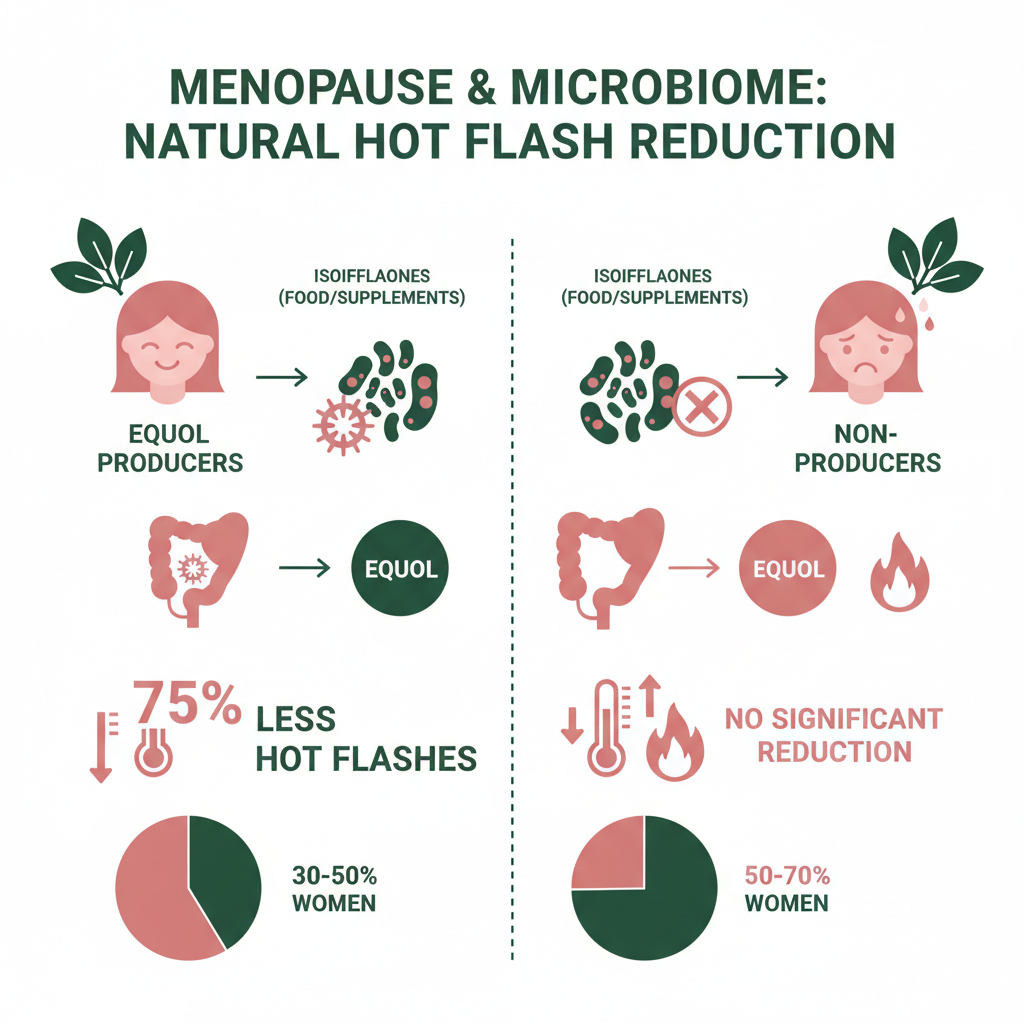
Isoflavones (a class of phytoestrogen) must be converted by gut bacteria into their active metabolites to exert meaningful oestrogenic effects. The most studied of these is equol, converted from daidzein (found in soya and red clover).
Only approximately 25–30% of Western women are "equol producers" — meaning they harbour the specific bacteria required to complete this conversion. Women who are equol producers tend to experience significantly greater relief from hot flashes when consuming phytoestrogen-rich foods or supplements.
Research published in Menopause: The Journal of The Menopause Society found that equol producers had a 58% greater reduction in hot flash frequency compared to non-producers when supplementing with soya isoflavones. (https://pubmed.ncbi.nlm.nih.gov/22968154/)
This explains why some women swear by phytoestrogen supplements and others notice no effect whatsoever — it comes down to the composition of their gut microbiome.
The empowering implication: improving your gut microbiome diversity may expand your capacity to activate phytoestrogens effectively. This is one of the most compelling clinical reasons to invest in probiotic support during the menopause transition.
Black Cohosh and the Gut: An Underexplored Connection
Black Cohosh (Actaea racemosa) is one of the most extensively studied herbal interventions for menopausal symptoms, with a long history of use in both Native American medicine and European herbal practice. It's also one of the hero ingredients in Her-Biotics Menopause Support.
Clinical trials have demonstrated that Black Cohosh can reduce hot flash frequency and severity, improve sleep quality, and support mood during the menopause transition. A 2007 meta-analysis published in Menopause found that Black Cohosh reduced hot flash frequency by up to 26% compared to placebo.
How Black Cohosh May Work
Interestingly, Black Cohosh does not appear to act primarily as a phytoestrogen. Current research suggests its mechanisms include:
- Serotonergic activity: Binding to serotonin receptors in the hypothalamus, reducing temperature dysregulation
- Dopaminergic effects: Supporting neurotransmitter balance associated with mood and thermoregulation
- Anti-inflammatory properties: Reducing the inflammatory signalling that amplifies vasomotor symptoms
- Possible gut-mediated effects: Emerging research suggests that some of Black Cohosh's active compounds (triterpene glycosides) may be metabolised by gut bacteria, with the resulting metabolites exerting downstream hormonal effects
This gut-mediated dimension of Black Cohosh activity is still being elucidated, but it adds another reason why combining botanical support with robust probiotic therapy is a clinically logical approach.
Building a Menopause-Supportive Microbiome: Practical Strategies
Armed with this understanding, let's talk about what you can actually do. The goal is to cultivate a diverse, resilient gut microbiome that actively supports oestrogen metabolism, reduces inflammation, optimises phytoestrogen conversion, and promotes serotonin production.
1. Prioritise Dietary Diversity
The single most important dietary driver of microbiome diversity is the variety of plant foods you eat. Research from the American Gut Project found that people who ate 30 or more different plant species per week had significantly greater microbiome diversity.
Practical targets:
- Aim for a minimum of 25–30 different plant foods per week (fruits, vegetables, wholegrains, legumes, nuts, seeds, herbs, spices all count)
- Include fermented foods daily: yoghurt, kefir, kimchi, sauerkraut, miso, tempeh
- Prioritise prebiotic-rich foods that feed beneficial bacteria: garlic, onions, leeks, asparagus, Jerusalem artichokes, oats, flaxseed
- Include phytoestrogen-rich foods regularly: organic soya, edamame, flaxseed, chickpeas, lentils, red clover tea
2. Reduce Microbiome Disruptors
What you remove from your lifestyle is just as important as what you add:
- Minimise unnecessary antibiotic use (always a medical decision — never refuse necessary treatment, but discuss alternatives when appropriate)
- Reduce ultra-processed foods and refined sugar, which have been shown to reduce Lactobacillus and Bifidobacterium populations
- Limit alcohol, which disrupts gut barrier integrity and has been independently associated with more severe hot flashes
- Manage chronic stress: cortisol directly alters gut microbiome composition via the gut-brain axis
3. Invest in High-Quality Probiotic Support
This is where targeted supplementation becomes genuinely transformative — but only if the probiotics you're taking are actually reaching your gut alive and intact.
This is the problem I built Her-Biotics to solve. Standard probiotic supplements lose between 90–99% of their viable bacteria before ever reaching the large intestine, destroyed by stomach acid and bile salts. Our patented SCO2 (supercritical carbon dioxide) microencapsulation technology protects each bacterial strain in a lipid shell, delivering 1000× more viable probiotics to the gut compared to conventional supplements.
For women in perimenopause and menopause specifically, strain selection matters enormously. The strains with the strongest evidence base for oestrobolome support and vasomotor symptom reduction include:
- Lactobacillus acidophilus: A key oestrobolome constituent involved in oestrogen deconjugation and recycling
- Lactobacillus reuteri: Demonstrated anti-inflammatory effects and positive impact on serotonin availability
- Bifidobacterium longum: Supports gut barrier integrity, reducing LPS translocation and inflammatory hot flash triggers
- Lactobacillus rhamnosus: Shown to influence GABA receptor expression, supporting mood and sleep quality during menopause
All of these strains, alongside 12 additional clinically validated strains, are present in Her-Biotics Menopause Support — formulated alongside Black Cohosh, Red Clover, Sage Leaf, and Vitamin D3/K2 for comprehensive menopausal support.
For more detail on the science behind our strain selection and encapsulation technology, visit our Science Page.
4. Support Gut Barrier Integrity
A healthy gut lining is the physical barrier that prevents inflammatory LPS from reaching your bloodstream and sensitising your hypothalamus. Key nutrients for gut barrier support include:
- Zinc: Supports tight junction proteins in the gut wall (included in Her-Biotics Original)
- Vitamin D3: Deficiency is strongly associated with both increased gut permeability and more severe menopausal symptoms
- L-Glutamine: The primary fuel source for enterocytes (gut lining cells)
- Collagen-rich foods: Bone broth, quality animal proteins
5. Prioritise Sleep and Stress Regulation
Sleep deprivation directly impairs microbiome diversity and increases inflammatory markers — creating a vicious cycle when hot flashes are already disrupting your nights. Proven strategies:
- Keep your bedroom cool (16–18°C / 60–65°F) to reduce hot flash triggers
- Establish a consistent sleep-wake schedule
- Consider magnesium glycinate in the evening for muscle relaxation and sleep quality (also present in Her-Biotics PMS Support)
- Practise mindfulness or yoga: a 2014 randomised trial found mindfulness-based stress reduction reduced hot flash intensity scores by 15% and significantly improved quality of life
What the Evidence Says About Probiotics and Menopausal Symptoms
The field of psychobiotics and the gut-hormone axis is moving rapidly. While large-scale clinical trials specifically on probiotics for hot flashes are still emerging, the mechanistic evidence is compelling and the preliminary clinical data is encouraging:
- A 2021 randomised controlled trial found that Lactobacillus and Bifidobacterium supplementation over 12 weeks significantly reduced inflammatory markers (CRP, IL-6) in postmenopausal women — the same markers associated with vasomotor symptom severity
- Studies on equol-producing bacteria supplementation have shown meaningful reductions in hot flash frequency, particularly in women who were previously non-producers
- Probiotic supplementation has been shown to improve vaginal pH and lactobacilli colonisation during menopause, addressing another common and distressing symptom — vaginal dryness and discomfort
For a curated collection of the research underpinning our formulas, explore our Radiance Hub, where we translate the latest science into accessible, actionable guidance for women at every life stage.
A Note on Hormone Replacement Therapy (HRT)
I want to be clear: HRT remains one of the most effective evidence-based interventions for severe menopausal symptoms, and it is significantly underused due to outdated fears stemming from a misinterpreted 2002 study. If your hot flashes are severely impacting your quality of life, please have an open conversation with your GP or menopause specialist about whether HRT is appropriate for you.
Microbiome support and botanical strategies are not alternatives to HRT where HRT is indicated — they are complementary strategies that can meaningfully improve quality of life, enhance the effects of HRT, reduce the threshold at which symptoms become debilitating, and support long-term metabolic, bone, and cardiovascular health during the menopause transition.
Your Next Step: Comprehensive Menopausal Support, Rooted in Science
Menopause is not a deficiency. It is a biological transition that, with the right support, can be navigated with vitality, clarity, and confidence. The science is clear: your gut microbiome is not a passive bystander in this transition — it is an active participant in your hormonal health.
By nurturing your gut bacteria through dietary diversity, targeted probiotic support, botanical allies like Black Cohosh and Red Clover, and consistent lifestyle practices, you give your body every advantage in reducing hot flashes naturally and moving through menopause on your own terms.
Her-Biotics Menopause Support was formulated specifically for this transition — combining our patented SCO2-encapsulated 16-strain probiotic blend with Black Cohosh, Red Clover isoflavones, Sage Leaf, and Vitamin D3/K2 in therapeutic, evidence-based doses. It is the most comprehensive gut-hormone support system I know of for women navigating perimenopause and menopause, and I formulated it because I knew women deserved better than the fragmented, inadequate options on the market.
If you're ready to work with your biology rather than against it, I invite you to explore the full Her-Biotics range at Shop All Formulas — and to remember that every thriving gut is a foundation for a thriving life.
Dr. Chomba Chuma, MD, is the Founder of Her-Biotics and a specialist in women's integrative medicine with a focus on the gut-hormone axis. The information in this article is for educational purposes and does not constitute personalised medical advice. Always consult a qualified healthcare professional before beginning any new supplement regimen.
Enjoyed this? Get the next one first.
Science made simple, delivered to your inbox. No spam, unsubscribe anytime.