

Bloating, IBS and Leaky Gut: How Probiotics Can Finally Solve Your Digestive Issues
By Dr. Chomba Chuma, MD & Founder, Her-Biotics | July 10, 2026
If there is one thing I hear from women in my clinic more than almost anything else, it is this: "I feel constantly bloated, my digestion is unpredictable, and I've been told everything is 'normal' — but it doesn't feel normal."
You are right to trust your body. Persistent bloating, erratic bowel habits, cramping, food sensitivities that seem to multiply with each passing year — these are not personality quirks or signs of anxiety. They are signals from a gut ecosystem that is under stress. And for millions of women aged 25–55, three conditions sit at the centre of that stress: IBS, leaky gut, and the chronic low-grade inflammation that ties them together.
The good news? The science of the gut microbiome has advanced dramatically, and targeted probiotic therapy is emerging as one of the most evidence-backed interventions we have. This article will walk you through what is actually happening in your gut, why women are disproportionately affected, and what you can do — starting today — to change the trajectory of your digestive health.
1. Understanding the Gut: Your Body's Most Underestimated Organ
The human gut is a 9-metre ecosystem housing approximately 38 trillion microorganisms — bacteria, fungi, archaea, and viruses — collectively known as the gut microbiome. This community is not passive. It trains your immune system, synthesises vitamins, regulates your mood via the gut-brain axis, and — critically — governs the integrity of the intestinal wall itself.
That intestinal wall deserves special attention. It is a single cell layer thick, stretching across a surface area roughly the size of a studio apartment. Its job is elegant and precise: allow nutrients in, keep pathogens and toxins out. The cells of this lining are held together by structures called tight junctions — molecular drawbridges that open and close in a tightly regulated fashion.
When the gut microbiome is diverse and balanced, tight junctions function perfectly. When it is disrupted — by stress, antibiotics, ultra-processed foods, hormonal fluctuations, or chronic illness — those tight junctions begin to loosen. And that is where the cascade of digestive dysfunction begins.
2. What Is Leaky Gut — and Is It Real?
For years, leaky gut was dismissed by mainstream medicine as a fringe concept. That has changed significantly. The medical term is increased intestinal permeability or gut permeability, and it is now the subject of thousands of peer-reviewed studies.
"Increased intestinal permeability plays a pathogenic role in various gastrointestinal conditions such as Crohn's disease, coeliac disease, and irritable bowel syndrome, as well as in extra-intestinal conditions including type 1 diabetes, allergic diseases, and autism." — Fasano A, Shea-Donohue T. Nature Clinical Practice Gastroenterology & Hepatology, 2005.
When gut permeability increases, the intestinal barrier becomes compromised. Partially digested food particles, bacterial endotoxins (particularly lipopolysaccharides, or LPS), and microbial byproducts cross into the bloodstream. The immune system — 70% of which resides in the gut — mounts a defensive response. The result is systemic low-grade inflammation that can manifest as:
- Persistent bloating and abdominal distension
- Food sensitivities that seem to appear from nowhere
- Brain fog and fatigue
- Skin conditions such as eczema or rosacea
- Joint aches
- Hormonal imbalances
- Anxiety and low mood
Why Women Are More Vulnerable
Women experience higher rates of intestinal permeability and IBS than men, and this is not a coincidence. Oestrogen receptors line the gastrointestinal tract, meaning that fluctuations across the menstrual cycle, pregnancy, perimenopause, and menopause directly affect gut motility and barrier function. Chronic psychological stress — which women report at higher rates — elevates cortisol, a known disruptor of tight junction proteins.
Leaky gut is not a life sentence. But addressing it requires more than removing trigger foods. It requires rebuilding the microbial ecosystem that maintains your gut lining in the first place.
3. IBS: Far More Than a Sensitive Stomach
IBS (Irritable Bowel Syndrome) affects approximately 10–15% of the global population, with women comprising up to 67% of diagnosed cases. It is characterised by:
- Recurrent abdominal pain or cramping
- Bloating and visible abdominal distension
- Altered bowel habits (diarrhoea, constipation, or alternating between both)
- Urgency and incomplete evacuation
- Mucus in stool
For decades, IBS was considered a disorder of gut-brain miscommunication — a "functional" condition with no identifiable structural cause. While the gut-brain axis undeniably plays a role, we now understand that dysbiosis (an imbalance in the gut microbiome) is central to IBS pathophysiology.
The Dysbiosis-IBS Connection
People with IBS consistently show:
- Reduced microbial diversity — fewer species means a less resilient ecosystem
- Depleted Lactobacillus and Bifidobacterium populations — the cornerstone beneficial bacteria
- Overgrowth of gas-producing bacteria — a direct driver of bloating and distension
- Elevated intestinal permeability — confirming the leaky gut overlap
- Heightened immune activation in the gut mucosa
A landmark 2022 meta-analysis published in Gut found that probiotic supplementation significantly reduced global IBS symptoms and abdominal pain compared to placebo, with multi-strain formulas showing superior outcomes to single-strain products. Read the full analysis on PubMed
This is why multi-strain, high-viability probiotic formulas are not a luxury — they are a clinical imperative for women dealing with IBS.
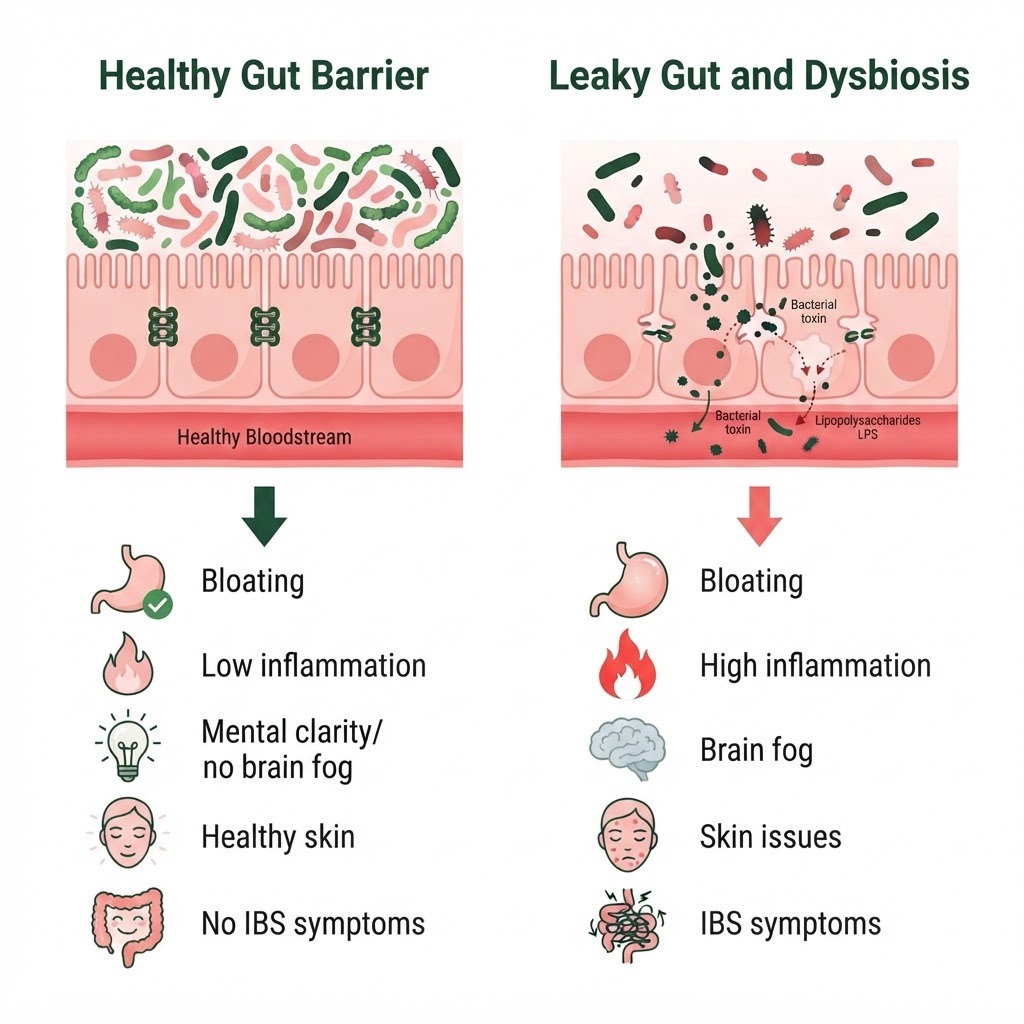 Figure: A side-by-side comparison showing a healthy gut wall with intact tight junctions and a diverse microbiome versus a leaky gut wall with loosened tight junctions, dysbiosis, and bacterial toxins crossing into the bloodstream — with arrows indicating the downstream effects: bloating, inflammation, brain fog, skin issues, and IBS symptoms.
4. The Probiotic Solution: What the Science Actually Says
Not all probiotics are created equal. This is perhaps the single most important sentence in this entire article, and I want you to sit with it for a moment.
The supplement market is flooded with products claiming billions of CFUs (colony-forming units), but the number on the label is almost meaningless if those bacteria cannot survive the journey from your mouth to your colon. Most probiotic bacteria are devastated by stomach acid, bile salts, and heat long before they reach the intestinal sites where they are needed most.
The Viability Problem — and How SCO2 Microencapsulation Solves It
At Her-Biotics, we built our entire formulation philosophy around solving this delivery problem. Our patented SCO2 (supercritical carbon dioxide) microencapsulation technology encases each probiotic strain in a protective lipid matrix using pressurised CO₂ — a process that does not require heat and therefore preserves full bacterial viability. The result is 1000× more viable probiotics reaching the gut compared to standard unencapsulated supplements.
This is not a marketing claim — it is validated by independent third-party stability testing and supported by the growing body of microencapsulation research demonstrating that protected probiotic strains show significantly higher colonisation rates and clinical efficacy.
What Specific Strains Do for Bloating, IBS and Leaky Gut
The 16-strain formula in Her-Biotics Original was assembled with precision, targeting the specific mechanisms of gut dysfunction:
For leaky gut and gut permeability:
- Lactobacillus rhamnosus GG — the most studied probiotic strain in the world, with demonstrated ability to upregulate tight junction proteins (ZO-1, occludin) and reduce intestinal permeability
- Bifidobacterium longum BB536 — shown to reduce LPS translocation across the gut barrier and modulate mucosal immune responses
For IBS and bloating:
- Lactobacillus plantarum 299v — a clinically validated strain shown in multiple RCTs to significantly reduce bloating, abdominal pain, and stool irregularity in IBS patients
- Bifidobacterium infantis 35624 — demonstrated in a pivotal 2006 Gastroenterology trial to outperform placebo across all primary IBS symptoms
- Lactobacillus acidophilus NCFM — reduces visceral hypersensitivity, a key driver of the pain experienced in IBS
For microbiome diversity and resilience:
- A broad spectrum of Lactobacillus, Bifidobacterium, Streptococcus, and Bacillus species that collectively seed diversity, produce short-chain fatty acids (SCFAs), and create an environment hostile to opportunistic pathogens
"Probiotics improve IBS symptoms by modulating gut microbiota composition, enhancing intestinal barrier function, reducing mucosal inflammation, and normalising gut-brain axis signalling." — World Gastroenterology Organisation Global Guidelines on Probiotics and Prebiotics, 2023
Learn more about the clinical rationale behind every ingredient on our Science Page.
5. The Role of Nutrition, Lifestyle and Synergistic Support
Probiotics are transformative — but they work best within a broader ecosystem of gut-supportive habits. Here is what I recommend to every patient navigating bloating, IBS, and leaky gut:
Dietary Foundations
- Eat the rainbow — diverse plant foods feed diverse bacteria. Aim for 30 different plant species per week (this is more achievable than it sounds: herbs, spices, and nuts count)
- Prioritise prebiotic fibres — inulin, fructooligosaccharides (FOS), and resistant starch from foods like garlic, asparagus, oats, and green bananas feed beneficial bacteria
- Reduce ultra-processed foods — emulsifiers like polysorbate-80 and carboxymethylcellulose are directly implicated in disrupting tight junctions and increasing gut permeability
- Introduce fermented foods — live-culture yogurt, kefir, kimchi, sauerkraut, and miso provide natural probiotic support alongside their food matrix
- Be cautious with elimination diets — while low-FODMAP diets reduce IBS symptoms short-term, long-term restriction can reduce microbiome diversity. Work with a registered dietitian
Lifestyle Factors That Directly Impact the Gut
- Stress management is non-negotiable. Chronic psychological stress increases intestinal permeability via corticotropin-releasing factor (CRF) receptors in the gut wall. Practices such as mindfulness-based stress reduction (MBSR), yoga, and breath work have measurable positive effects on gut barrier function
- Prioritise sleep — gut microbiome diversity follows a circadian rhythm. Poor sleep disrupts microbial balance within days
- Move your body — moderate aerobic exercise increases microbial diversity and accelerates gut transit, reducing fermentation time and therefore bloating
- Be antibiotic-aware — antibiotics are sometimes necessary and life-saving, but always follow a course with a high-quality, multi-strain probiotic to rebuild your ecosystem
What About Digestive Enzymes and Zinc Carnosine?
For women with significant leaky gut, I often recommend pairing probiotic therapy with zinc carnosine (shown in clinical studies to restore tight junction integrity) and digestive enzyme support. Notably, Her-Biotics Original includes Zinc in its formula — not merely as a micronutrient afterthought, but because zinc is a cofactor in tight junction protein synthesis and mucosal repair. The addition of Vitamins B, C, and E further supports the inflammatory resolution and oxidative stress reduction that accelerates gut healing.
For women whose digestive symptoms are tied to their menstrual cycle — worsening cramping, bloating, and bowel changes in the luteal phase — our Her-Biotics PMS Support formula adds Magnesium Glycinate and Vitamin B6, both of which reduce prostaglandin-driven gut inflammation. You can explore the full range at Shop All Formulas.
6. How Long Does It Take to See Results? Setting Realistic Expectations
This is one of the most common questions I receive, and honest communication here matters enormously.
Week 1–2: Some women notice a reduction in bloating and improvements in stool consistency relatively quickly as beneficial bacteria begin to populate and outcompete gas-producing organisms. Others may experience a temporary increase in gas as the microbiome transitions — this is normal and typically resolves within 7–10 days.
Week 3–4: The majority of women report measurable improvements in IBS symptoms — reduced pain frequency, more predictable bowel habits, and less post-meal distension.
Month 2–3: Gut barrier repair is a slower process. Studies on leaky gut and intestinal permeability markers (such as zonulin and lactulose/mannitol ratios) typically show significant improvement at the 8–12 week mark with consistent probiotic use.
Month 3–6: Sustainable microbiome remodelling and long-term resilience are built over this timeline. Women who commit to 6 months of consistent supplementation alongside dietary changes report the most durable outcomes.
Consistency is everything. Because our SCO2 microencapsulation technology ensures that the strains in Her-Biotics Original arrive alive and in full force at the sites where colonisation occurs, the timeline to results is meaningfully accelerated compared to standard supplements. See the independent viability data on our Science Page.
A 2021 NIH-supported review confirmed that multi-strain probiotic supplementation for a minimum of 8 weeks produced statistically significant reductions in intestinal permeability biomarkers in adults with functional gastrointestinal disorders. Read the NIH review here
7. When to Seek Medical Assessment
Probiotics are safe, evidence-based, and appropriate for the vast majority of women. However, I want to be clear: certain symptoms should prompt a conversation with your doctor before beginning any new supplement regimen. Please seek prompt medical evaluation if you experience:
- Unintentional weight loss
- Blood in your stool
- Symptoms that wake you from sleep
- A family history of colorectal cancer or inflammatory bowel disease (Crohn's, ulcerative colitis)
- Symptoms that are rapidly worsening
These may indicate conditions beyond IBS or leaky gut that require diagnostic investigation. Probiotics are powerful allies — but they are not a substitute for appropriate medical care.
For women navigating IBS alongside other complex health presentations, I recommend exploring our full educational library on the Radiance Hub, where our clinical team regularly publishes evidence-based guidance.
Your Gut Health Journey Starts Here
If you have read this far, I suspect you are ready for a different approach to your digestive health — one that goes beyond antispasmodics and elimination diets, and actually addresses the root cause: your gut microbiome.
Her-Biotics Original was formulated specifically for women like you. With 16 clinically selected probiotic strains, our patented SCO2 microencapsulation technology delivering 1000× more viable bacteria to your gut, and a synergistic blend of Zinc, B-Vitamins, and Vitamins C and E to support barrier repair and immune balance — this is not another supplement you hope might work. It is a precision tool built on real science, designed for your body, and backed by the clinical understanding of what it actually takes to heal a compromised gut.
Your bloating does not have to be your baseline. Your IBS does not have to dictate your social life. Your leaky gut can heal — and it can heal faster than you think, with the right support.
Take the first step today. Explore Her-Biotics Original and begin the 90-day gut reset your body has been waiting for.
Dr. Chomba Chuma, MD is a physician, functional medicine practitioner, and founder of Her-Biotics. She has spent over a decade focusing on women's health, gut microbiome science, and the clinical application of probiotic therapy. This article is for informational purposes only and does not constitute personalised medical advice.