
By Dr. Chomba Chuma, MD & Founder, Her-Biotics | June 22, 2026
There is a quiet revolution happening in women's health science, and it begins — somewhat surprisingly — in your gut. For decades, the beauty and longevity conversation centred on topical creams, hormonal therapies, and calorie restriction. But a growing body of peer-reviewed research is pointing us somewhere far more fundamental: the gut microbiome.
As a physician and the founder of Her-Biotics, I have spent years at the intersection of gut science and women's health. And what I can tell you, with both clinical confidence and personal conviction, is this: the path to ageless wellness after 50 is not paved with expensive serums alone. It runs directly through the 38 trillion microorganisms living in your digestive tract.
Whether you are approaching 50, navigating it, or well into a decade that deserves to be celebrated, this article is for you. Let us explore what science actually tells us about gut microbiome aging, why it matters for your skin, your energy, and your longevity — and what you can do today to support it.
1. What Happens to Your Gut Microbiome After 50?
Your microbiome is not static. It shifts continuously throughout your life in response to diet, stress, medications, hormonal changes, and simply the passage of time. But the years around and after 50 bring some of the most significant microbial shifts a woman will ever experience.
The Science of Microbial Aging
Research published in Cell Host & Microbe and supported by data from the Human Microbiome Project demonstrates that microbial diversity — the number and variety of bacterial species in your gut — tends to decline with age. This reduction in diversity is not a trivial cosmetic concern. It is associated with:
- Increased systemic inflammation (a phenomenon researchers now call "inflammaging")
- Reduced production of short-chain fatty acids (SCFAs), which protect the gut lining
- Decreased synthesis of key vitamins including B12, B9 (folate), and K2
- Compromised immune regulation, since approximately 70% of the immune system is housed in gut-associated lymphoid tissue
- Impaired nutrient absorption, meaning even a well-balanced diet delivers less at the cellular level
"The microbiome of centenarians — people living past 100 — is notably distinct from typical older adults, characterised by higher microbial diversity and an enrichment of specific beneficial species associated with reduced inflammation and enhanced metabolic health." — Biagi et al., Cell Reports, 2016
After menopause, the decline in oestrogen adds another layer of complexity. Oestrogen receptors exist throughout the gut, and falling oestrogen levels alter the composition of the "estrobolome" — the collection of gut bacteria responsible for metabolising and recycling oestrogen. A disrupted estrobolome contributes to weight changes, mood instability, bone loss, and yes, accelerated skin aging.
The good news? The microbiome is extraordinarily responsive to intervention. Unlike your genetics, it is modifiable — and that is deeply empowering.
2. The Gut-Skin Axis: Your Microbiome Is Your Mirror
If your gut is struggling, your skin will say so. This is not metaphor — it is mechanistic biology, mediated by what scientists call the gut-skin axis.
How Gut Health Drives Skin Aging
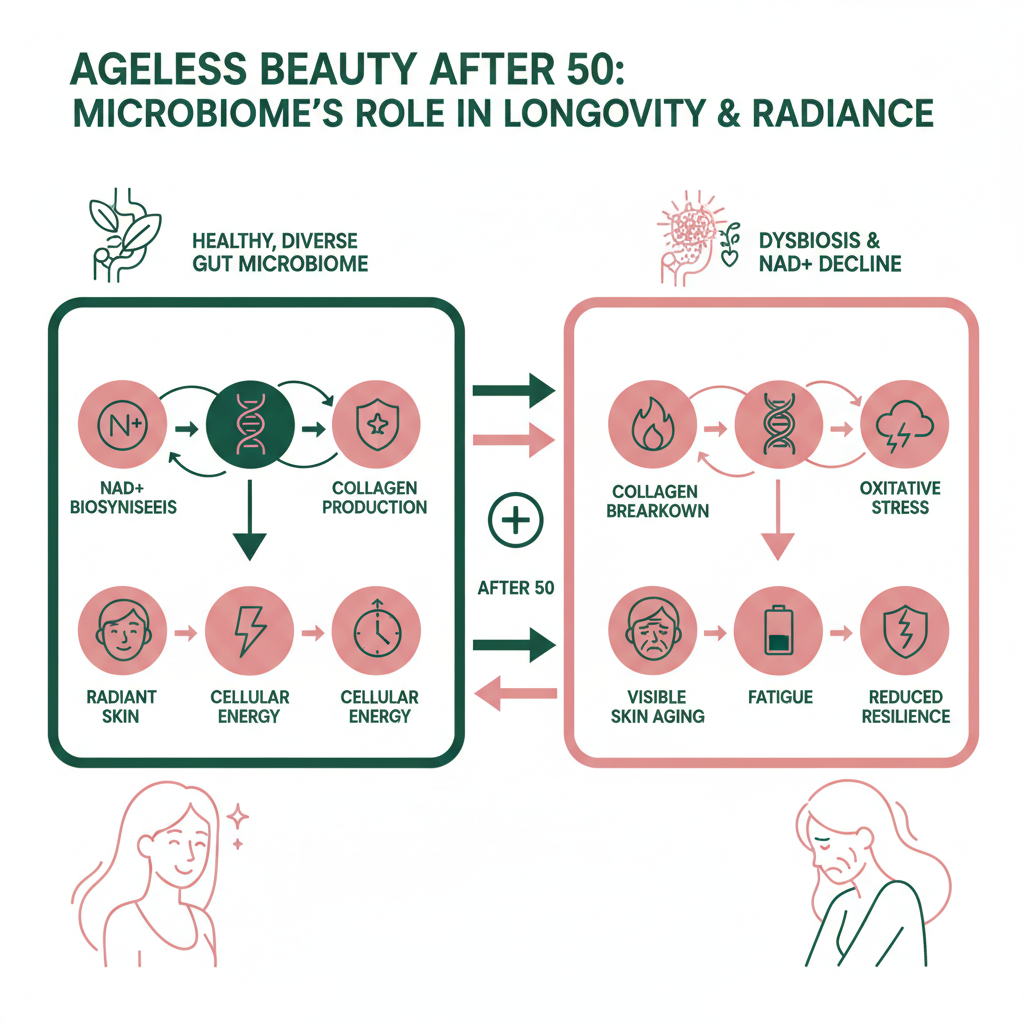
The gut and the skin are in constant biochemical communication via the immune system, the nervous system, and the circulatory system. When your microbiome is imbalanced — a state called dysbiosis — a cascade of pro-inflammatory signals is released into the bloodstream. These signals:
- Activate matrix metalloproteinases (MMPs) — enzymes that degrade collagen and elastin fibres in the dermis
- Increase oxidative stress — generating free radicals that damage skin cell DNA and accelerate the hallmarks of aging
- Compromise the skin's moisture barrier — reducing ceramide production and transepidermal water retention
- Impair wound healing — slowing the turnover of skin cells and the repair of UV-damaged tissue
Collagen deserves special mention here. It is the most abundant structural protein in your body, responsible for the firmness, elasticity, and plumpness we associate with youthful skin. After 50, women lose collagen at a rate of approximately 1–2% per year, a decline accelerated sharply by post-menopausal hormonal shifts. But research increasingly shows that gut bacteria play a critical role in collagen synthesis — both by producing metabolites that stimulate fibroblast activity and by regulating the absorption of collagen-building nutrients like vitamin C, zinc, and proline.
A landmark 2021 study in the Journal of Investigative Dermatology found that women with higher gut microbial diversity had measurably fewer deep wrinkles, improved skin hydration scores, and greater dermal density compared to women of the same age with lower microbial diversity. These findings were independent of sun exposure, smoking, and BMI.
For a deeper look at how our formulations target the gut-skin axis from the inside out, visit our Science Page.
3. NAD+, Cellular Energy, and the Microbiome Connection
One of the most exciting frontiers in longevity science centres on a molecule called NAD+ (nicotinamide adenine dinucleotide). If you have not yet heard of it, you will — because NAD+ may be one of the most important molecules governing how gracefully we age.
What NAD+ Actually Does
NAD+ is a coenzyme found in every cell of your body. It is essential for:
- Mitochondrial energy production — the process by which your cells convert nutrients into usable energy (ATP)
- DNA repair — activating enzymes called sirtuins and PARPs that patch damage to your genetic code
- Circadian rhythm regulation — keeping your internal clock aligned, which impacts everything from sleep quality to hormone secretion
- Cellular senescence — helping to clear out "zombie cells" that accumulate with age and drive inflammation
Here is the problem: NAD+ levels decline by approximately 50% between the ages of 40 and 60. This decline is one of the primary drivers of fatigue, cognitive fog, slower metabolism, and the loss of the cellular vitality that we associate with looking and feeling young.
What does this have to do with the gut microbiome? Quite a lot, as it turns out.
Your gut bacteria are directly involved in the biosynthesis of NAD+ precursors, particularly nicotinamide riboside (NR) and nicotinamide mononucleotide (NMN), from dietary tryptophan via the kynurenine pathway. Dysbiosis impairs this pathway, reducing the body's ability to self-generate NAD+. Conversely, a diverse, well-supported microbiome enhances NAD+ precursor availability — creating a virtuous cycle of cellular energy and repair.
"Emerging evidence demonstrates that the gut microbiota regulates host NAD+ metabolism, with implications for aging, metabolic disease, and longevity." — Tran et al., Nature Metabolism, 2023
This is precisely why Her-Biotics Ageless 50+ incorporates direct NAD+ support alongside a robust probiotic foundation. Rather than addressing cellular energy or gut health in isolation, we designed a formula that works on both axes simultaneously — because the science demands it.
4. Antioxidants, Oxidative Stress, and Why Your Gut Determines Their Effectiveness
You have almost certainly heard that antioxidants are good for aging skin. You may even take a vitamin C serum or eat blueberries with deliberate intention. But here is what most women are not told: the effectiveness of every antioxidant you consume is heavily mediated by the state of your gut microbiome.
The Antioxidant Absorption Problem
Plant-derived antioxidants — polyphenols like resveratrol, astaxanthin, flavonoids, and carotenoids — are not absorbed passively in the small intestine the way simple sugars are. They require microbial biotransformation in the colon to be converted into their bioactive, absorbable forms.
For example:
- Resveratrol, found in grape skins and red wine, must be metabolised by specific Lactobacillus and Bifidobacterium species into dihydroresveratrol before it exerts its anti-inflammatory and sirtuin-activating effects
- Astaxanthin, the powerful marine carotenoid that gives salmon its pink colour and is now celebrated as one of the world's most potent natural antioxidants (with 6,000× the antioxidant capacity of vitamin C), requires an intact gut barrier and optimal bile acid chemistry — both regulated by the microbiome — for efficient uptake
- CoQ10, critical for mitochondrial function and skin cell energy, has notoriously poor bioavailability that is further compromised by gut dysbiosis
This means that two women taking the identical antioxidant supplement can have dramatically different outcomes based solely on the composition of their gut microbiota. Investing in your microbiome is not just about digestion — it is the prerequisite for every other longevity intervention to actually work.
The Free Radical Burden After 50
Oxidative stress — the imbalance between free radical production and the body's antioxidant defences — accelerates visibly after 50. Contributing factors include:
- Declining oestrogen (which itself has antioxidant properties)
- Reduced mitochondrial efficiency (producing more reactive oxygen species as a byproduct)
- Accumulated environmental exposures: UV radiation, pollution, dietary toxins
- Chronic low-grade inflammation from gut dysbiosis
A healthy microbiome directly counters this burden by producing short-chain fatty acids like butyrate, which have potent anti-inflammatory and antioxidant properties, and by upregulating the body's own antioxidant enzymes including superoxide dismutase (SOD) and glutathione peroxidase.
To explore how our foundational formula supports gut health at every life stage, visit the Her-Biotics Original product page. For women managing hormonal transitions alongside these concerns, Her-Biotics Menopause Support offers targeted botanical and microbiome support. And if you are building the foundation from scratch, our Radiance Hub is a great place to begin your personalised wellness journey.
5. The SCO2 Difference: Why Delivery Technology Changes Everything
All of this science is exciting — but it raises an important question that I hear from patients constantly: "I have tried probiotics before and felt nothing. Why would Her-Biotics be different?"
The honest answer is delivery technology. And this is where SCO2 (supercritical carbon dioxide) microencapsulation changes the conversation entirely.
The Probiotic Survival Problem
Standard probiotic supplements face a gauntlet of destruction before a single bacterium reaches your colon, where it is actually needed:
- Manufacturing heat — most production processes expose live bacteria to temperatures that kill a significant proportion before the capsule is even sealed
- Stomach acid (pH 1.5–3.5) — a hostile environment that eliminates the majority of unprotected probiotic strains within minutes
- Bile salts in the small intestine — a second wave of antimicrobial assault
- Shelf degradation — standard capsules lose viability over months, meaning the CFU count on the label may be theoretical at best
Studies suggest that less than 1% of bacteria in a standard uncoated probiotic capsule survive to colonise the gut. You are essentially paying for viability you are not receiving.
How SCO2 Microencapsulation Works
Our patented SCO2 process uses supercritical carbon dioxide — a state of CO₂ that behaves simultaneously as a liquid and a gas — to encapsulate each probiotic strain in a precise, uniform lipid shell without any heat exposure. The result is:
- 1000× greater viable probiotic delivery to the gut compared to standard supplements
- Full protection through stomach acid and bile salts
- Preserved potency across the product's full shelf life without refrigeration
- Targeted release in the colon, where colonisation and microbial balance occur
This is not a marketing claim — it is physics and biology working in concert. When we say our probiotics reach your gut alive and in therapeutic concentrations, the technology behind that statement is real and independently validated. You can read the full mechanistic breakdown on our Science Page.
6. Building Your Ageless Wellness Protocol: Practical Strategies for Life After 50
Science without application is just reading. So let us talk about what you can actually do, starting today, to support your microbiome and activate your body's longevity pathways.
Nutrition: Feed Your Microbiome First
- Eat 30+ different plant foods per week — the single most evidence-backed dietary strategy for increasing microbial diversity (Tim Spector's ZOE research consistently confirms this threshold)
- Prioritise fermented foods daily: kefir, kimchi, miso, sauerkraut, and natural yoghurt introduce beneficial bacteria and their metabolites
- Increase prebiotic fibre: chicory root, Jerusalem artichoke, garlic, leeks, green bananas, and oats feed your existing beneficial strains
- Reduce ultra-processed foods: emulsifiers like polysorbate-80 and carboxymethylcellulose, common in packaged goods, have been shown to disrupt the gut mucosal layer and alter microbial composition even at low doses
- Collagen-supportive nutrients: prioritise vitamin C-rich foods (bell peppers, citrus, kiwi), zinc-rich foods (pumpkin seeds, legumes, shellfish), and silica-rich foods (cucumber, oats, green beans)
Lifestyle: The Non-Negotiables
- Sleep 7–9 hours: the gut microbiome follows a circadian rhythm, and sleep deprivation measurably shifts it toward dysbiosis within 48 hours
- Manage chronic stress: cortisol increases intestinal permeability ("leaky gut"), allowing bacterial endotoxins into the bloodstream and triggering the inflammation that accelerates skin aging
- Move your body daily: regular moderate exercise increases microbial diversity and short-chain fatty acid production. Even 30 minutes of walking makes a measurable difference
- Limit unnecessary antibiotics: each course eliminates beneficial species, some of which may never fully recover without deliberate microbiome support
Supplementation: The Strategic Layer
For women over 50, I recommend approaching supplementation as a layered system:
- A high-viability, multi-strain probiotic as the non-negotiable foundation
- NAD+ precursor support to address the age-related decline in cellular energy
- Targeted antioxidants (resveratrol, astaxanthin, CoQ10) chosen for bioavailability, not just label potency
- Fat-soluble vitamins D3 and K2 for bone density, immune function, and cardiovascular health
These are not random selections — they are the evidence-based pillars of the longevity and radiance protocol I designed Her-Biotics Ageless 50+ to address in a single, intelligently formulated product. You can also explore the full range across all life stages at Shop All Formulas.
A Final Word From Dr. Chomba
I became a physician because I wanted to help women understand their bodies — not fear them, not fight them, but truly understand them. And what I have come to believe deeply, both from the research and from years of clinical practice, is that aging is not a problem to be solved. It is a process to be optimised.
Your microbiome is one of the most powerful levers you have for that optimisation. It is the foundation upon which your skin health, your energy, your immune resilience, and your capacity for genuine ageless wellness are built. And unlike your genetics, it responds — sometimes remarkably quickly — to the choices you make.
You are not at the mercy of your age. You are at the beginning of understanding how to work with your biology in ways that previous generations never had access to. That, to me, is one of the most exciting things about being a woman in 2026.
Ready to Support Your Microbiome for Ageless Radiance?
If you are ready to give your gut — and your skin, your energy, and your longevity — the science-backed support it deserves, Her-Biotics Ageless 50+ was formulated precisely for this moment in your life. With our patented SCO2 microencapsulation delivering 1000× more viable probiotics to your gut, combined with NAD+, astaxanthin, CoQ10, and resveratrol in bioavailable forms, this is not just a probiotic. It is a comprehensive longevity protocol in a single daily capsule.
Discover Her-Biotics Ageless 50+ →
Because radiance is not something you chase after 50. It is something you cultivate — from the inside out.
Dr. Chomba Chuma, MD, is a board-certified physician and the founder of Her-Biotics. The information in this article is intended for educational purposes and does not constitute personalised medical advice. Please consult your healthcare provider before beginning any new supplement regimen.
Enjoyed this? Get the next one first.
Science made simple, delivered to your inbox. No spam, unsubscribe anytime.